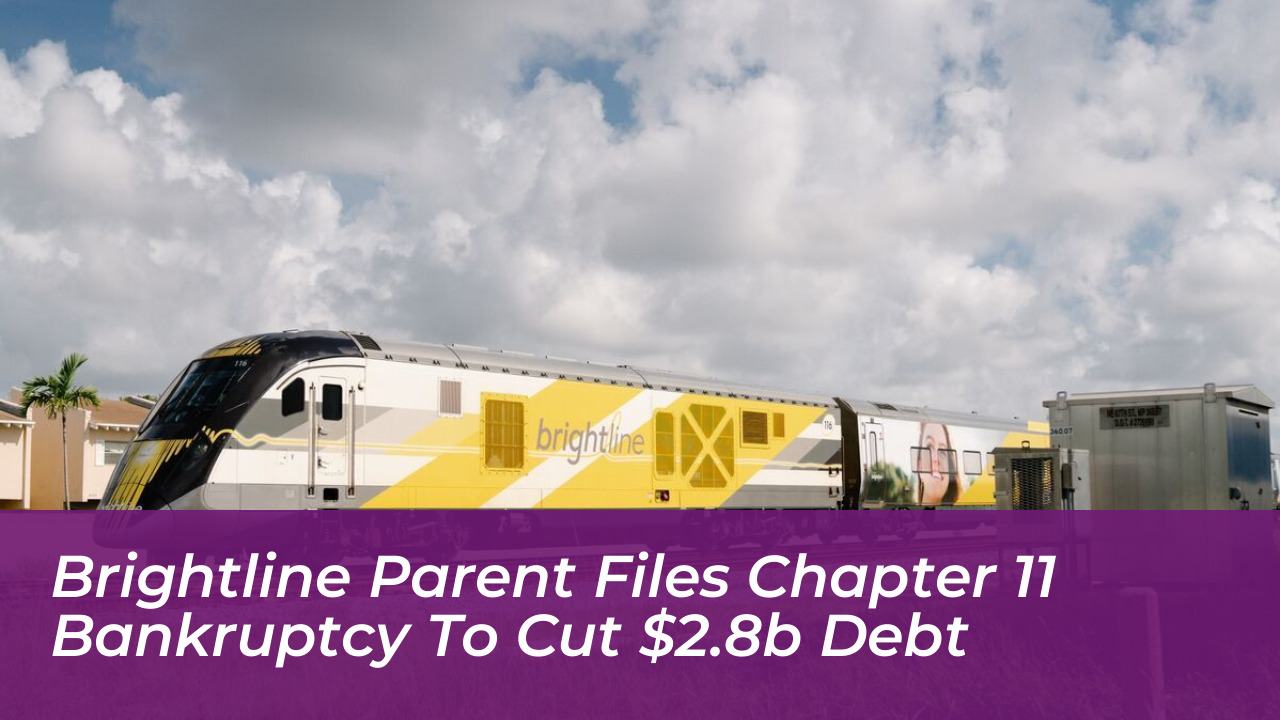
Parent entities associated with high-speed rail operator Brightline filed for prearranged Chapter 11 bankruptcy protection in the U.S. Bankruptcy Court for the District of New Jersey on September 25, 2026. This legal filing initiates a comprehensive financial restructuring plan designed to reorganize $5.5 billion in total balance sheet obligations. The restructuring eliminates $2.8 billion in corporate liabilities and secures $490 million in new exit financing to stabilize long-term operations. The central core fact of this proceeding is that Brightline Trains Florida LLC is explicitly excluded from the bankruptcy filing. This crucial legal firewall ensures that high-speed passenger rail service between Miami and Orlando operates without any disruption.
- Structural Isolation: How Brightline Protects Passenger Train Operations
- Uninterrupted Service across Florida Rail Corridors
- Financial Reorganization and 0 Million Capital Injection
- Corporate Balance Sheet Reduction Strategy
- Comprehensive Breakdown of Brightline’s .5 Billion Debt Stack
- Senior Municipal Bonds and Insurance Guarantee Protections
- The Financial Escalation: Revenue Yields, Interest Costs, and Cash Deficits
- Revenue Acceleration and Long-Haul Expansion Realities
- Frequently Asked Questions
- Is Brightline passenger train service shutting down?
- Why did Brightline parent entities file for Chapter 11 bankruptcy?
- Are Brightline municipal bonds affected by the bankruptcy?
- Which entities are included in the Chapter 11 filing?
Structural Isolation: How Brightline Protects Passenger Train Operations
A multi-tiered corporate structure separates parent holding companies from operating subsidiaries to insulate daily transit activities from financial distress. AAF Operations Holdings LLC and other parent entities absorbed holding-level debt during years of infrastructure expansion. Meanwhile, critical operational assets, rolling stock, and track leases remained safely inside Brightline Trains Florida LLC. This division isolates daily revenue and commercial activities from parent-level liabilities.
Filing for Chapter 11 strictly at the non-operating level prevents the appointment of a federal bankruptcy trustee over train operations. Courts cannot interfere with the day-to-day management of the railway because the operating company itself is solvent and remains outside judicial supervision. This corporate architecture protects the transit system from external creditor seizures and keeps management fully focused on passenger mobility and service expansion.
Uninterrupted Service across Florida Rail Corridors
Passengers traveling across the 235-mile route connecting South and Central Florida experience zero changes to train schedules, ticketing platforms, station management, and onboard concessions. Normal commercial payments to line employees, maintenance contractors, vendors, and station partners continue without requiring judicial approval. The company maintains normal cash flows for operational expenditures independently of the holding company restructuring.
Chief Executive Officer Patrick Goddard emphasized that the transaction reinforces corporate liquidity and operational momentum. Brightline remains a vital component of Florida’s transportation network. The infusion of fresh capital ensures that ridership growth and regional expansion continue on schedule while the holding companies resolve their legacy debt burdens through the court system.
Financial Reorganization and $490 Million Capital Injection
The $490 million exit financing package is structured across two distinct debt tranches supplied by key financial stakeholders and institutional asset managers. This fresh capital provides the necessary runway to cover court-approved restructuring expenses and fund immediate liquidity needs. Institutional backing comes from a prominent consortium of bond insurers and investment funds.

The financing structure splits into a $140 million senior secured debt tranche and a $350 million junior debt tranche. Assured Guaranty, Nuveen, First Eagle Investment Management, BlackRock, Invesco, and Nomura comprise the primary institutional stakeholders supporting the transaction. Their capital commitment reflects strong confidence in the long-term economic viability of the Florida rail corridor despite past financial imbalances.
Corporate Balance Sheet Reduction Strategy
The core mechanism of the Restructuring Support Agreement involves converting approximately $1.1 billion in corporate debt and unsecured parent notes into equity or subordinated debt instruments. This liability reduction brings overall consolidated debt down from $5.5 billion to approximately $2.7 billion. Senior institutional bondholders and tax-exempt bond structures remain fully protected under the negotiated terms.
Junior corporate creditors and speculative holding-level lenders absorb significant write-downs to clear the balance sheet. By eliminating high-interest parent holding debt, the enterprise positions itself for sustainable financial performance. The restructuring removes the heavy interest burden that previously outpaced operating revenue gains.
Comprehensive Breakdown of Brightline’s $5.5 Billion Debt Stack
Brightline accumulated a massive debt stack over a decade of continuous financing used to build, expand, and operate Florida’s intercity rail system. Understanding the multi-tier capital structure requires evaluating how different debt instruments are treated within the restructuring framework.
| Entity Name | Debt Series / Instrument | Principal Amount | Bankruptcy Filing Status | Restructuring Treatment |
|---|---|---|---|---|
| Brightline Trains Florida LLC | Series 2024 Tax-Exempt Bonds | $2.200 Billion | Unaffected (Non-Filing) | Remains outstanding in full; backed by Assured Guaranty policy. |
| Brightline Florida Expansion Project | Series 2025B Expansion Bonds | $985 Million | Unaffected (Non-Filing) | Remains outstanding with zero principal reduction. |
| AAF Operations Holdings LLC | Series 2024 Tax-Exempt Bonds | $925 Million | Unaffected (Non-Filing) | Remains outstanding with zero principal reduction. |
| AAF Operations Holdings LLC | Series 2024A Tax-Exempt Bonds | $285.7 Million | Unaffected (Non-Filing) | Remains outstanding with zero principal reduction. |
| Parent Entities | Corporate Debt & Unsecured Notes | ~$1.100 Billion | Chapter 11 Subject | Equitized, written down, or converted under court-approved RSA. |
Senior Municipal Bonds and Insurance Guarantee Protections
Senior tax-exempt municipal bonds remain fully intact under the Restructuring Support Agreement, protecting municipal market credit ratings. The $2.2 billion Brightline Trains Florida LLC Series 2024 Tax-Exempt Bonds experience no principal write-downs or coupon reductions. Assured Guaranty maintains its financial guaranty insurance policy, ensuring timely principal and interest disbursements to municipal bondholders.
Additional project bonds, including the $985 million Series 2025B expansion tranche and the AAF Operations Holdings series, retain their aggregate principal amounts without modification. Shielding these senior municipal instruments from the holding company bankruptcy preserves market confidence in private activity bond structures used for major transportation infrastructure projects.
The Financial Escalation: Revenue Yields, Interest Costs, and Cash Deficits
Brightline faced severe financial strain due to a structural mismatch between passenger rail revenues and high debt service obligations. Between 2017 and 2025, cumulative revenues reached $562 million, while debt service interest payments totaled $762 million. Heavy initial infrastructure expenditures created debt obligations that far outpaced early-stage operational cash flows.
This capital-intensive launch generated cumulative comprehensive net losses exceeding $2.0 billion since trial operations began. Although top-line ticket sales scaled rapidly following the Orlando extension, interest expenses continued to erode cash reserves. These financial pressures ultimately triggered mid-2025 payment deferrals and the subsequent September 2026 restructuring agreement.
Revenue Acceleration and Long-Haul Expansion Realities
Annual revenue figures demonstrate steady commercial growth despite macroeconomic headwinds. The company recorded $7.4 million during the pandemic low in 2020, $3.1 million during the 2021 reboot, and $87.6 million following the Orlando launch in 2023. Revenue climbed to $187.9 million during the first full year of intercity service in 2024, followed by $214.0 million in 2025.
Performance metrics through August 2026 show $160 million in revenue, representing a 17 percent year-over-year increase alongside a 14 percent rise in total ridership. While top-line growth proves strong consumer demand for high-speed rail, it could not immediately bridge the immense interest payment gap. The current court-approved restructuring successfully rightsizes the capital structure to match actual operating yields.
Frequently Asked Questions
Is Brightline passenger train service shutting down?
No. Brightline passenger rail service between Miami and Orlando operates normally with zero interruptions to schedules, ticketing, or station amenities.
Why did Brightline parent entities file for Chapter 11 bankruptcy?
Parent holding companies filed for Chapter 11 to reorganize $5.5 billion in total debt, eliminate $2.8 billion in corporate liabilities, and secure $490 million in new exit financing.
Are Brightline municipal bonds affected by the bankruptcy?
No. Senior tax-exempt municipal bonds, including the $2.2 billion Series 2024 bonds, remain fully intact and are backed by Assured Guaranty insurance policies.
Which entities are included in the Chapter 11 filing?
The bankruptcy filing is strictly limited to non-operating parent holding entities. Operating subsidiary Brightline Trains Florida LLC is explicitly excluded from the court proceedings.