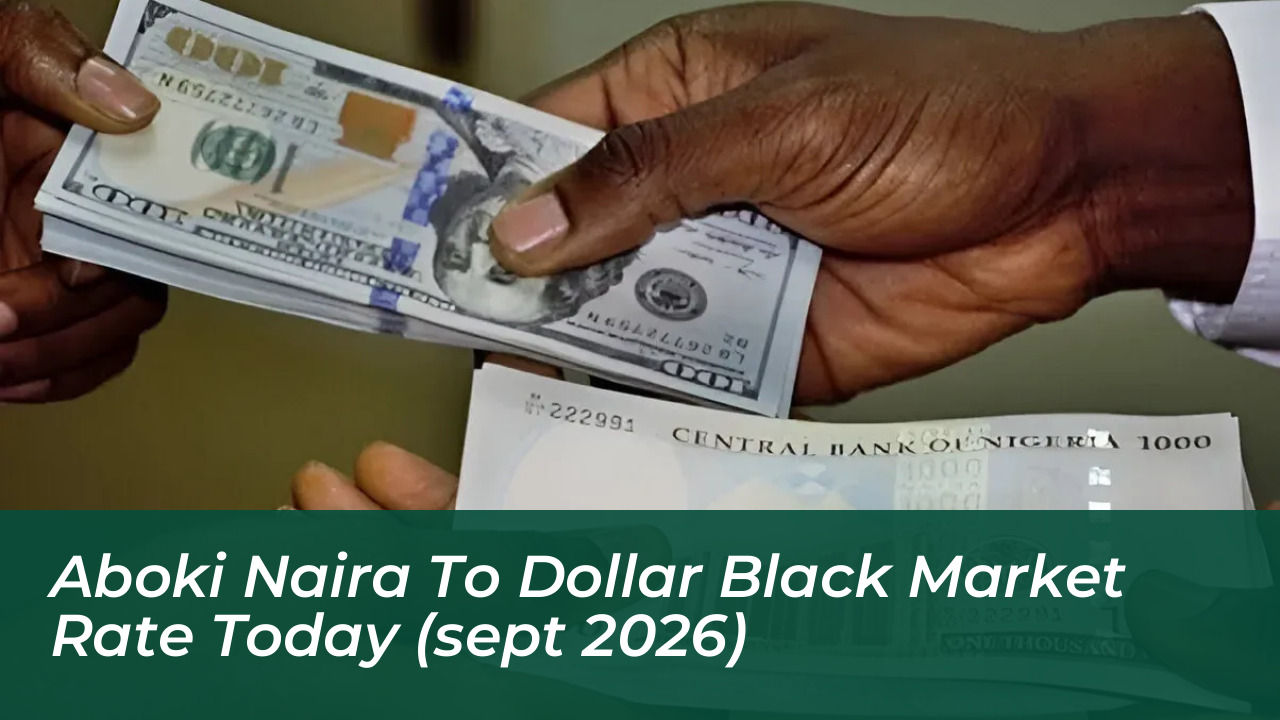
Understanding the Aboki Naira to Dollar Black Market Exchange Rate on 26th September 2026 requires looking closely at a familiar economic reality in Nigeria. Foreign exchange dynamics here are driven by a sharp divide between the official central bank rate and the parallel market, commonly called the black market. On Saturday, 26th September 2026, street traders, Bureau de Change operators, and financial analysts tracked the parallel market naira to dollar exchange rate holding within a tight band between ₦1,375 and ₦1,390 per dollar. This rate reflects active real world supply and demand pressures operating entirely outside the immediate controls of the Central Bank of Nigeria.
- Detailed Breakdown of Official Versus Black Market Rates
- Official Central Bank Benchmarks
- Parallel Market Realities
- Macroeconomic Drivers Influencing the Naira on September 26, 2026
- Monetary Policy Rate Cuts and Liquidity Surges
- External Reserves and International Bank Projections
- Distinction Between Buy Rates and Sell Rates at Bureau de Change Outlets
- Understanding the Buy Rate Mechanics
- Understanding the Sell Rate Mechanics
- The Note Condition Premium
- Comparative Performance Across African Currencies
- Practical Risk Management and Safe Trading Practices
- Frequently Asked Questions Regarding the Aboki Naira to Dollar Rate
- Why does the black market rate remain higher than the CBN official rate?
- How frequently are parallel market exchange rates updated?
- What demographic groups rely most heavily on the parallel market?
- Does a high interest rate guarantee a stronger naira?
The parallel market exists to serve millions of individuals, corporate entities, small scale importers, and international travelers who require immediate access to foreign currency. These users often encounter stringent documentation requirements, transaction caps, or allocation delays within commercial banking channels. While the official Nigerian Foreign Exchange Market window reports rates fluctuating near ₦1,328 to ₦1,330 per dollar, street level trading accounts for the persistent liquidity gaps that formal banking windows cannot fully clear.
Everyday individuals rely on these informal channels because banking halls demand extensive paperwork, tax identification numbers, and rigorous compliance checks that can take days or weeks. For urgent medical bills abroad, school fees due immediately, or raw material purchases for small businesses, waiting is simply not an option. Consequently, the parallel market acts as an essential release valve for the entire domestic economy, dictating actual purchasing power for a vast segment of the population.
Detailed Breakdown of Official Versus Black Market Rates
Official Central Bank Benchmarks
Analyzing the official Nigerian Foreign Exchange Market window reveals rates hovering consistently between ₦1,328 and ₦1,330 per dollar. This window represents the authorized trading platform where commercial banks, exporters, and eligible corporate entities execute transactions under the watchful eye of the monetary authority. Central bank interventions and automated matching systems keep these figures tightly controlled throughout the active trading week.
Formal bank allocations play a critical role in clearing priority import and school fee transactions for large corporations and well documented individual requests. However, access remains restricted by strict documentation hurdles and daily limits set by individual financial institutions. Importers dealing in heavy machinery or agricultural inputs rely heavily on these official channels to secure large allocations without facing exorbitant parallel market markups.
Parallel Market Realities
Examining major liquidity hubs like Lagos Island and Wuse Zone 4 in Abuja shows a very different operational environment. Here, physical cash changes hands rapidly based on real time market sentiment, interbank supply shortages, and sudden surges in corporate demand. These physical currency markets operate with minimal bureaucracy, allowing participants to conclude high value transactions in a matter of minutes.
The premium spread between official and street rates currently sits between 4.29 and 5.4 percent. This spread represents the friction cost of securing immediate liquidity without navigating banking delays. When banking windows experience severe dollar shortages, this premium widens sharply as desperate buyers compete for a limited pool of physical notes.
The following table outlines the clear financial differences between official banking channels and parallel street markets:
| Exchange Window | Buy Rate (NGN) | Sell Rate (NGN) | Spread / Premium |
|---|---|---|---|
| Official CBN / NFEM Rate | ₦1,328.49 | ₦1,330.00 | Baseline Reference |
| Parallel / Black Market Rate | ₦1,371.34 | ₦1,390.00 | ₦51 to ₦72 Premium |
Macroeconomic Drivers Influencing the Naira on September 26, 2026
Monetary Policy Rate Cuts and Liquidity Surges
Evaluating the Central Bank of Nigeria adjustment of the benchmark Monetary Policy Rate downward to 23.0 percent highlights a strategic shift toward stimulating domestic economic growth. By easing borrowing costs, the monetary authority aims to support disinflation trends and encourage local manufacturing. However, lower interest rates occasionally spark capital reallocation, influencing how foreign portfolio investors view domestic fixed income securities.
Adding to this liquidity environment, maturities of Open Market Operation bills worth ₦2.27 trillion pushed banking system liquidity to an impressive ₦7.45 trillion. This abundant liquidity caused short term money market rates to decline, with overnight rates settling near 21.76 percent. Excess liquidity in the banking sector often spills over into parallel foreign exchange demand as holders of local currency seek alternative stores of value.
External Reserves and International Bank Projections
Reviewing Nigeria gross external reserves reveals a notable milestone, reaching an 18-year high of $54.83 billion. This figure represents a robust 30.02 percent increase compared to the $42.17 billion recorded during the same period in 2025. Such a formidable reserve buffer provides the central bank with significant confidence and intervention capacity to defend the currency against unexpected external shocks or speculative attacks.
International investment bank Goldman Sachs maintains its ambitious 12-month appreciation target for the naira at ₦1,250 per dollar. Analysts point to sustained oil export revenues, growing balance of payments surpluses, and attractive local asset yields exceeding 20 percent on open market operation securities as primary drivers supporting this optimistic long term forecast.
Distinction Between Buy Rates and Sell Rates at Bureau de Change Outlets
Understanding the Buy Rate Mechanics
How freelancers, remote workers, and diaspora families convert foreign cash into local currency directly impacts their overall earnings. The buy rate is the price at which a Bureau de Change operator purchases United States Dollars from a customer. When incoming wire transfers or physical greenbacks are converted to naira, understanding this specific rate ensures that account holders receive fair value for their foreign income.
Freelancers working for international clients often utilize intermediary digital platforms before converting balances to local cash through trusted agents. Because parallel market operators compete for physical foreign currency inflows, buy rates frequently adjust multiple times a day depending on how much cash is circulating within local trading clusters.
Understanding the Sell Rate Mechanics
How importers, students, and travelers source physical dollars for urgent international payments dictates their operational overhead. The sell rate represents the cost of acquiring physical United States Dollars from an exchange operator. Importers purchasing physical goods from regional trade hubs must budget carefully around these fluctuating sell rates to protect their profit margins.
Travelers heading out for medical tourism or educational pursuits rely heavily on these physical notes when international credit card limits fail to cover expenses abroad. Because sell rates include a profit margin for the operator, they always sit higher than the corresponding buy rates observed on the same trading floor.
The Note Condition Premium
Why crisp, post-2009 US dollar bills command a ₦5 to ₦20 premium over worn or older currency notes is a unique quirk of the parallel market. Operators impose discounts on older series notes because international banks and overseas exchange bureaus often reject them or charge heavy processing fees for acceptance. Consequently, holders of pristine, unblemished federal reserve notes enjoy better conversion rates during street transactions.
Comparative Performance Across African Currencies
Contrasting Nigerian currency stability with regional peers on September 26, 2026, reveals divergent macroeconomic trajectories across the continent. While the Nigerian Naira held steady within parallel market ranges, neighboring and regional currencies faced distinct pressures driven by localized energy demands, trade deficits, and debt management updates.
The Ugandan Shilling faced downward pressure due to elevated energy import demand caused by ongoing Middle East geopolitical tensions, threatening to test the psychological 4,000 per dollar threshold. Meanwhile, the Ghana Cedi experienced persistent corporate demand for foreign exchange that consistently outpaced interbank supply, pushing the rate down to 11.57 per dollar on market data feeds.
In contrast, the Kenyan Shilling remained broadly stable between 129.55 and 129.65 per dollar as regional pressures eased and interbank flows achieved temporary balance. Further south, the Zambian Kwacha strengthened against the dollar, supported by an improved macroeconomic outlook, successful debt restructuring initiatives, and elevated global copper prices.
Practical Risk Management and Safe Trading Practices
Actionable guidelines for verifying real-time rates through trusted aggregators like Aboki Forex help market participants avoid misinformation and predatory pricing. Checking multiple platforms before executing any trade allows individuals to spot market anomalies and negotiate from an informed position.
The importance of utilizing licensed Bureau de Change entities over anonymous street traders cannot be overstated. Licensed operators maintain physical offices, adhere to basic regulatory guidelines, and offer recourse in the event of transaction disputes or counterfeit cash allegations.
Physical security protocols remain paramount when handling large cash volumes in busy commercial districts. Avoiding the transport of massive physical cash sums across public spaces reduces exposure to theft. Whenever possible, utilize secure electronic bank transfers for the local currency equivalent when dealing with verified institutional exchange partners.
Frequently Asked Questions Regarding the Aboki Naira to Dollar Rate
Why does the black market rate remain higher than the CBN official rate?
Explaining how unhindered supply and demand offset strict formal banking allocation limits. The black market clears transactions instantly without bureaucratic hurdles, attracting participants willing to pay a premium for guaranteed speed and availability.
How frequently are parallel market exchange rates updated?
Details on hourly fluctuations driven by shifting interbank fixes and market sentiment. Operators adjust their boards multiple times a day in response to incoming physical supply, sudden corporate demand spikes, and general currency trader sentiment.
What demographic groups rely most heavily on the parallel market?
Identifying key groups including cross-border traders, SMEs, and families funding urgent overseas expenses. These users often lack access to formal wholesale banking windows and require immediate liquidity to keep their personal or business operations running smoothly.
Does a high interest rate guarantee a stronger naira?
Analyzing the relationship between carry trade returns, export earnings, and trade deficits. While high interest rates attract portfolio inflows, sustained currency strength ultimately depends on robust export revenues, diversified industrial production, and balanced trade flows.