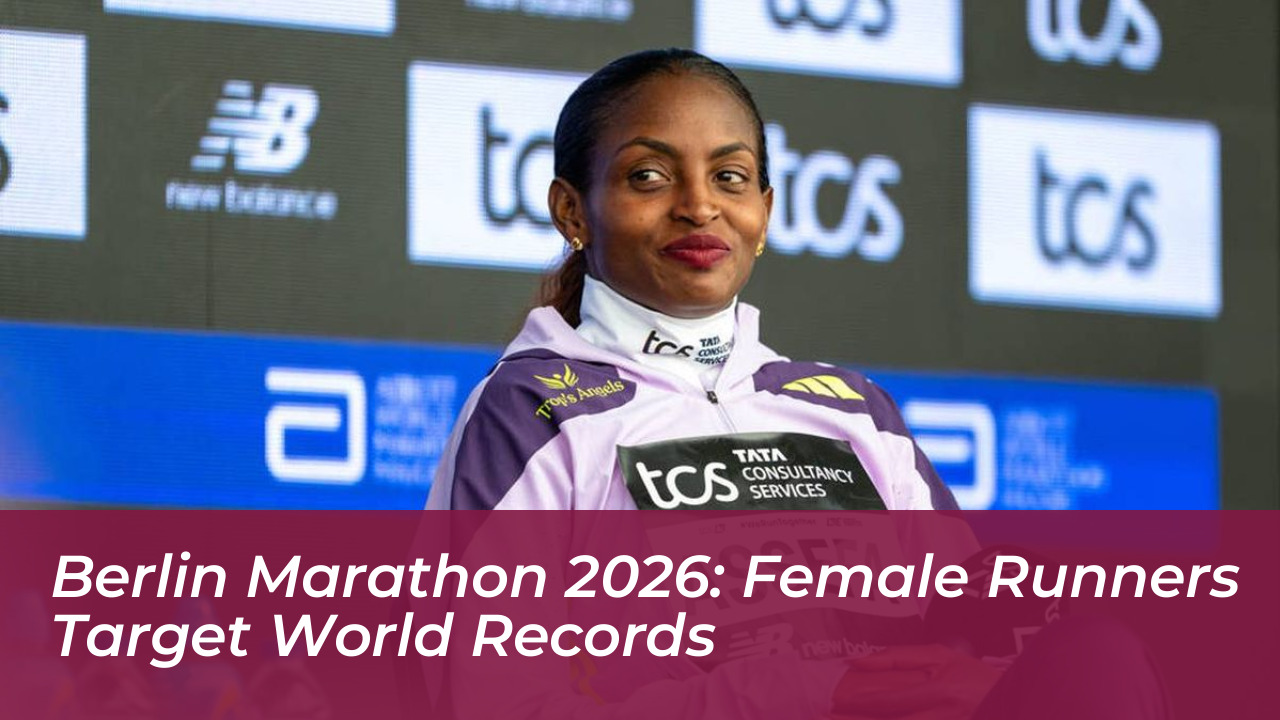
The stage is set for a historic exhibition of endurance and speed as elite female runners converge on the German capital for the 52nd edition of the BMW Berlin Marathon. Scheduled for Sunday, September 27, 2026, at 8:45 AM, the premier road race promises an electrifying showcase across the iconic 42.195-kilometer course. Following the withdrawal of top male contenders due to injuries, the global spotlight shifts squarely onto the world-class women’s elite field. Ethiopian superstar Tigst Assefa leads the charge with her sights set firmly on reclaiming the world record, while Germany’s own Esther Pfeiffer targets the long-standing national record.
- Introduction to the 2026 Berlin Marathon Elite Women Field
- Tigst Assefa and the Pursuit of World Record Number 14
- Pacing Strategy and Tactical Group Splits
- Defending Champion Rosemary Wanjiru Targets Sub-2:15
- Esther Pfeiffer Chases the German National Record
- Unprecedented Depth in the Elite Women Field
- Elite Women Field Performance Breakdown
- Course Modifications and Heat Management Strategies
- Nutritional Science and Personal Hydration Protocols
- Economic and Cultural Impact of the Berlin Marathon
Organizers from SCC Events anticipate a record-breaking turnout, uniting over 84,000 participants across all events. This massive gathering includes more than 56,000 registered runners representing approximately 162 nations. With optimal weather conditions forecast for the morning hours, starting at a crisp 13°C and rising to 17.5°C near the Brandenburg Gate finish line, the historic asphalt stands primed for fast times, aggressive pacing strategies, and unforgettable athletic triumphs.

Introduction to the 2026 Berlin Marathon Elite Women Field
The 52nd edition of the BMW Berlin Marathon marks a significant turning point in road racing history. For decades, men’s world record attempts dominated the headlines in the German capital. This year, the elite women division commands the absolute center of attention. Fans and media analysts alike are tuning in to witness what promises to be the fastest women’s race in the history of the sport.
Key storylines driving this massive interest include Tigst Assefa chasing world record redemption and local hero Esther Pfeiffer hunting the coveted German national record. The logistical scale supporting these athletes is staggering. Over 84,000 participants across multiple events will take to the streets, creating an atmosphere of electric energy that fuels personal bests and championship performances from the front of the pack to the final finishers.
Favorable weather forecasts provide the final ingredient for a historic morning. Temperatures starting at 13°C and gradually rising to 17.5°C near the finish line offer ideal thermoregulatory conditions. Runners avoid the oppressive heat waves that plagued previous editions, allowing cardiovascular systems to operate at maximum efficiency over the full marathon distance.
Tigst Assefa and the Pursuit of World Record Number 14
Ethiopian distance legend Tigst Assefa returns to the streets of Berlin three years after rewriting the history of women’s distance running. In 2022, Assefa stunned the global running community by slashing her personal best by nearly 20 minutes to win in 2:15:37. She returned in 2023 to shatter the world record on the very same course, clocking an astonishing 2:11:53. Although that mark was later eclipsed by Kenya’s Ruth Chepngetich in Chicago, Assefa remains intensely focused on reclaiming the absolute standard.
Assefa enters the race with unmatched pedigree, having claimed silver medals at both the Paris 2024 Olympic marathon and the 2025 World Championships. She also holds the women-only world record, set without male pacemakers, after running 2:15:41 in London. In Berlin, however, mixed-race rules apply, allowing Assefa to utilize male pacemakers to maintain her aggressive target pace.
Analysts project that a successful world record attempt requires a blistering first half in roughly 64:22. This demands precise pacing, flawless execution, and immense physical resilience over the closing kilometers. Assefa possesses the tactical intelligence and raw speed necessary to manage these demanding splits, making her the ultimate favorite to threaten the sub-2:10 barrier.
Pacing Strategy and Tactical Group Splits
Race dynamics on Sunday feature three distinct pacing groups among the elite women, ensuring that athletes of varying target goals receive optimal support. Structured pacing tiers provide clear pathways to success, allowing athletes to shelter from headwinds and maintain strict metabolic efficiencies throughout the first 30 kilometers.
Group One represents the world record pace. Led exclusively by Tigst Assefa and her assigned male pacemakers, this tier aims for a sub-2:10:00 finish. Record pace requires maintaining splits just under 3:05 per kilometer from the gun. Group Two functions as the sub-2:15:00 chase pack. Headed by defending champion Rosemary Wanjiru, this group features a formidable Ethiopian contingent including Bedatu Hirpa, Dera Dida, and Zeineba Yimer.
Group Three serves as the sub-2:20:00 rhythm group. Comprising European champion Alisa Vainio and Germany’s Esther Pfeiffer, this tier targets a consistent 3:18 per kilometer rhythm. These structured splits prevent erratic racing and ensure that every athlete runs within their optimal physiological zone.
Defending Champion Rosemary Wanjiru Targets Sub-2:15
Kenya’s Rosemary Wanjiru returns to Berlin as the defending champion, eager to improve upon her hard-fought victory from 2025, where she conquered extreme heat to cross the finish line in 2:21:05. Wanjiru’s marathon debut in Berlin in 2022 resulted in a stunning runner-up finish of 2:18:00, followed by a victory at the Tokyo Marathon six months later.
Armed with a personal best of 2:16:14, Wanjiru has elected not to chase Assefa’s aggressive world record pace. Instead, she anchors the second elite pack with the clear objective of dipping under the 2:15:00 barrier. Running alongside Wanjiru is a deeply talented trio of Ethiopian athletes, including Bedatu Hirpa, Dera Dida, and Zeineba Yimer.
Dida, who is married to Olympic marathon champion Tamirat Tola and trains alongside Assefa in Addis Ababa, brings significant tactical awareness to the second group. This collective horsepower guarantees high-velocity racing well behind the outright leader, keeping spectator excitement at a maximum through every district of the city.
Esther Pfeiffer Chases the German National Record
From a domestic perspective, all eyes in Germany lock onto Esther Pfeiffer of Düsseldorf Athletics. Pfeiffer enters her second serious marathon campaign with ambitions of capturing the long-standing German national record of 2:19:19, set by Irina Mikitenko back in 2008. Pfeiffer’s marathon experience is concise, as she won her debut at the 2023 Cologne Marathon in 2:37:00 in an unchallenged solo effort.
Her developmental trajectory over shorter distances signals readiness for a massive breakthrough. In March, Pfeiffer clocked a stellar 67:25 at the Generali Berlin Half Marathon, followed by a blazing 10K personal best of 30:45. These metrics confirm her current physiological state exceeds the requirements for a sub-2:20 performance.
By attaching herself to the sub-2:20:00 group alongside Finland’s Alisa Vainio, Pfeiffer places herself directly in position to rewrite German distance running history. Maintaining a steady 3:18 per kilometer rhythm provides the exact mathematical framework needed to eclipse Mikitenko’s seventeen-year-old milestone.
Unprecedented Depth in the Elite Women Field
The BMW Berlin Marathon boasts the deepest women’s elite start list in the event’s storied history. Statistical analysis of the field highlights the extraordinary caliber of talent assembled by SCC Events. The concentration of global talent guarantees high-velocity racing across every kilometer of the flat asphalt course, cementing Berlin’s reputation as the fastest marathon venue on earth.
Performance tiers showcase an unprecedented level of competition. Seven runners enter the race with personal bests under 2:20:00, while thirteen athletes boast personal records faster than 2:22:00. This dense clustering of elite talent transforms the race into a true tactical battle rather than a solitary time trial.
Elite Women Field Performance Breakdown
| Performance Tier | Number of Athletes | Notable Competitors |
|---|---|---|
| Sub-2:20:00 Personal Bests | 7 Runners | Tigst Assefa, Rosemary Wanjiru, Amane Beriso, Alisa Vainio, Dera Dida |
| Sub-2:22:00 Personal Bests | 13 Runners | Bedatu Hirpa, Zeineba Yimer, Esther Pfeiffer (Targeting) |
| Sub-2:30:00 Personal Bests | Entire Elite Tier | International contenders and elite domestic runners |
Course Modifications and Heat Management Strategies
Organizers have implemented critical schedule adjustments and course enhancements following the challenging high temperatures experienced during past events. Sunday’s main race start time has been brought forward by 30 minutes, with the elite wave departing precisely at 8:45 AM. This adjustment minimizes midday solar exposure for elite competitors.
Meteorological forecasts indicate favorable conditions at the gun, with temperatures hovering around 13°C before climbing to roughly 17.5°C as the elite women cross the finish line near the Brandenburg Gate. To safeguard athlete health throughout the 42.195-kilometer journey, course operations feature expanded hydration and cooling infrastructure.
Strategic cooling stations equipped with large water troughs allow participants to quickly submerge sponges or cooling towels. , personal hydration systems remain integral for elite and sub-elite runners alike, enabling precise electrolyte and fluid management to prevent performance degradation.
Nutritional Science and Personal Hydration Protocols
Modern marathon success relies heavily on advanced nutritional science. Elite female runners utilize hydrogel carbohydrate technology to maintain high carbohydrate absorption rates without experiencing gastrointestinal distress. Formulated drinks allow athletes to process up to 90 grams of carbohydrates per hour during maximal exertion.
Official hydration partners provide sustainable refill stations and Expo support, ensuring athletes have access to clean, reliable water sources throughout race week. Customized bottle placement tables positioned every five kilometers allow elite runners to retrieve their personalized energy mixes seamlessly without breaking their racing stride.
Proper carbohydrate and electrolyte replenishment keeps glycogen stores fully saturated, delaying the onset of muscular fatigue during the final ten kilometers. This scientific approach to fueling directly contributes to the record-shattering velocities witnessed on the Berlin course.
Economic and Cultural Impact of the Berlin Marathon
Beyond athletic achievements, the marathon serves as a massive socio-economic engine driving tourism, hospitality, and local business in the German capital. Hotels, restaurants, and retail stores experience record patronage as tens of thousands of international visitors flood the city center to support friends, family, and elite athletes.
Sustainable infrastructure integration remains a top priority for title sponsor BMW, which utilizes all-electric i5 and iX safety vehicles to lead the race fields with zero tailpipe emissions. Commercial partner contributions from major brands like adidas, Abbott, Zalando, Generali, and NORQAIN ensure the event operates with world-class efficiency.
Ultimately, female runners targeting world and national records at the Berlin Marathon elevate the sport to unprecedented heights. The combination of ideal weather, deep elite fields, and scientific pacing guarantees a race day that will resonate throughout global athletics for years to come.