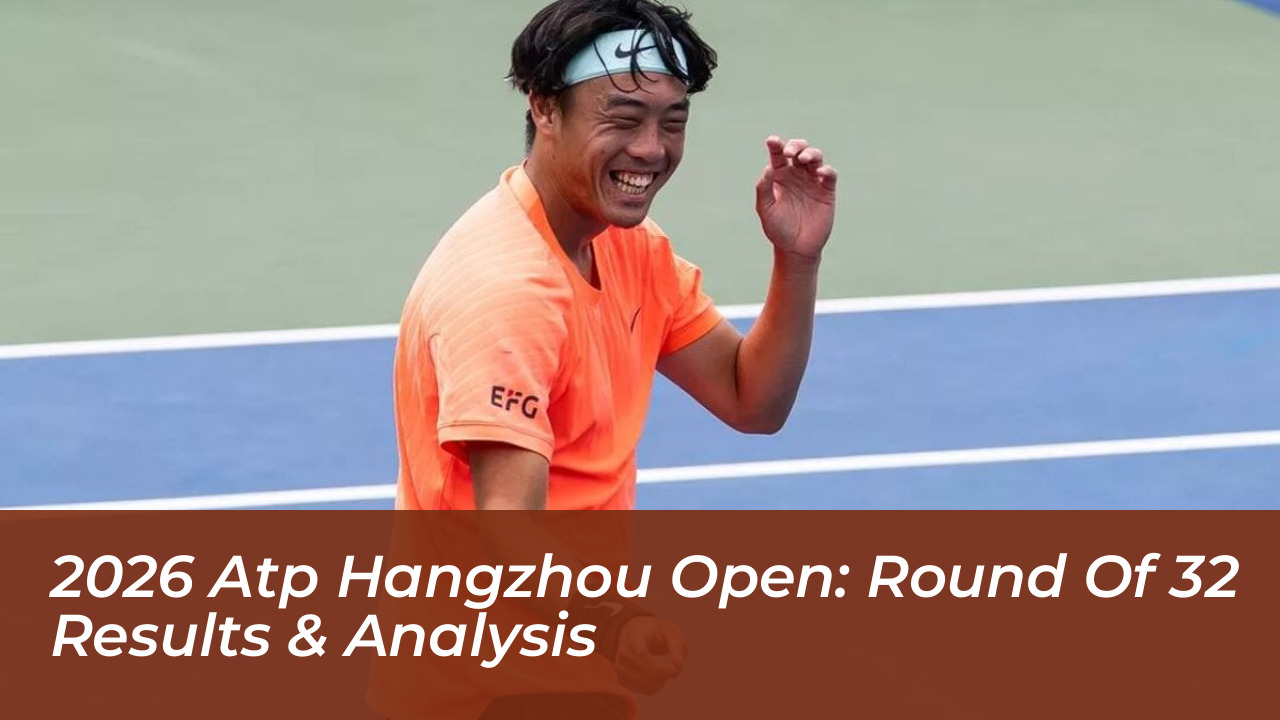
The 2026 Lynk and Co Hangzhou Open has officially launched the Asian hard-court swing at the Hangzhou Olympic Sports Centre Tennis Centre, delivering high-stakes action across the Round of 32. Featuring a total financial commitment of $1,039,090, the ATP 250 event hosts pivotal encounters as players fight for essential ranking points in China. This opening round sets the stage for a compelling week of tennis, defined by sharp tactical adjustments, surprising local upsets, and fierce battles for year-end glory.
- Tournament Overview: Top Seed Dynamics and Main Draw Reconfigurations
- Featured Round of 32 Matches: Analytical and On-Court Efficiency
- Home Crowd Drama: Local Favorites Face Mixed Fortunes
- Round of 32 Complete Scoreboard and Key Performances
- Financial Stakes and Ranking Point Structure
- Round of 16 Projections and Tournament Trajectory
- Frequently Asked Questions
- Where is the 2026 Hangzhou Open taking place?
- What is the total prize money for the tournament?
- Who was the standout local player in the Round of 32?
- How many ranking points does the singles champion receive?
Tournament Overview: Top Seed Dynamics and Main Draw Reconfigurations
Top seed Daniil Medvedev headlines a talent-packed draw in Hangzhou. As the top contender, Medvedev enters the autumn swing looking to secure critical points for the year-end ATP Finals qualification. His presence on the fast outdoor hard courts elevates the competitive standard for the entire field. Early service holds and fast-court adaptability remain vital as top players adjust to the specific bounce and speed of the Hangzhou surface.
Pre-tournament roster adjustments altered the initial main draw composition significantly. Several original direct entries withdrew prior to the start of play, opening opportunities for high-ranking alternates and qualifiers. Adam Walton replaced Daniel Altmaier, Roman Safiullin stepped in for Matteo Arnaldi, and Bu Yunchaokete took the spot of Marin Cilic. Additional changes saw Kyrian Jacquet replace Karen Khachanov, Terence Atmane step in for Thanasi Kokkinakis, and Aleksandar Vukic take over for Alex Michelsen. Coleman Wong replaced Corentin Moutet, while Mattia Bellucci filled the spot left by Luca Van Assche.
Players adjusted quickly to the tournament conditions during the opening practices. Coaches noted that the court speed favored aggressive baseline players who could dictate the pace early. These adjustments proved decisive as the tournament schedule rolled into the first official matches on Monday morning.
Featured Round of 32 Matches: Analytical and On-Court Efficiency
One of the most anticipated opening-round clashes featured Poland’s Kamil Majchrzak against Italy’s Mattia Bellucci. Their match highlighted how tactical preparation translates onto the court during early-round tournament play. Observers favored Kamil Majchrzak to win the match straight up based on recent hard-court form. Experts also anticipated a closely contested battle where Mattia Bellucci would push the game margins.
Majchrzak entered the fixture carrying a 15-16 season record, bolstered by his career-first ATP singles title won at Den Bosch in June 2026. Bellucci held an 11-17 tour-level record for the year, aiming to repeat his prior victory over Majchrzak from the 2024 US Open. Majchrzak outperformed expectations by controlling play from the baseline. The Pole neutralized Bellucci’s left-handed serve, securing break points in both sets to lock in a clean 6-3, 6-4 win.
French players achieved remarkable collective success during the initial stage of the tournament, winning several hard-fought opening matches. Hugo Gaston delivered an exceptional tactical display against Japan’s Sho Shimabukuro, winning 6-4, 6-4. Gaston dominated behind his first serve, winning 81 percent of those points by securing 25 out of 31 attempts. Shimabukuro generated five break point chances across the match but converted only once. Gaston converted three of his six break point opportunities, capturing 52 percent of the total points played to seal his spot in the Round of 16.
Home Crowd Drama: Local Favorites Face Mixed Fortunes
The home crowd experienced major disappointment as three out of the four Chinese players in the main draw suffered early exits. Hong Kong’s Coleman Wong produced the biggest upset of the Round of 32 by defeating China’s top-ranked player, Zhizhen Zhang. Wong played aggressive, clean tennis, breaking Zhang multiple times to earn a direct 6-3, 6-3 victory. Wildcard entrant Jie Cui also fell short, losing to Paraguay’s Daniel Vallejo 6-1, 6-7(2), 6-4 after a demanding three-set battle. Qualifier Fajing Sun struggled to gain footing against a relentless Roman Safiullin, falling 6-2, 6-0.
Bu Yunchaokete stood out as the sole Chinese player to advance past the opening hurdle. Bu handled pressure smoothly, defeating American entrant Michael Zheng 6-4, 6-3. Bu relied on strong baseline defense and consistent depth on his groundstrokes to control the pace of play. His ability to shoulder local expectations separates him from the pack as the tournament progresses.

Local fans filled the stadium grandstands despite the midweek scheduling. Supporters brought immense energy to every match involving Chinese competitors. The tournament atmosphere reached a peak during the evening sessions under the modern venue lights.
Round of 32 Complete Scoreboard and Key Performances
The opening round provided several straight-set dominant performances alongside tight tiebreak finishes across the outer courts. Roman Safiullin spent minimal time on court, dispatching Fajing Sun in straight sets. Hungary’s Fabian Marozsan displayed strong form by eliminating Alex Bolt 6-4, 6-2. Australia’s Rinky Hijikata fought through a tense opening-set tiebreak to overcome Czech player Dalibor Svrcina 7-6(7), 6-4.
| Matchup | Winner | Score |
|---|---|---|
| K. Majchrzak vs. M. Bellucci | K. Majchrzak | 6-3, 6-4 |
| H. Gaston vs. S. Shimabukuro | H. Gaston | 6-4, 6-4 |
| Y. Bu vs. M. Zheng | Y. Bu | 6-4, 6-3 |
| C. Wong vs. Z. Zhang | C. Wong | 6-3, 6-3 |
| R. Safiullin vs. F. Sun | R. Safiullin | 6-2, 6-0 |
| D. Vallejo vs. J. Cui | D. Vallejo | 6-1, 6-7(2), 6-4 |
| R. Hijikata vs. D. Svrcina | R. Hijikata | 7-6(7), 6-4 |
| F. Marozsan vs. A. Bolt | F. Marozsan | 6-4, 6-2 |
| J. Faria vs. T. Atmane | J. Faria | 3-6, 7-6(11), 6-4 |
| T. Daniel vs. D. Sweeny | T. Daniel | 7-6(6), 6-2 |
Additional matches featured intense three-set battles that tested players’ physical limits. Portugal’s Jaime Faria overcame Terence Atmane in a marathon encounter lasting over two and a half hours. Taro Daniel used his veteran experience to outmaneuver Dane Sweeny in straight sets.
Financial Stakes and Ranking Point Structure
The 2026 Lynk and Co Hangzhou Open offers $1,039,090 in total prize money, reflecting a 2.0 percent increase over the 2025 event total of $1,019,185. Players competing in the main draw earn substantial financial rewards and ATP ranking points based on their round progression.
- Winner: 250 ATP Points
- Finalist: 165 ATP Points
- Semifinalists: 100 ATP Points
- Quarterfinalists: 50 ATP Points
- Round of 16: 25 ATP Points
- Round of 32: 0 ATP Points
Prize money distribution follows standard ATP 250 guidelines to support players across all tournament tiers. Early-round participants secure guaranteed checks to offset travel and training expenses during the grueling Asian swing.
Round of 16 Projections and Tournament Trajectory
With the Round of 32 concluded, the tournament transitions into high-stakes Round of 16 clashes. Prominent matchups include Kyrian Jacquet confronting Tomas Martin Etcheverry, while Fabian Marozsan meets Japan’s Taro Daniel. Rinky Hijikata faces a formidable challenge against Andrey Rublev, and Jaime Faria matches up against Hugo Gaston.
The hard courts at the Hangzhou Olympic Sports Centre provide ideal conditions for fast, aggressive tennis, making early service holds paramount for players advancing into the final stages.
Physical endurance and court positioning will dictate the outcomes as these athletes push deeper into the draw. Fans can expect heightened intensity, longer rallies, and tactical adjustments from players striving to lift the championship trophy.
Frequently Asked Questions
Where is the 2026 Hangzhou Open taking place?
The tournament is held at the Hangzhou Olympic Sports Centre Tennis Centre in China, marking the start of the Asian hard-court swing.
What is the total prize money for the tournament?
The 2026 event features a total financial commitment and prize pool of $1,039,090 for participating athletes.
Who was the standout local player in the Round of 32?
Bu Yunchaokete was the sole Chinese player to advance to the next round after defeating American entrant Michael Zheng.
How many ranking points does the singles champion receive?
The singles tournament winner earns 250 ATP ranking points along with the championship trophy and top prize money.