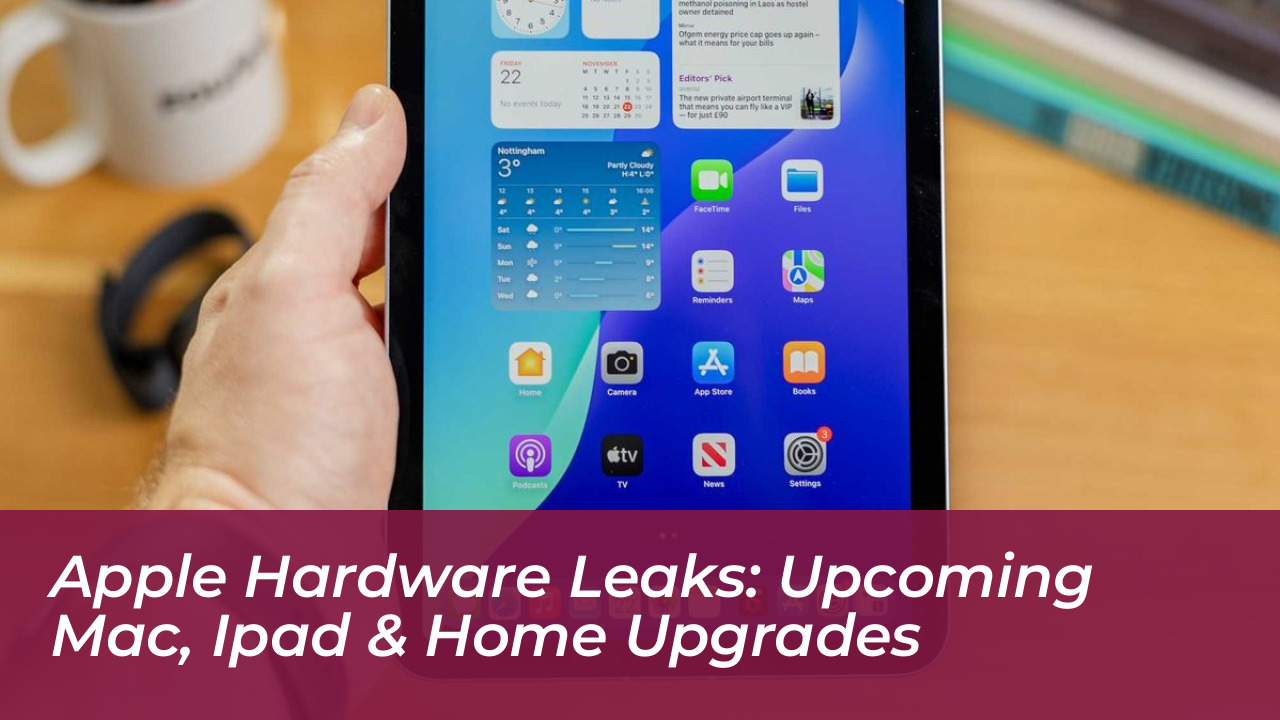
Internal software builds and verified device identifiers reveal Apple’s hardware strategy running through late 2025 and 2026. Rather than relying on standard rumor mill speculation, this data originates directly from internal naming conventions and chip architectures embedded in operating system code. These disclosures point to systematic silicon transitions, performance boosts, and display overhauls across the entire ecosystem.
- Unprecedented Apple Hardware Leak Exposes Multi-Year Roadmap
- Smart Home and Living Room: HomePod Mini 2 and Apple TV 4K
- HomePod Mini 2 Codename B525 Architecture Shifts
- Apple TV 4K Refresh and Apple Intelligence Integration
- Tablet Roadmap: iPad Mini and Entry-Level iPad Upgrades
- iPad Mini 8 Codenames J510 and J511 Powerhouse Performance
- Entry-Level Budget iPad Refresh
- Mac Silicon and Display Pipeline for 2026
- M5 and M6 Mac Refreshes Across Studio, Pro, and MacBook Lines
- Apple Studio Display 2 Mini-LED Transition
- Vision Pro 2 and Wearable Ecosystem Updates
- Vision Pro Second Generation M5 Integration
- Apple Watch Series 11, Ultra 3, and SE 3 Architecture
- Comprehensive Apple Hardware Upgrade Matrix
- Strategic Implications of the Leaked Apple Roadmap
- Frequently Asked Questions
- What do Apple hardware leaks reveal about future product releases?
- Are these leaked hardware specifications officially confirmed by Apple?
- When can consumers expect these upgraded devices to launch?
- Will older devices support the new software capabilities?

Unprecedented Apple Hardware Leak Exposes Multi-Year Roadmap
Internal Apple code unearthed by researchers reveals an extensive pipeline of unannounced hardware upgrades spanning the entire ecosystem. Discovered within publicly shared software builds and verified device identifiers, these references offer a concrete look at Apple’s product strategy extending through late 2025 and 2026.
Rather than relying on standard rumor mill speculation, this fresh data comes directly from internal naming conventions, product codenames, and chip architectures embedded in Apple software. The disclosures point to substantial silicon transitions, performance boosts, and display overhauls across the HomePod, Apple TV, iPad mini, Mac, and Vision Pro lines. While Apple has not officially confirmed these release schedules, the structural consistency of these software identifiers provides a reliable map of upcoming enterprise and consumer hardware launches.
Smart Home and Living Room: HomePod Mini 2 and Apple TV 4K
Home audio and living room entertainment hardware receive significant internal overhauls, bringing advanced microarchitectures and wireless communication standards to smart home devices.
HomePod Mini 2 Codename B525 Architecture Shifts
- Transition away from the legacy S5-class processor to Apple’s T8310 microarchitecture.
- Introduction of a 64-bit dual-core CPU derived from A-series silicon alongside a dedicated 4-core Neural Engine.
- Faster on-device processing speeds for rapid Siri command execution and dynamic room acoustics tuning.
- Integration of an in-house Wi-Fi and Bluetooth combo chip supporting Wi-Fi 6E connectivity.
Apple TV 4K Refresh and Apple Intelligence Integration
- Hardware upgrade housing the A17 Pro chip or newer, replacing the current A15 Bionic processor.
- RAM capacity expansion to 8GB, providing necessary headroom for console-style gaming titles.
- Full support for Apple Intelligence features arriving on living room displays for the first time.
- Custom N1 wireless chip integration bringing Wi-Fi 7 and Bluetooth 6 support for multi-band bandwidth optimization.
Tablet Roadmap: iPad Mini and Entry-Level iPad Upgrades
Tablets across Apple’s lineup receive performance leaps, focusing heavily on bringing advanced machine learning capabilities to lower price points.
iPad Mini 8 Codenames J510 and J511 Powerhouse Performance
- Leapfrogging immediate expectations by targeting the A19 Pro chip family, moving past the current A17 Pro setup.
- Positioning the small-form-factor tablet as a mobile workstation for creative workflows and spatial computing companion tasks.
- Supply chain exploration of future OLED panels for upcoming iterations.
Entry-Level Budget iPad Refresh
- Transitioning from the current A16 chip to an advanced A18 processor equipped with a 16-core Neural Engine.
- Localized Apple Intelligence tools arriving at the budget tier without altering the established $349 starting price point.
Mac Silicon and Display Pipeline for 2026
Desktop and laptop computers continue their systematic migration across Apple Silicon generations, with code references explicitly detailing the M5 and M6 rollouts.
M5 and M6 Mac Refreshes Across Studio, Pro, and MacBook Lines
- Internal product identifiers mapping out Mac Studio, Mac Pro, MacBook Pro, and iMac updates.
- Enhanced performance cores and superior GPU capabilities targeting intensive machine learning workloads and high-end rendering.
Apple Studio Display 2 Mini-LED Transition
- Successor to the original 27-inch Studio Display slated for early 2026 release under codenames J427 and J527.
- Adoption of mini-LED backlighting to elevate peak brightness, contrast ratios, and dynamic range performance.
Vision Pro 2 and Wearable Ecosystem Updates
Spatial computing and wearable hardware receive targeted iterations focused on performance efficiency and comfort optimizations.
Vision Pro Second Generation M5 Integration
- Confirmation that the next-generation mixed-reality headset utilizes the M5 chip rather than an M4 variant.
- Ergonomic adjustments, including an upgraded strap design for improved weight distribution, targeting the hardware release cycle.
Apple Watch Series 11, Ultra 3, and SE 3 Architecture
- Reliance on the S11 System in Package (SiP) while optimizing power efficiency.
- Packaging updates ensuring steady entry-level pricing across aluminum and titanium configurations.
Comprehensive Apple Hardware Upgrade Matrix
| Product Line | Current Hardware | Leaked Upcoming Upgrade | Expected Release Window |
|---|---|---|---|
| HomePod mini 2 | S5 Chip | T8310 Architecture, A16-derived CPU, 4-core Neural Engine | 2026 |
| Apple TV 4K (Gen 4) | A15 Bionic, 4GB RAM | A17 Pro / newer, 8GB RAM, Wi-Fi 7, Apple Intelligence | Current Cycle |
| iPad mini 8 | A17 Pro | A19 Pro Chip, increased GPU cores | 2026 |
| Entry-Level iPad | A16 Bionic | A18 Chip, 16-core Neural Engine | Spring 2026 |
| Studio Display 2 | Standard LED, 60Hz | Mini-LED Backlighting, M5 Mac Pairing | Early 2026 |
| Vision Pro 2 | M2 Chip | M5 Chip, Ergonomic Strap Redesign | Recent Cycle |
Strategic Implications of the Leaked Apple Roadmap
The accidental publication of internal identifiers highlights Apple’s aggressive hardware cadence. Standardizing advanced silicon like the Neural Engine across entry-level and flagship tiers ensures that local artificial intelligence features operate seamlessly across every device category.
Consumers and enterprise buyers alike must prepare for a densely packed release schedule that fundamentally reshapes price-to-performance ratios across the entire hardware ecosystem. These systematic upgrades point toward a unified operational framework where performance bottlenecks disappear.
Frequently Asked Questions
What do Apple hardware leaks reveal about future product releases?
Internal software builds show systematic silicon updates across Mac, iPad, HomePod, and Vision Pro product lines.
Are these leaked hardware specifications officially confirmed by Apple?
Apple has not made formal announcements, but the data stems directly from verified operating system code.
When can consumers expect these upgraded devices to launch?
Releases are rolling out sequentially across 2026, targeting major updates for displays, processors, and smart home items.
Will older devices support the new software capabilities?
Newer features heavily rely on upgraded Neural Engine chips found in upcoming hardware iterations.