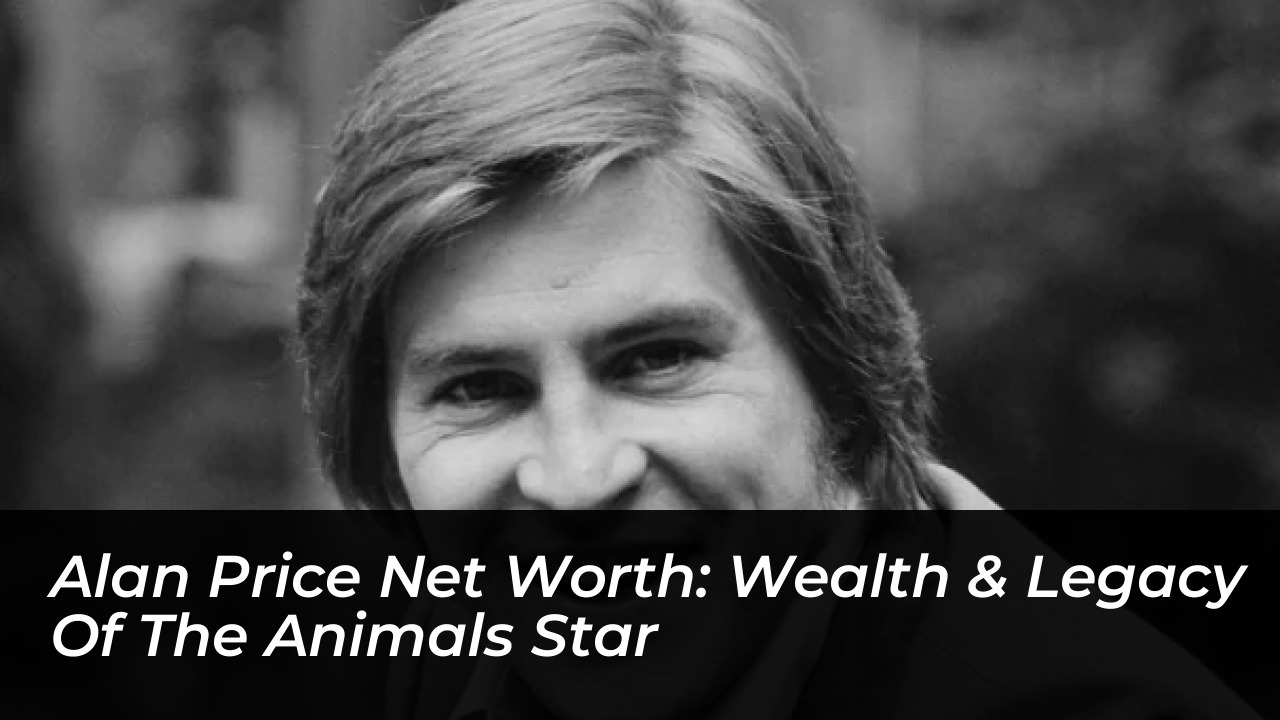

Alan Price has built an enduring legacy as an English musician, singer, songwriter, and composer, accumulating an estimated net worth of $4 million. Best known as the original keyboardist and a founding member of the legendary 1960s rock band The Animals, Price defined the group’s signature blues-influenced sound with his distinctive Hammond organ playing. Beyond his work with the British Invasion icons, he forged a diverse and successful solo career, composed award-winning film scores, and secured valuable songwriting and arrangement royalties that continue to sustain his financial standing.
Early Life and Musical Beginnings
Alan Price was born on April 19, 1942, in Fatfield, Washington, County Durham, England, to parents John George Price and Elizabeth Gowen. Tragedy struck the family in February 1948 when his father, who worked at a British Oxygen plant, died in an industrial accident at the age of 38. Following the accident, Price and his family relocated to Jarrow, an industrial town in northeastern England, where they lived with his maternal grandparents.
Price attended Jarrow Grammar School and developed an early, self-taught passion for the piano and organ. Although music captured his imagination, he initially pursued conventional employment, working for Britain’s Inland Revenue. During his spare time, he performed in local bands, gradually immersing himself in Newcastle’s vibrant rhythm and blues circuit. In the early 1960s, he formed the Alan Price Rhythm and Blues Combo, which eventually recruited singer Eric Burdon and rebranded as The Animals.
Rise to Fame With The Animals
As a founding member of The Animals alongside Eric Burdon, guitarist Hilton Valentine, bassist Chas Chandler, and drummer John Steel, Price became the musical engine of the group. Their powerful blend of American blues and British rock propelled them to international stardom after moving to London in 1964 to work with producer Mickie Most.
The band’s breakthrough arrived with their electric blues interpretation of the traditional folk song “The House of the Rising Sun.” Released in June 1964, the recording topped charts in both the United Kingdom and the United States, cementing The Animals as defining figures of the British Invasion. Price’s haunting organ arrangement was universally recognized as the core of the track’s success. The group followed up with hits like “I’m Crying,” “Don’t Let Me Be Misunderstood,” and “Bring It On Home to Me.”
Despite their massive commercial triumph, internal tensions mounted. Price disliked the grueling demands of constant international touring, particularly air travel, and experienced personal and creative friction with his bandmates. He officially departed from The Animals in May 1965.
The Value of “House of the Rising Sun” Royalties
One of the most financially lucrative components of Alan Price’s career stems from the arrangement credits for “The House of the Rising Sun.” Because the track was a traditional public-domain folk tune, modern songwriting copyright did not apply to the underlying melody and lyrics. However, a unique musical arrangement of a public-domain composition generated independent publishing royalties.
When the single was released in 1964, the record credited the arrangement exclusively to Alan Price. This sole designation became an exceptionally valuable revenue stream as the track generated decades of continuous radio play, global reissues, compilations, and licensing deals.
The arrangement credit also sparked long-standing friction among former band members. Hilton Valentine and John Steel later claimed that all five members contributed to the arrangement and expected shared royalties, while manager Mike Jeffery reportedly cited space constraints on the record label as the reason for listing only Price’s name. Eric Burdon also expressed frustration over receiving no songwriting royalties despite performing the iconic lead vocals. Nonetheless, the credit secured Price an enduring financial interest separate from his performance earnings.
Solo Career and The Alan Price Set
Following his departure from The Animals, Price formed the Alan Price Set, transitioning toward a diverse musical style incorporating jazz, pop, and traditional British entertainment. In 1966, he scored a major British hit with his cover of Screamin’ Jay Hawkins’ “I Put a Spell on You,” which reached number nine on the charts.
He continued his commercial momentum with “Hi-Lili, Hi-Lo” and Randy Newman’s “Simon Smith and the Amazing Dancing Bear,” which climbed to number four in 1967. Price served as an early British champion of Newman’s unique theatrical songwriting. Later in 1967, Price wrote, arranged, and produced “The House That Jack Built,” which also reached number four in Britain, proving his capability as a self-contained hitmaker.
Collaborations and 1970s Success
In the late 1960s, Price began a fruitful partnership with fellow keyboardist and singer Georgie Fame. The duo toured, recorded, and hosted BBC television programs such as “The Price of Fame” and “Fame at Any Price,” featuring comedy writing by Monty Python member Terry Jones. In 1971, Price and Fame scored a top-charting hit with “Rosetta.”
Price achieved his critical peak as a solo artist in 1974 with the autobiographical concept album Between Today and Yesterday. Exploring his working-class northeastern upbringing, the album reached number nine on the UK charts and featured “Jarrow Song,” a tribute to his hometown that peaked at number six.
Film Scores, Theater, and Acting
Price expanded his artistic repertoire into cinema through a successful collaboration with director Lindsay Anderson. He composed and performed the soundtrack for Anderson’s 1973 satirical film O Lucky Man!, acting on screen alongside his band. His innovative work earned him the 1974 BAFTA Award for Best Film Music (the Anthony Asquith Memorial Award) and a Golden Globe nomination for Best Original Score.
His subsequent scoring credits included Anderson’s Britannia Hospital (1982) and The Whales of August (1987), starring Bette Davis and Lillian Gish. He also composed music for theater productions, including the 1981 West End musical Andy Capp.
Later Career and Recognition
Price periodically reunited with The Animals, recording the 1977 album Before We Were So Rudely Interrupted and the 1983 project Ark. In 1994, he was officially inducted into the Rock and Roll Hall of Fame as a member of The Animals.
He maintained a consistent presence as a live performer well into his eighties, playing intimate club venues across Britain, including London’s Bull’s Head in Barnes. He has been married twice-first to Maureen Donneky, with whom he shares a daughter, Elizabeth, and subsequently to singer Alison Thomas, with whom he also has a daughter.
Frequently Asked Questions About Alan Price
What is Alan Price’s net worth?
Alan Price has an estimated net worth of $4 million, primarily earned through his decades-long career as a musician, valuable publishing royalties from “The House of the Rising Sun,” solo hits, and award-winning film compositions.
Why did Alan Price leave The Animals?
Price left The Animals in 1965 due to personal and musical differences with his bandmates, alongside a well-documented fear of flying that made intense international touring difficult to sustain.
Does Alan Price still receive royalties for “The House of the Rising Sun”?
Yes. Because Alan Price was credited solely for the song’s musical arrangement upon its 1964 release, he collected valuable publishing and songwriting royalties from decades of global airplay, reissues, and licensing agreements.
What awards has Alan Price won?
In 1974, Price won the BAFTA Award for Best Film Music for his soundtrack to Lindsay Anderson’s film O Lucky Man!. He was also nominated for a Golden Globe Award for the same score and was inducted into the Rock and Roll Hall of Fame with The Animals in 1994.
Is Alan Price still active in music?
Price maintained a long career spanning over six decades, continuing to perform live concert dates and club appearances in the United Kingdom into his eighties.