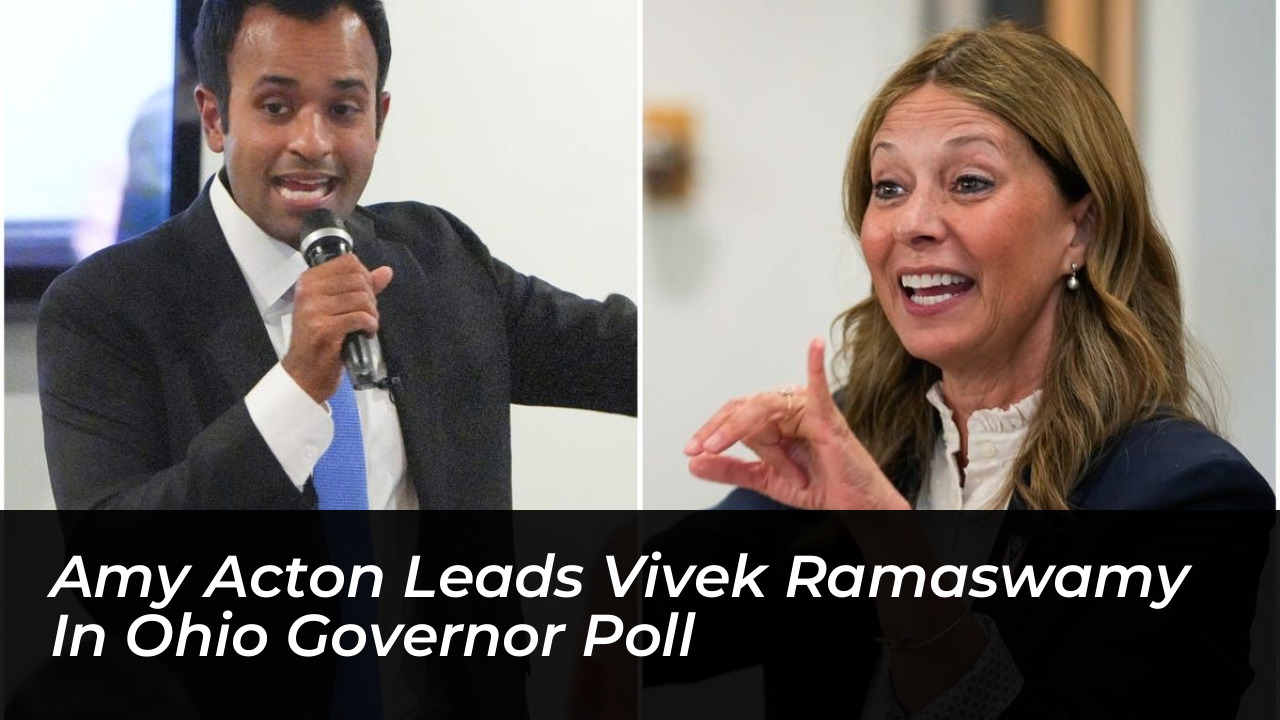
Democrat Amy Acton holds a lead over Republican Vivek Ramaswamy in the race for the Ohio governorship, according to a Suffolk University/USA TODAY Ohio Network poll conducted between September 23 and September 27.
- Shifting Voter Demographics and Key Issues
- Campaign Strategies and Candidate Profiles
- Broader Polling Context in the Midterms
- Frequently Asked Questions About the Ohio Governor’s Race
- Who are the main candidates in the 2026 Ohio governor’s race?
- What did the Suffolk University/USA TODAY poll find?
- Why is current polling varied across different organizations?
- What are the central issues driving voters in this election?
- When is the Ohio gubernatorial election scheduled?
The survey of 500 likely voters shows Acton leading Ramaswamy 50.4% to 41.4%. Libertarian candidate Don Kissick drew 2.8% support in the survey, which carries a margin of error of plus or minus 4.4 percentage points. The poll utilized the 2018 midterm electorate as a modeling baseline.
David Paleologos, director of the Suffolk University Political Research Center, detailed the methodology behind using the 2018 midterm structure. He noted it served as the last competitive, open midterm race following a presidential victory. In that 2018 election, Republican Mike DeWine defeated Democrat Rich Cordray 50% to 47%.
Shifting Voter Demographics and Key Issues
The poll highlights strong momentum for Acton among independent voters and women in a state that voted heavily for Donald Trump in the 2024 presidential election. Acton secured significant backing among independents, a group that traditionally leans or breaks toward Republican candidates in the state. Analysts attribute the shift to growing voter concerns regarding the cost of living, economic direction, and national political sentiment.
Approximately 53.8% of respondents indicated that Ohio is on the wrong track, while nearly 60% disapproved of the job Donald Trump was doing as president. Acton’s campaign has centered heavily on affordability and reducing everyday expenses for families.
Campaign Strategies and Candidate Profiles
Ramaswamy, a biotech entrepreneur who gained national prominence during his 2024 presidential run, secured an endorsement from Donald Trump in February 2025, which cleared much of the Republican primary field. He has positioned his campaign around his business background and his potential to implement sweeping structural changes in Ohio.
However, the race has seen substantial spending on negative advertising. Survey respondents pointed to intense political mudslinging, with 47.6% stating that Ramaswamy had run a more negative campaign, compared to 22.8% who pointed to Acton.
Acton previously served as the director of the Ohio Department of Health from February 2019 through June 2020, navigating the initial wave of the COVID-19 pandemic under Governor Mike DeWine. Her tenure during the pandemic remains a polarizing point for some conservative voters, though her overall favorability numbers in recent surveys have outpaced her opponent’s.
Broader Polling Context in the Midterms
While the Suffolk University poll shows a wider gap, other recent surveys reflect a much tighter race. A Marist Poll released around the same period showed Acton leading Ramaswamy 50% to 44% among registered voters. Meanwhile, other statewide trackers, including a Bowling Green State University-YouGov poll, have shown margins well within the respective margins of error, keeping the contest classified as a toss-up by major nonpartisan forecasters like the Cook Political Report and Sabato’s Crystal Ball.
With Election Day approaching on November 3, 2026, both campaigns continue to pour resources into voter mobilization across key suburban and bellwether counties throughout the state.
Frequently Asked Questions About the Ohio Governor’s Race
Who are the main candidates in the 2026 Ohio governor’s race?
The primary candidates are Democrat Amy Acton, former director of the Ohio Department of Health, and Republican Vivek Ramaswamy, a biotech entrepreneur and former presidential candidate. Libertarian Don Kissick is also on the ballot.
What did the Suffolk University/USA TODAY poll find?
The poll showed Democrat Amy Acton leading Republican Vivek Ramaswamy 50.4% to 41.4% among 500 likely voters surveyed between September 23 and September 27, with a margin of error of plus or minus 4.4 percentage points.
Why is current polling varied across different organizations?
Polling variations often stem from different voter modeling baselines. For instance, Suffolk University modeled its poll on the 2018 midterm electorate, whereas other polls utilize different registered or likely voter screens, capturing shifting dynamics in a traditionally Republican-leaning state.
What are the central issues driving voters in this election?
Voters are heavily focused on economic conditions, the cost of living, affordability, and the overall direction of the state and federal government.
When is the Ohio gubernatorial election scheduled?
The general election for governor of Ohio is scheduled for November 3, 2026, as incumbent Republican Governor Mike DeWine is term-limited.