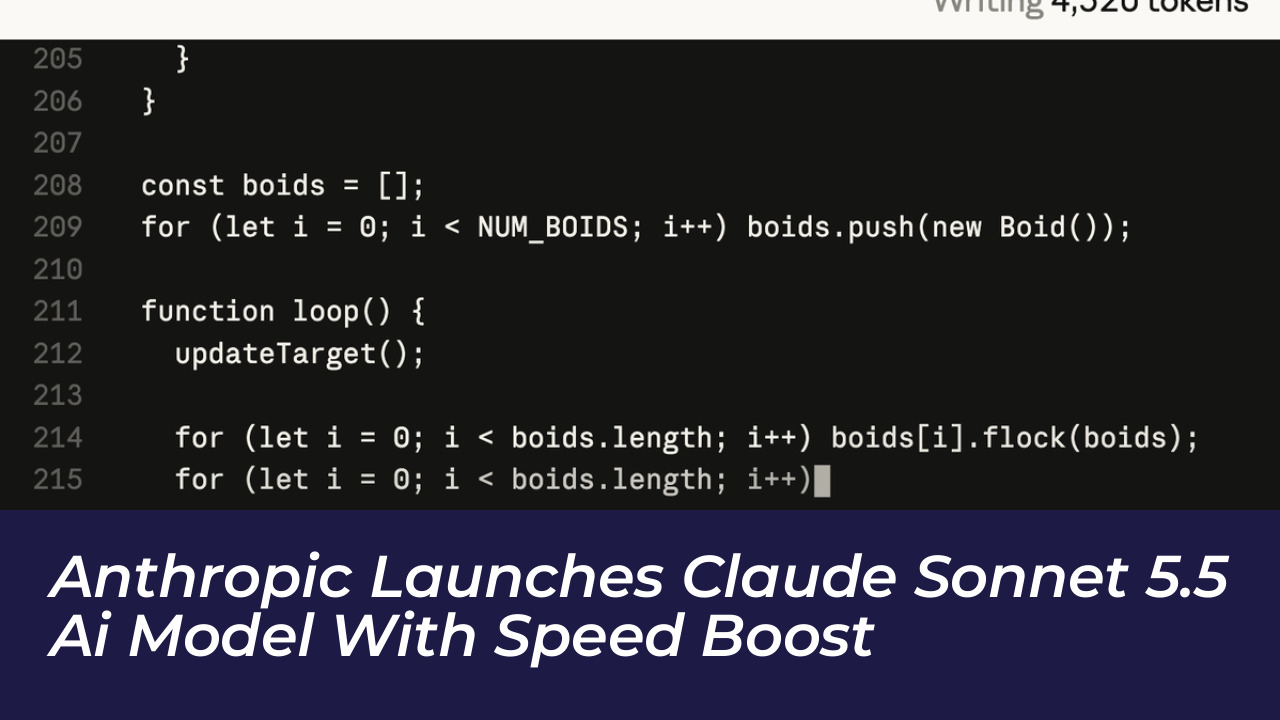
Artificial intelligence company Anthropic has officially released Claude Sonnet 5.5, the second model in its Claude 5.5 product family. This medium-tier model delivers major speed and performance upgrades for everyday workflows, software development, and document creation while reducing task-related expenses.
The rollout follows the introduction of the high-judgment Claude Opus 5.5 model. A high-volume model named Claude Haiku 5.5 will follow in the coming weeks. According to Anthropic, Sonnet 5.5 operates over 30 percent faster than Claude Sonnet 5 and cuts task operational costs by up to 30 percent.
Benchmark Performance and Technical Capabilities
Benchmark testing shows major performance gains across several technical domains. On the Terminal-Bench 4.0 agentic coding evaluation, Sonnet 5.5 scored 70.6 percent, a significant jump from the 10.3 percent scored by the previous version.
The model also came within two points of Opus 5.5 on GDPval-AA, a test measuring real-world workplace execution across 44 occupations and nine industries. Theo Chu, a research product manager at Anthropic, stated that Sonnet is built for cost-conscious customers handling routine tasks that require reliable output without needing an Opus-class model.
Core Optimization Areas for Developers
- Software Development: Excels across the development lifecycle, scoping codebase changes quickly and keeping edits concise for review.
- Agentic Workflows: Handles well-defined agent tasks like technical investigations, code reviews, and document drafting efficiently.
- Visual Design: Features a refined eye for user interface design, structured diagrams, and template-based slides that need minimal cleanup.
- Enterprise Knowledge Tasks: Delivers clear, direct writing for office productivity, analysis, spreadsheets, and presentations.
Pricing, Token Efficiency, and Platform Availability
Claude Sonnet 5.5 is priced at $2 per million input tokens and $10 per million output tokens, alongside cache read rates. Because the model uses fewer tokens per task than earlier versions, and supports prompt caching and batch processing, organizations can achieve substantial savings.
The model is available through multiple channels. These include the Claude Platform, web and mobile apps (iOS and Android), and major cloud ecosystems such as Amazon Web Services (AWS), Google Cloud, and Microsoft Foundry (Azure and Anthropic).
Safety Frameworks and Cybersecurity Safeguards
To address security, Anthropic integrated advanced governance into the release. Sonnet 5.5 features safety protocols and cyber safeguards enabled by default. This marks the first time a Sonnet model has launched with the specialized fallbacks previously reserved for Anthropic’s most advanced systems.
Alignment testing indicates the model does not expand the raw frontier of general capabilities. However, its targeted safety evaluations successfully mitigate risks to ensure dependable operations across corporate and public cloud infrastructures.