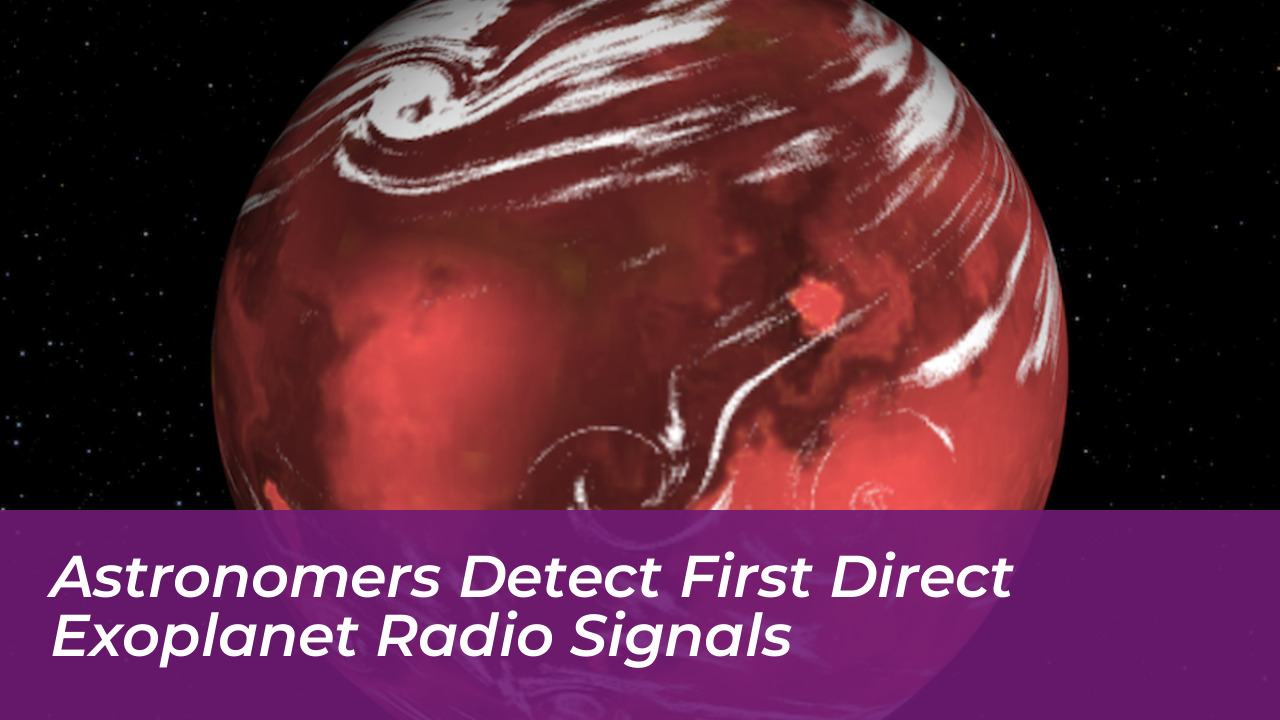
International teams of astronomers have captured direct radio wave emissions originating from a planet outside our Solar System for the first time. Using South Africa’s MeerKAT radio telescope array, researchers successfully detected variable radio bursts coming directly from Beta Pictoris b, a massive gas giant exoplanet located approximately 63.4 light-years from Earth.
The landmark finding, detailed in a research paper shared on the arXiv preprint repository by scientists from the Center for Astrophysics | Harvard & Smithsonian and the University of Oregon, marks a major milestone in exoplanet science. While previous radio detections in planet-hosting systems could not be unambiguously separated from their host stars, this new observation isolates signals directly to an extrasolar planet.
Unlocking the Physics of Planetary Auroras
Although scientists clarify that the signals are not a sign of extraterrestrial life, the discovery provides crucial insights into planetary magnetism. The detected radio waves share identical underlying physics with the mechanisms that power auroras on Earth, Jupiter, Saturn, Uranus, and Neptune.
As energetic, charged particles spiral down along magnetic field lines toward a planet’s polar regions, they interact with the atmosphere and release energy via Electron Cyclotron Maser Instability (ECMI). By analyzing these repeating, highly circularly polarized bursts captured across four separate observation campaigns in 2025 and 2026, the research team calculated the magnetic field strength of Beta Pictoris b.
The data reveals that Beta Pictoris b possesses an exceptionally powerful magnetic field-thousands of times stronger than Earth’s-consistent with dynamo-scaling predictions for a young, massive gas giant spinning on its axis every 8 to 9 hours.
Implications for the Search for Habitable Worlds
Understanding planetary magnetic fields is vital for evaluating the habitability of distant worlds. Magnetic fields act as protective shields, safeguarding planetary atmospheres from being stripped away by stellar winds and high-energy radiation from host stars.
While Beta Pictoris b itself is a massive gas giant roughly 10 to 12 times the mass of Jupiter, making it an unlikely home for life as we know it, the techniques developed in this study open a new observational pathway. As next-generation radio observatories increase instrument sensitivity by five to seven times, astronomers hope to apply these same methods to rocky, terrestrial exoplanets.
By mapping the magnetic fields of smaller, potentially habitable worlds, scientists can better determine which planets retain the atmospheric stability required to support liquid water and surface life.
Additional Research and Deep Space Surveys
Parallel to the MeerKAT observations, deep-space surveys utilizing facilities like China’s Five-hundred-meter Aperture Spherical Radio Telescope (FAST) continue to refine machine-learning pipelines for wavelet analysis. While terrestrial radio interference remains a common hurdle when parsing faint signals from distant systems like K2-155, advancements in data processing are rapidly accelerating humanity’s ability to listen to the cosmos.
With seven other known giant exoplanets across five nearby star systems already targeted for future analysis, astronomers stand on the threshold of a new era in characterizing planetary environments across our galaxy.