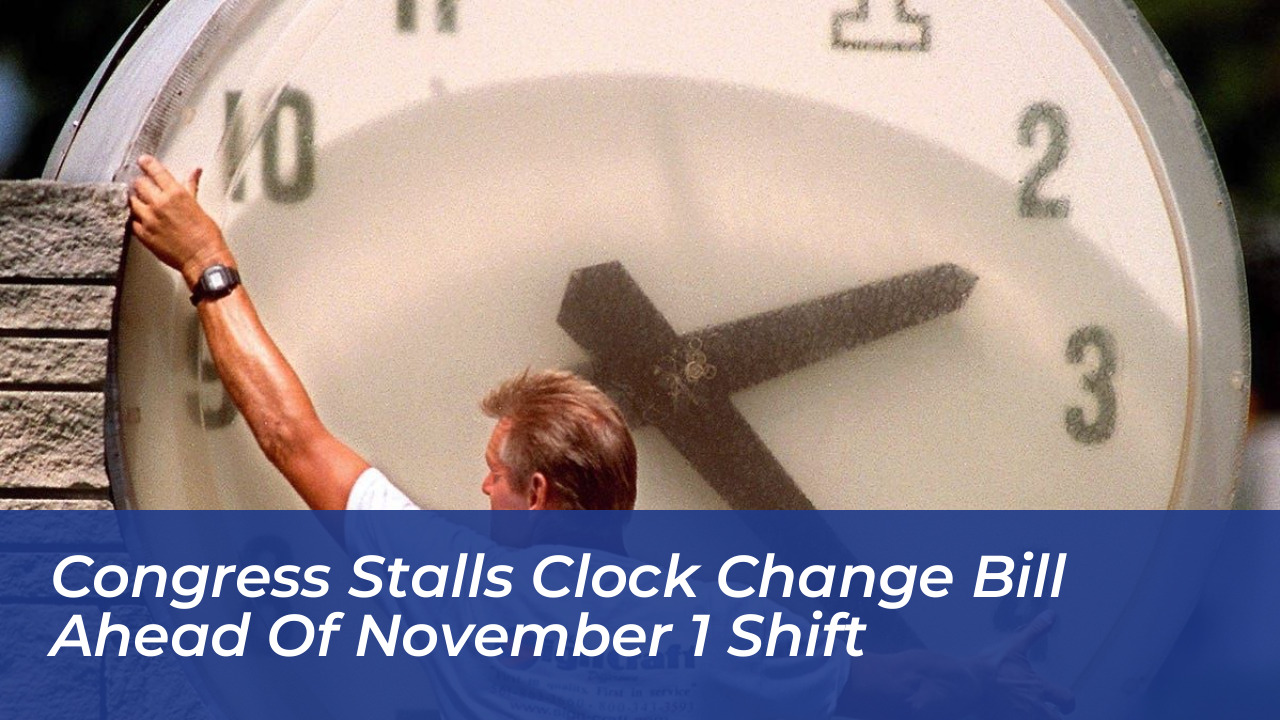

Millions of Americans will turn their clocks back one hour at 2 a.m. local time on Sunday, November 1, 2026, as daylight saving time officially ends and standard time resumes. While the transition grants an extra hour of sleep overnight, it also marks the return of earlier winter sunsets. Despite strong public frustration and high-profile backing from President Donald Trump, federal legislation designed to eliminate seasonal time changes remains completely stalled in the U.S. Senate.
The legislative effort centers on the Sunshine Protection Act, a proposal that would establish permanent daylight saving time nationwide and do away with the twice-yearly clock adjustments. Although the U.S. House of Representatives overwhelmingly approved a version of the bill in July by a bipartisan 308-117 vote, the measure has failed to gain traction in the upper chamber. With lawmakers facing a tight legislative calendar and no floor vote currently scheduled, time has effectively run out to prevent the upcoming autumn transition.
The Shrinking Legislative Window
The path forward for permanent daylight saving time faces severe calendar constraints. Following their summer recess, senators returned to Washington on September 14, but scheduled recesses and upcoming campaign cycles leave only a narrow window for debate. Senate leadership has indicated that competing legislative priorities and deep divisions among members continue to prevent the bill from moving forward.
Senate Majority Leader John Thune has expressed hesitation regarding a uniform national clock mandate, noting that opinion among senators remains closely divided. Conservative opposition led by lawmakers such as Sen. Tom Cotton (R-AR) has created substantial procedural hurdles. Cotton has publicly vowed to block the measure from reaching a unanimous floor consent vote, arguing that year-round daylight saving time carries unintended regional consequences.
Geographic Divisions and Medical Objections
Opposition to the Sunshine Protection Act is largely divided along regional and biological lines rather than strict party alignments. Senators representing northern states-such as South Dakota, Montana, and Washington-have raised alarms about the impact of permanent daylight saving time on daily routines during the darkest winter months.
Under the House-passed plan, winter sunrises would be pushed significantly later into the morning. In certain northern communities and locations situated on the western edges of time zones, the sun would not rise until past 9 a.m. Critics argue this would force school children, commuters, and early-morning workers to navigate pitch-dark conditions, creating severe public safety and logistical risks.
At the same time, the medical community has voiced deep reservations about Congress’s chosen approach. Prominent health organizations-including the American Medical Association, the American Academy of Sleep Medicine, and the National Sleep Foundation-unanimously support ending biannual clock shifts, but they advocate for permanent standard time rather than permanent daylight saving time. Chronobiologists argue that standard time aligns much more closely with the human body’s natural circadian rhythms, reducing chronic social jet lag and lowering long-term health risks such as cardiovascular strain and sleep deprivation.
What Remains Exempt and What Happens Next
As the November 1 transition approaches, the current rules under the Uniform Time Act of 1966 remain fully in force:
- The Shift: At 2 a.m. on Sunday, November 1, 2026, clocks fall back one hour to 1 a.m. local time.
- Exemptions: Hawaii and most of Arizona do not observe daylight saving time and will continue operating on their current year-round schedules.
- Future Outlook: The next scheduled clock change is the spring-forward transition set for March 14, 2027.
Nineteen states-including Florida, Washington, and Texas-have previously passed conditional legislation ready to adopt permanent daylight saving time instantly should federal approval finally clear Congress. However, until the Senate takes up the Sunshine Protection Act, passes it, and sends it to the president’s desk, Americans across the country must prepare to adjust their clocks once again this November.