Most running plans fail in the first week, not because the running is hard, but because the first run asks too much. Couch to 5K works the other way round. Your first jog lasts sixty seconds. Sixty seconds, then you walk. Eight times, then you go home. That is the whole of week one, and it is enough, because the plan never asks you to do in week two what you could not do in week one. Nine weeks later you jog for thirty minutes without stopping, and the distance takes care of itself: about five kilometres for most people at an easy pace.
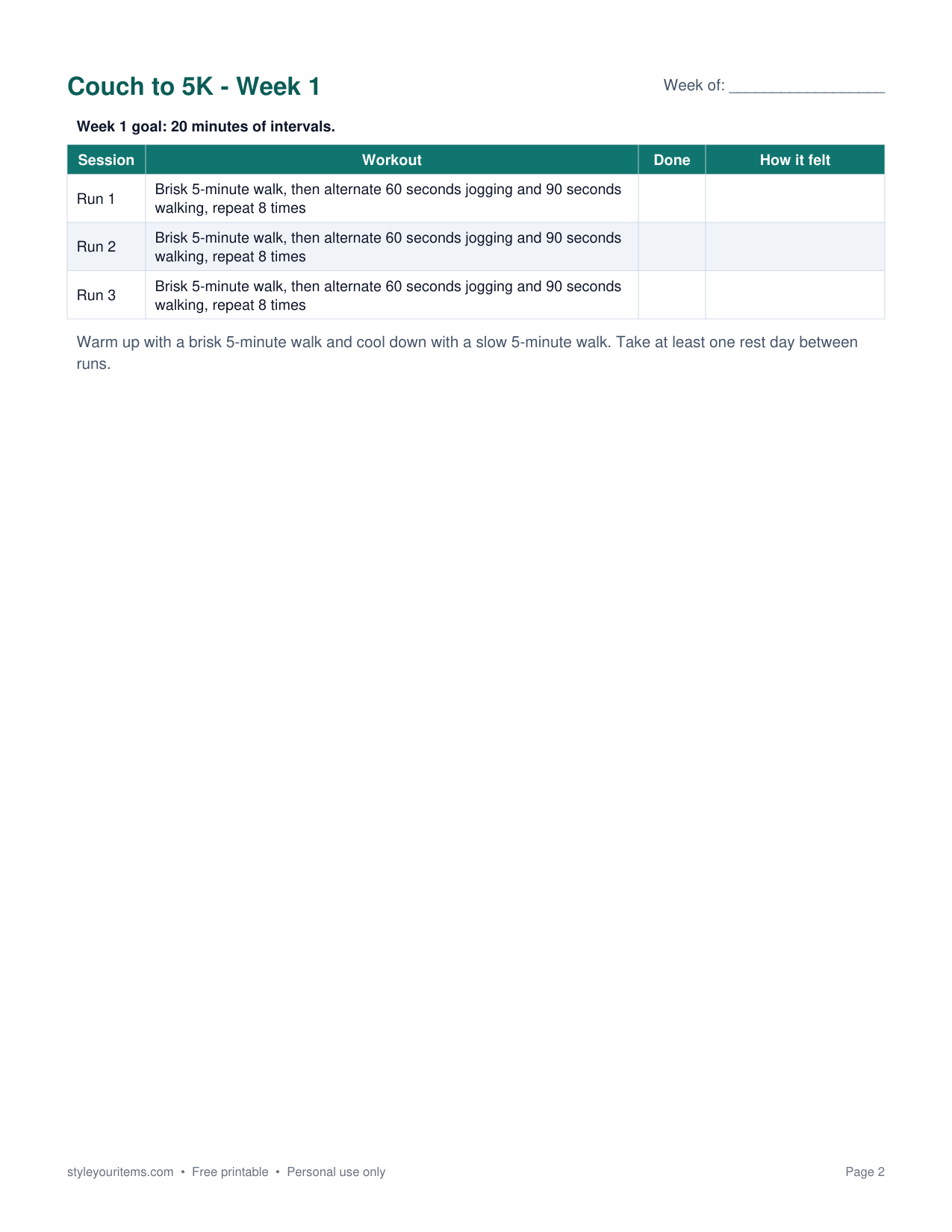
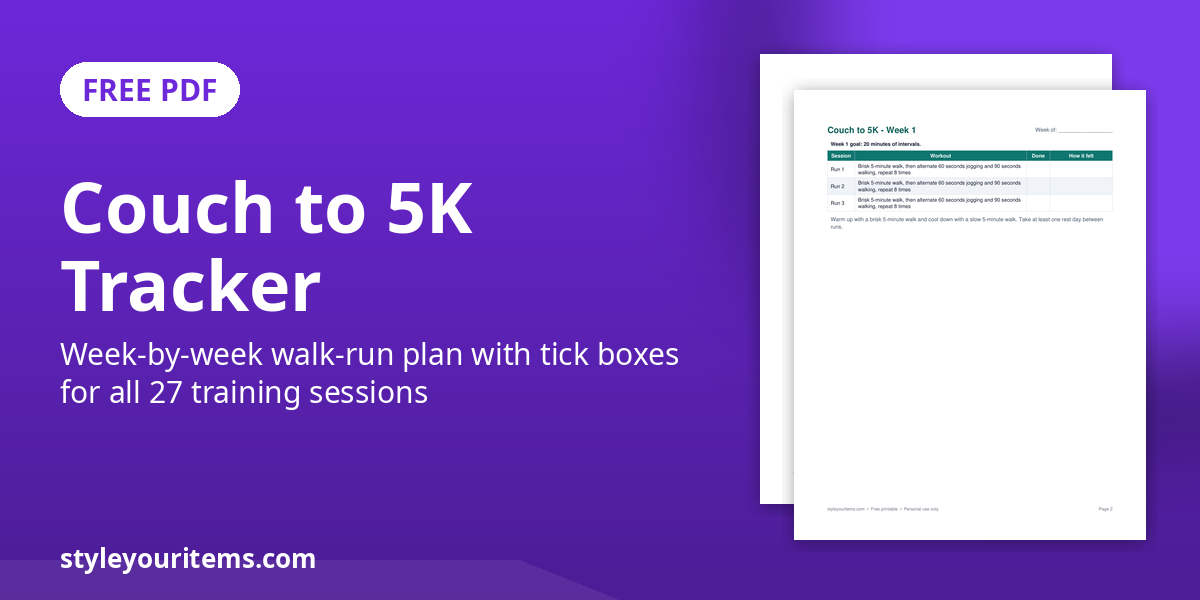
This free printable couch to 5K tracker follows the classic nine-week plan, three runs a week, with a tick box for every one of the twenty-seven sessions. Each week has its own page, so you print the set once and work through it in order. The workout for each run is written on the page, with a box to tick when it is done and a line to note how it felt. There is a rest day between every run, because rest is when your legs actually get stronger, and a goal page at the end for the race or run you are aiming at.
The nine weeks at a glance
Every week has three identical runs, so you only need to learn one workout per week. Read the week, run it three times, move on. If a week feels too hard, repeat it. Repeating a week is not failing the plan, it is how the plan is meant to be used.
| Week | Each run | The goal |
|---|---|---|
| Week 1 | Alternate 60 seconds jogging and 90 seconds walking, 8 times | Your first jog |
| Week 2 | Alternate 90 seconds jogging and 2 minutes walking, 6 times | Longer jogs, shorter walks |
| Week 3 | 90 seconds jog, 90 seconds walk, 3 minutes jog, 3 minutes walk, repeat twice | Your first 3-minute jog |
| Week 4 | 3-minute jog, 90-second walk, 5-minute jog, 2.5-minute walk, 3-minute jog, 90-second walk, 5-minute jog | Your first 5-minute jog |
| Week 5 | Run 1: 5-minute jogs with 3-minute walks. Run 2: 8-minute jogs with 5-minute walks. Run 3: 20 minutes jogging, no walking | Your first 20-minute run |
| Week 6 | Run 1: 5, 8 and 5-minute jogs with walks between. Run 2: two 10-minute jogs. Run 3: 25 minutes jogging | Your first 25-minute run |
| Week 7 | 25 minutes jogging, no walking, three times | Three 25-minute runs |
| Week 8 | 28 minutes jogging, no walking, three times | Three 28-minute runs |
| Week 9 | 30 minutes jogging, no walking, three times | 30 minutes non-stop: 5K ready |
How to run your first week
- Pick three days with a rest day between them. Monday, Wednesday and Friday is the classic pattern, but any three days work. Put them on the calendar now, before the week starts, and treat them like appointments.
- Warm up with a brisk five-minute walk. Every run in the plan starts this way. It is not wasted time: it tells your legs what is coming and it is the difference between a comfortable first jog and a stitch in your side. The workout log is a good companion sheet if you also want to record walks, gym sessions or other training alongside this plan.
- Jog slowly enough to talk. The jogging parts are not a race. If you cannot say a full sentence out loud, you are going too fast. Slow down until you can, even if the jog feels barely faster than the walk. Speed comes later; finishing the intervals comes first.
- Use a timer, not your feelings. Sixty seconds feels long when you are jogging and short when you are walking. A phone timer or a free interval app keeps you honest. Start the timer, follow it, and stop thinking about the clock.
- Cool down with a slow five-minute walk. Do not stop dead at the end of the last interval. Walk until your breathing is back to normal, then tick the run off on the tracker and write two words about how it felt. “Tired but fine” is a perfect entry.
Five habits that keep beginners running
- Run at the same time of day. Morning works for most people, because the day has not had a chance to get in the way yet. Whatever time you pick, keep it steady for the first three weeks, until the run is part of the day rather than a decision you have to make.
- Repeat a week without guilt. Week five is where most people stall, because the third run jumps to twenty minutes with no walking. If you cannot finish it, run week five again next week. The plan is nine weeks long only if every week works the first time, and for most beginners it does not. The 30-day fitness challenge calendar uses the same idea: a streak you can restart, not a test you can fail.
- Wear shoes that fit, not shoes that cost a lot. You do not need racing shoes. You need shoes that do not pinch, with laces that stay tied. If your knees or shins hurt for more than a day after a run, slow down first, then look at your shoes.
- Write how it felt, every run. The “how it felt” box on each page is the most useful part of the tracker. After a month you can see which weeks felt easy and which felt hard, and you will notice that hard weeks usually follow bad sleep or a skipped rest day, not a lack of fitness. Our sleep tracker pairs well with this plan if your energy feels uneven.
- Keep the tracker where you can see it. On the fridge, by the front door, next to your shoes. A ticked box is a small reward, and three ticks in a week is a visible win. If you recently gave up smoking, this plan is a good next step: your lungs are already improving, and the tracker shows it week by week. Our quit smoking tracker covers the other side of the same change.
You will find this tracker in the Health, Habits and Wellness collection, next to the yoga tracker and the workout log. Print it, pick your three days, and start with sixty seconds. That is all week one asks.
Frequently asked questions
What if I miss a run?
Just do it the next day, and shift the rest of the week by a day. One missed run changes nothing. Two missed weeks means repeating the week you were on, which is also fine. The plan waits for you.
Do I need to be able to run at all to start?
No. Week one asks for sixty seconds of jogging, eight times, with walking in between. If sixty seconds is too much, jog for thirty and walk for two minutes instead, then build up to the full week one over two weeks.
Can I run on a treadmill?
Yes. Set the walking pace to a brisk walk and the jogging pace to whatever lets you talk in full sentences. The intervals and the tick boxes work exactly the same way indoors.
What if I finish week nine and cannot run 5K yet?
Thirty minutes of steady jogging is the goal, and for most people that is close to five kilometres. If your thirty minutes covers less, add five minutes a week until it does. You are already a runner by then: the distance is just arithmetic.