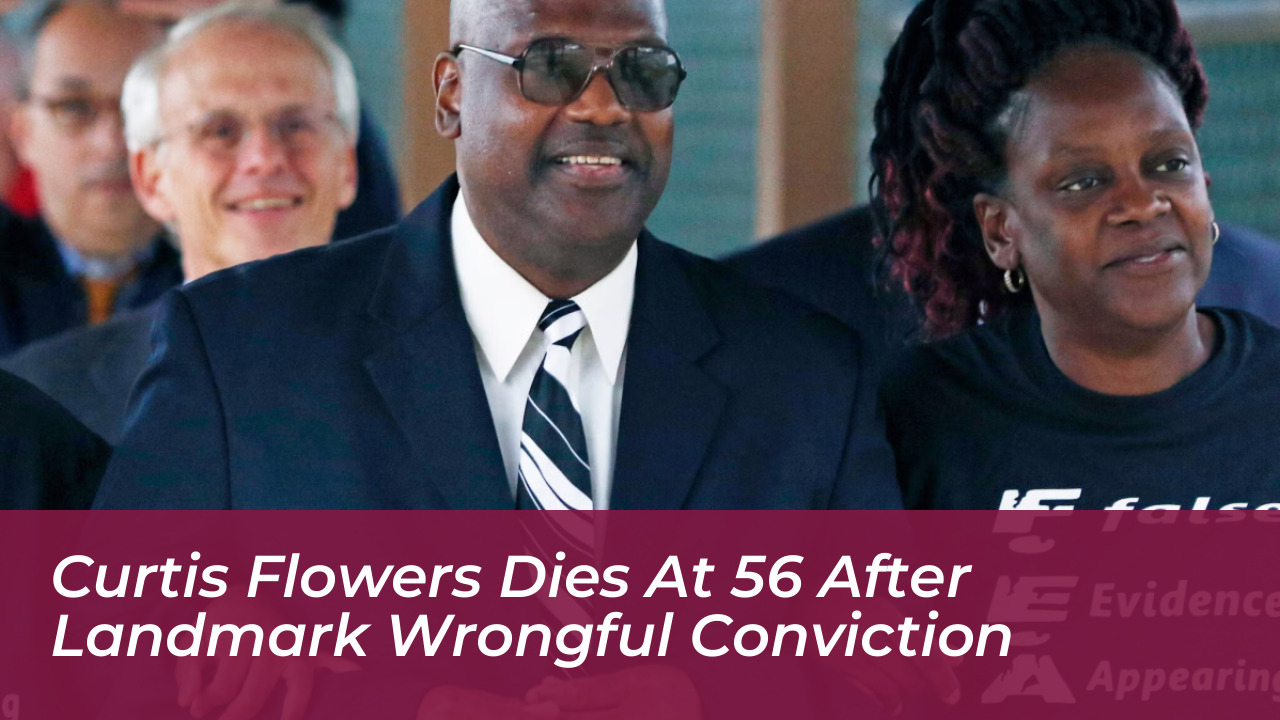


Curtis Flowers, a Mississippi man whose six separate trials for a 1996 quadruple murder became a landmark national case on systemic racial bias in jury selection, died Wednesday at his home in Winona, Mississippi, at the age of 56. His death was confirmed by his family and his attorney, Rob McDuff.
No immediate cause of death was announced. His sister, Priscilla Flowers-Ward, told The New York Times that Flowers had been managing advanced diabetes while the family awaited the results of an autopsy. Montgomery County Coroner Allan Pratt stated that his passing remained under active review.
A Decades-Long Ordeal Rooted in Winona
The legal battle that defined much of Flowers’ life began on the morning of July 16, 1996, at Tardy Furniture in Winona, a town located roughly 92 miles north of Jackson. Four people were shot and killed execution-style inside the store: owner Bertha Tardy, bookkeeper Carmen Rigby, delivery man Robert Golden, and 16-year-old employee Derrick Stewart.
Flowers had briefly worked at the furniture store that summer before being let go after three days. Although local police initially questioned him following the tragedy, he was not arrested at the time and later moved to Texas to live with his sister. Law enforcement arrested him there in January 1997, noting he had no prior criminal record. The murder weapon was never recovered, and investigators found no DNA or fingerprint evidence linking him to the crime scene.
Six Trials and Supreme Court Intervention
Prosecuted entirely by then-Montgomery County District Attorney Doug Evans, Flowers faced an unprecedented sequence of trials. In his first trial, an all-White jury deliberated for just an hour before convicting Flowers, then 27, and sentencing him to death. The Mississippi Supreme Court overturned that verdict, kicking off a cycle of repeated trials, overturned convictions, and mistrials.
Investigators and journalists-notably through American Public Media’s investigative podcast In the Dark-later exposed a stark pattern of racial discrimination. Data revealed that across the six trials, prosecutor Evans struck 41 of 42 Black prospective jurors. Out of 72 total jurors empaneled across the proceedings, 61 were White, and all 61 voted to convict.
In June 2019, the U.S. Supreme Court voted 7-2 to overturn Flowers’ sixth conviction. Justice Brett Kavanaugh wrote in the majority opinion that the state demonstrated a “relentless, determined effort to rid the jury of Black individuals.”
Exoneration and Later Years
Following the Supreme Court ruling, Flowers was released on bail in December 2019 after spending more than 22 years behind bars, much of it on death row. When Evans withdrew from the case in early 2020, the Mississippi Attorney General’s Office took over. In September 2020, Circuit Judge Joey Loper officially dismissed all capital murder charges with prejudice after the state noted a lack of living, credible prosecution witnesses without conflicting statements, alongside exculpatory evidence pointing toward other suspects.
A Montgomery County court subsequently awarded Flowers $500,000 for wrongful imprisonment in March 2021. Flowers later filed civil lawsuits against officials involved in his prosecution, though federal courts ultimately dismissed the federal claims.
Flowers is survived by his wife, Marlena Wright, daughter Crystal, granddaughter Ariel, four sisters, one brother, and an extended family. His parents, Archie Lee Flowers and Lola Flowers, preceded him in death.
Frequently Asked Questions About Curtis Flowers
Who was Curtis Flowers?
Curtis Flowers was a Mississippi man who spent over 22 years in prison after being wrongfully convicted of a 1996 quadruple murder at Tardy Furniture in Winona, Mississippi. His case gained national prominence due to being tried six times by the same prosecutor.
Why was Curtis Flowers’ conviction overturned?
The U.S. Supreme Court overturned his final conviction in 2019, ruling 7-2 that the prosecution had systematically and unconstitutionally excluded Black prospective jurors from serving on the juries based on their race.
How many times was Curtis Flowers tried for the same crime?
Flowers was tried six times for the same murders by District Attorney Doug Evans. The proceedings resulted in four convictions that were later overturned on appeal, and two mistrials due to hung juries.
When was Curtis Flowers released from prison?
Flowers was released on bail in December 2019 after spending nearly 23 years incarcerated. All criminal charges against him were officially dismissed by the state in September 2020.
Did Curtis Flowers receive compensation for his wrongful imprisonment?
Yes. A Mississippi court ordered the state to pay Flowers $500,000 in wrongful-imprisonment compensation in March 2021.