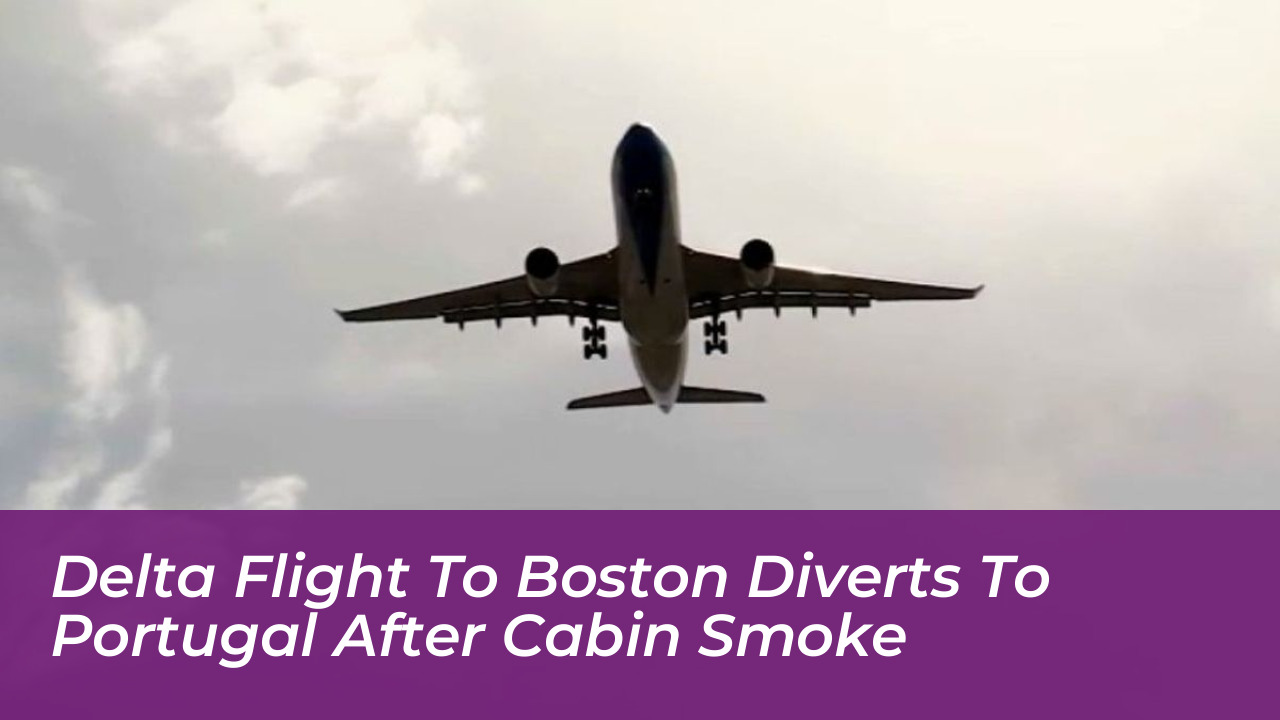
A Boston-bound Delta Air Lines flight carrying 296 people was forced to make an emergency landing in Porto, Portugal, after smoke filled the cabin about two and a half hours into a transatlantic journey from Barcelona on Sunday, September 27, 2026.
- Emergency Squawk and Safe Landing in Porto
- Medical Response and Hospitalizations
- Aircraft and Operational Impact
- Frequently Asked Questions
- What caused the smoke on Delta Flight DL251?
- How many people were injured or hospitalized?
- Why did the flight divert to Porto instead of continuing to Boston?
- Are passengers entitled to compensation under EU regulations?
- What happened to the passengers after the emergency landing?
Flight DL251, operated using an Airbus A330-300, departed Barcelona-El Prat Airport around 3:15 p.m. local time with 283 passengers and 13 crew members on board. While flying over northern Spain and heading toward the Atlantic Ocean at a cruise altitude of approximately 32,000 feet, the flight crew reported a mechanical issue and detected smoke inside the cabin.
Emergency Squawk and Safe Landing in Porto
As the situation developed, the flight crew broadcast the emergency transponder code “Squawk 7700” to international air traffic control. Choosing to divert before reaching deep oceanic airspace where diversion options diminish rapidly, the aircraft turned back and landed safely on Runway 35 at Francisco Sá Carneiro Airport in Porto shortly before 6:00 p.m. local time.
Local civil protection authorities initiated a Level 2 emergency response, deploying roughly 60 emergency personnel and 22 emergency vehicles to meet the wide-body aircraft directly on the tarmac.
Medical Response and Hospitalizations
Emergency medical services immediately evaluated passengers and crew upon arrival. Reports from local authorities and news agencies varied slightly regarding total treatment numbers:
- Up to 14 people received medical assistance at the scene, primarily for smoke inhalation.
- Twelve individuals required oxygen support either in flight or immediately upon landing.
- Eight passengers were treated directly on the tarmac by paramedics.
- Four individuals-comprising three passengers and one crew member-were transported to a local facility, São João Hospital, for further evaluation of mild respiratory symptoms.
Hospital spokespersons confirmed that the hospitalized patients were admitted to the emergency department, received treatment for minor smoke inhalation, and remained in stable condition.
Aircraft and Operational Impact
The aircraft involved in the incident was an 11-year-old Airbus A330-300 registered under tail number N824NW, which entered service with Delta in June 2015. While Portuguese emergency services confirmed that no active fire broke out onboard, the exact source of the cabin smoke remains unconfirmed pending technical inspections.
Delta Air Lines attributed the diversion to a reported mechanical issue. The unexpected grounding stranded nearly 300 passengers at Francisco Sá Carneiro Airport without checked baggage or immediate onward connections, forcing subsequent schedule adjustments and the cancellation of related return segments while the airline worked to rebook travelers onto alternative flights.
Frequently Asked Questions
What caused the smoke on Delta Flight DL251?
The precise technical source of the smoke has not been officially confirmed. Delta Air Lines cited a mechanical issue, while Portuguese emergency responders and civil protection authorities confirmed smoke was present in the cabin. No onboard fire was reported.
How many people were injured or hospitalized?
Up to 14 people received medical attention. While eight individuals were treated directly on the airport tarmac, four people (three passengers and one crew member) were transported to São João Hospital with mild respiratory symptoms and later reported to be in stable condition.
Why did the flight divert to Porto instead of continuing to Boston?
Cabin smoke represents an urgent in-flight event where flight crews cannot immediately determine the root cause or severity from the flight deck. Standard aviation safety protocol mandates landing at the nearest suitable airport rather than continuing over open ocean, making Porto’s coastal location an optimal diversion point.
Are passengers entitled to compensation under EU regulations?
Because Flight DL251 departed from Barcelona, an EU airport, passenger rights under EU261 apply. While extraordinary circumstances may limit direct financial compensation for the delay, airlines maintain an unconditional duty of care to cover meals, refreshments, and hotel accommodations.
What happened to the passengers after the emergency landing?
Passengers were disembarked at Porto Airport while emergency teams cleared the aircraft. Delta coordinated alternative travel arrangements and replacement flights to help customers complete their journeys to Boston, though travelers experienced significant delays and separate baggage handling adjustments.