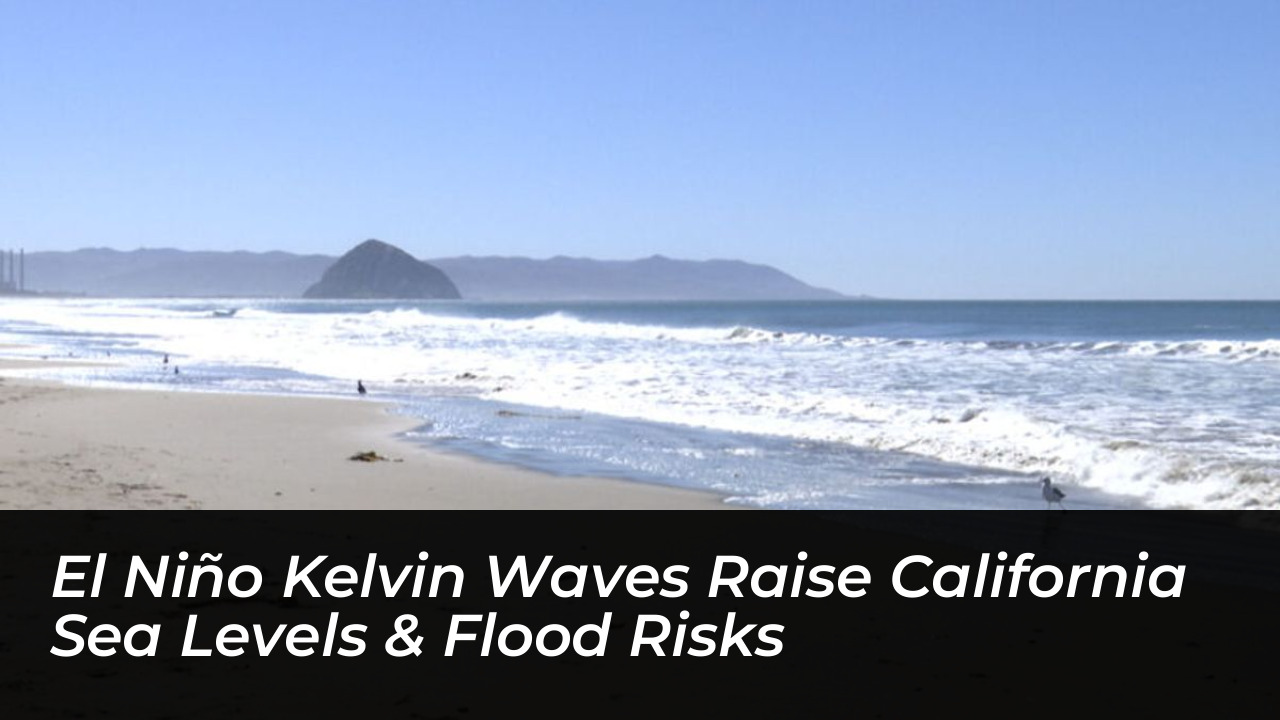

California’s coastline is experiencing unusually high water levels as a powerful El Niño drives an underwater Kelvin wave northward along the Pacific coast. The large-scale oceanic disturbance reached San Francisco Bay and the Central Coast in October 2026, contributing to record-breaking October water levels, localized coastal flooding, and heightened concerns about severe erosion when upcoming winter storms coincide with seasonal high tides.
National Weather Service observations showed that San Francisco’s water levels peaked on October 10 and 11, reaching approximately 1.73 feet above predicted levels. This significantly surpassed the previous October record of approximately 1.4 feet above normal. Along the San Luis Obispo County North Coast, measured water levels similarly exceeded predictions by more than a foot, according to regional reporting.
What Is a Kelvin Wave and How Does El Niño Create It?
A Kelvin wave is a slow-moving, planetary-scale ocean disturbance that travels thousands of miles across the Pacific basin. Unlike ordinary wind-driven waves that crash against the shore, a coastal Kelvin wave alters ocean temperature, pressure, and sea-surface height while following paths shaped by the Earth’s rotation.
During an El Niño event, weakened trade winds allow warm water that is normally piled up in the western Pacific to shift eastward. Oceanic Kelvin waves carry this warm subsurface water toward Central and South America. When these disturbances reach the Americas, their energy turns north and south along the coast as coastally trapped waves traveling at roughly 6 mph, temporarily elevating the ocean’s baseline.
Contributing Factors Behind Elevated Sea Levels
Scientists attribute the elevated water levels to several overlapping factors combining along the Pacific rim:
- Coastally Trapped Kelvin Waves: Broad pulses of warm subsurface water traveling northward from the equator.
- Thermal Expansion: Unusually warm ocean water taking up more physical volume.
- Marine Heat Waves: Persistent regional warmth amplifying baseline water heights.
- Climate Change: Long-term sea level rise providing a higher foundational platform for temporary anomalies.
- Distant Storm Residuals: Lingering effects from remote oceanic weather systems and swells.
While the San Francisco anomaly began easing as storm-driven swells temporarily subsided, forecasters warn that additional Kelvin wave pulses could prolong elevated coastal conditions deep into the winter and spring seasons.
Increased Risks of Coastal Flooding and Beach Erosion
The primary danger of an elevated ocean baseline is the compounding effect it creates during extreme weather. When a higher baseline combines with king tides, storm surges, and large Pacific swells, incoming waves have less distance to travel before reaching beaches, coastal roadways, and residential infrastructure.
State coastal officials note that higher water levels increase vulnerability across several fronts:
- High-Tide Flooding: King tides scheduled for late 2026 and early 2027 can push water into low-lying areas that normally remain dry.
- Accelerated Beach Erosion: Waves reaching farther up the profile can strip sand away from narrow beaches much faster.
- Bluff Retreat: Sustained wave action at a higher water level attacks coastal cliffs, increasing localized landslide and sinkhole risks.
- Infrastructure Exposure: Roads, rail lines, and seawalls face greater risk of overtopping and structural damage.
State Preparedness and Emergency Response
In response to the strengthening 2026-2027 El Niño outlook, California declared a state of emergency to accelerate readiness. State and local agencies are actively staging flood-fighting supplies, road-closure equipment, and monitoring tools to address multiple expected hazards, including heavy rainfall, river flooding, and powerful coastal storms.
Residents living along the shoreline are advised to monitor local tide gauges, heed weather advisories, and prepare for potential disruptions as the combination of El Niño-driven Kelvin waves and winter storm activity unfolds.