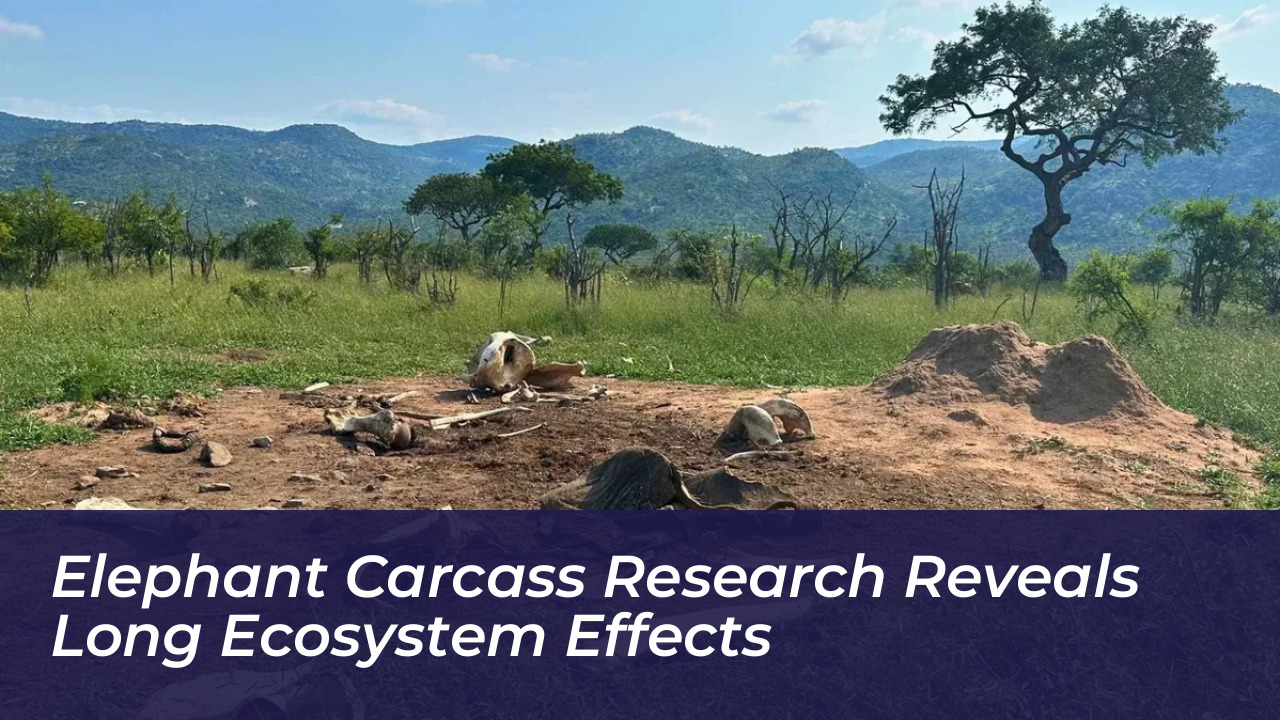

Research conducted in South Africa’s Kruger National Park reveals that elephant carcasses continue to shape and alter savannah ecosystems for years after death. Published in the Proceedings of the National Academy of Sciences, the study investigates how terrestrial megacarcasses create massive, long-lasting nutrient pulses that profoundly influence soil chemistry, microbial communities, plant growth, and grazing animal behavior.
The research project originated from a roadside observation in 2009. Dave Thompson, a researcher with the South African Environmental Observation Network, routinely passed the body of a large, lone elephant named Alexander while traveling for an unrelated assignment. Watching the steady decomposition of the massive animal sparked a curiosity that ultimately grew into a comprehensive, multi-institutional scientific investigation.
Ecosystem Engineers in Life and Death
While alive, African savanna elephants, which can weigh up to 6,000 kilograms, are widely recognized as powerful ecosystem engineers. They alter vegetation by felling trees, disperse seeds across vast distances, fertilize the soil through waste, and modify landscapes in ways that allow other species to thrive.
However, scientists previously knew very little about the scale of their ecological influence once they die. An adult elephant contains hundreds of kilograms of carbon, nitrogen, and phosphorus. When the animal perishes, this immense concentration of matter is deposited into a remarkably small area of land.
“When a megafauna animal dies, its body becomes an enormous pulse of nutrients deposited into the surrounding ecosystem,” researchers noted, comparing the phenomenon to marine “whale falls,” where decomposing whale carcasses support deep-sea life for decades on the ocean floor.
From Nitrogen Spikes to Phosphorus Hotspots
The study tracked elephant remains of various ages across Kruger National Park, capturing the shifting environmental stages of decomposition:
- Initial Phase: Plant life directly beneath and surrounding fresh carcasses was temporarily eliminated. Nitrogen concentrations in the soil spiked to levels up to 3,000 times higher than normal.
- Microbial Shifts: Soil-dwelling bacterial diversity decreased, but the activity of surviving, fast-growth microbes skyrocketed as they consumed the sudden abundance of resources.
- Flora Evolution: Once the extreme soil chemistry mellowed, plant diversity remained selective, favoring a handful of fast-growing, highly nutritious grass species.
- Long-Term Persistence: The ecological alterations and concentrated soil nutrients remained detectable for at least eight years after the animal’s death.
Deron Burkepile of the University of California, Santa Barbara, described the transformation of the local flora vividly, noting that the carcass legacy turns local grasses “from watery iceberg lettuce into a juicy romaine.”
Attracting Grazers and Herbivores
The flush of high-quality forage did not go unnoticed by local wildlife. Herbivores repeatedly returned to feed on the nutrient-rich grasses growing over the decomposition sites. As these animals grazed and deposited manure, they contributed even more organic matter back into the soil, reinforcing the localized fertility loop.
Izak Smit of South African National Parks emphasized the broader implications of the findings. The research demonstrates how strongly historical legacies influence current natural landscapes, even long after the direct causes have vanished from view.
A Natural Laboratory in Kruger National Park
Spanning approximately 20,000 square kilometers, Kruger National Park offered an ideal natural laboratory for the study. The park features pronounced environmental gradients, including rainfall that decreases from roughly 700 mm annually in the south to 375 mm in the north, alongside shifting geological foundations from sandy granite soils in the west to clay-rich basalt soils in the east.
By analyzing more than 400 georeferenced elephant carcasses documented through annual field observations by park staff, the research team determined how ecological legacies vary across different environmental settings.
Frequently Asked Questions
What inspired the study on elephant carcass ecological legacies?
The research was inspired in 2009 by a lone elephant named Alexander that died beside a road in Kruger National Park. Researcher Dave Thompson observed the decomposition process during his daily commutes, prompting an investigation into how megafauna remains affect terrestrial habitats.
How long do the ecosystem effects of an elephant carcass last?
Data from the study showed that the biochemical and ecological impacts of an elephant carcass persist in the environment for at least eight years.
How do elephant carcasses change the soil?
Fresh carcasses release extreme amounts of nitrogen, reaching levels up to 3,000 times normal concentrations, alongside carbon and phosphorus. Over time, the sites transition from carbon and nitrogen hotspots with high microbial activity into phosphorus-driven zones.
Why do herbivores gather around old elephant carcass sites?
Decomposition leaves behind patches of highly nutritious, fast-growing grasses. Grazing animals frequent these areas to feed on the superior forage, subsequently adding more nutrients through their own manure.
Where was the research published?
The findings of this multi-institutional study were published in the scientific journal Proceedings of the National Academy of Sciences.