
Newly released orbital telemetry and public flight data portals allow space enthusiasts and researchers to track the exact coordinates of NASA’s Europa Clipper as it navigates deep space. Following a flagship interplanetary mission once required direct access to mission control consoles at institutions such as the Jet Propulsion Laboratory (JPL). Today, high-precision trajectory modeling renders deep space tracking accessible through interactive browsers, translating raw radio dish communications directly into intuitive visual telemetry across the inner solar system.
Real-Time Flight Visualisers: How to Plot the Coordinates
Anyone wondering how to track the Europa Clipper location can turn to primary tracking portals developed directly by space agencies. These interactive platforms convert complex mathematical ephemeris data into three-dimensional representations of the solar system:
- NASA Eyes on the Solar System: This web-based 3D engine renders the probe along its calculated flight path. Users can scrub forward or backward in time, toggle distance meters to Earth and Jupiter, and view the spacecraft’s orientation relative to celestial bodies.
- Horizons System (JPL): For high-accuracy orbital vectors, the JPL Horizons system provides raw ephemeris data utilized by professional astronomers and tracking stations across the globe.
- Deep Space Network (DSN) Now: When mission controllers communicate with the probe, this live dashboard displays active radio links across ground stations in Madrid, Goldstone, and Canberra.
Interplanetary trajectory tracking relies on continuous two-way Doppler shift and ranging measurements. This process converts minute frequency deviations into precise velocity and position coordinates. While dynamic graphical tools provide visual gratification, underlying navigation depends strictly on ground-based radio science that monitors every millimeter-per-second shift in velocity.
The Flight Path: The Gravity Assist Route
Direct paths to the outer solar system require prohibitive amounts of fuel. Instead, mission planners utilize gravitational slingshots around inner planets to build the kinetic energy necessary to reach Jupiter’s orbit. Launched on October 14, 2024, aboard a SpaceX Falcon Heavy rocket from Launch Complex 39A at Kennedy Space Center, Europa Clipper embarked on a 1.8-billion-mile (2.9-billion-kilometer) journey scheduled to arrive at Jupiter in April 2030.
A common misconception holds that interplanetary probes fire their main engines continuously during transit. In reality, the spacecraft spends almost the entirety of its journey in unpowered ballistic coasting, where its trajectory is shaped entirely by the gravitational pull of the Sun and planetary flybys. Engine burns occur primarily for minute course adjustments known as Trajectory Correction Maneuvers.
Decoding Live Telemetry Metrics
When monitoring public dashboards, several critical parameters define the spacecraft’s ongoing status. Interpreting these numbers correctly provides context to where the spacecraft sits within its broader transit phase.
| Metric | Operational Meaning |
|---|---|
| Heliocentric Velocity | The speed of the probe relative to the Sun, governing transit timing across planetary orbits. |
| Earth Range | The instantaneous distance between ground antennas and the craft, dictating light-travel communication delay. |
| Round-Trip Light Time | The total minutes required for a radio instruction to reach the probe and confirm back on Earth. |
| Target Relative Speed | Velocity measured against the Jovian system, crucial during final orbital insertion planning. |
Understanding these values transforms raw coordinates into a narrative of gravitational physics. It shows precisely how planetary mechanics propel human instruments toward unexplored oceans.
Ground Antennas and the Deep Space Signal
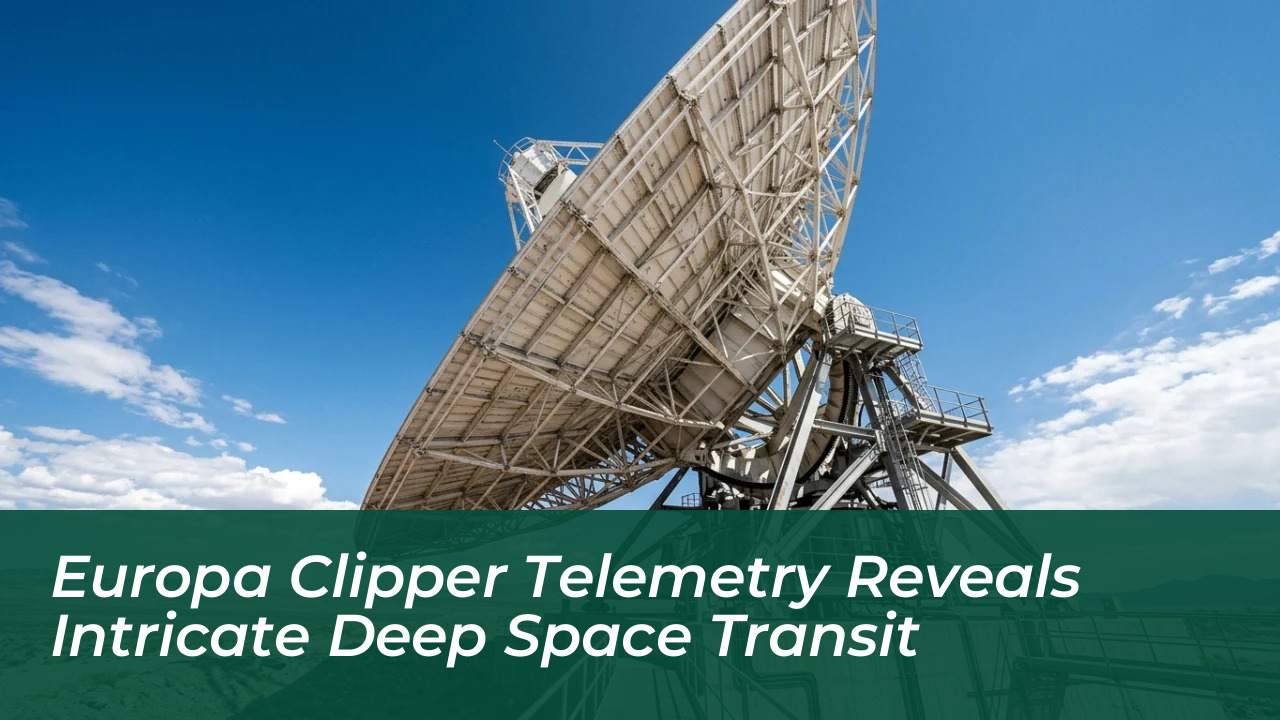
Tracking the physical location of the craft also means understanding how Earth listens to it. Giant parabolic dishes stationed worldwide point at calculated patches of the sky, receiving signals that have weakened over millions of miles. Observers following tracking status updates through professional networks often examine downlink frequencies within the X-band and Ka-band ranges.
Because planet Earth rotates constantly, communication hands over sequentially between ground complexes in California, Spain, and Australia to maintain an unbroken telemetry umbilical. Once the spacecraft reaches the Jovian system in April 2030, it will perform nearly 50 close, low-altitude flybys of Europa. It will utilize its nine science instruments and a specialized gravity experiment to determine if the moon’s subsurface saltwater ocean harbors conditions suitable for life.
Frequently Asked Questions
When did Europa Clipper launch?
Europa Clipper launched on October 14, 2024, at 12:06 p.m. EDT aboard a SpaceX Falcon Heavy rocket from Launch Complex 39A at NASA’s Kennedy Space Center in Florida.
When will Europa Clipper arrive at Jupiter?
The spacecraft is scheduled to reach Jupiter and begin its orbital insertion phase on April 11, 2030, after covering a total distance of approximately 1.8 billion miles (2.9 billion kilometers).
How does the spacecraft gain enough energy to reach Jupiter?
Mission planners utilize gravitational assist maneuvers-or slingshots-past inner planets like Mars and Earth to build the necessary kinetic energy without requiring prohibitive amounts of fuel.
What is the main scientific objective of the mission?
Europa Clipper’s primary goal is to determine whether there are places below the surface of Jupiter’s icy moon, Europa, that could support life by investigating its ice shell, subsurface ocean, composition, and geology.
How can the public track the spacecraft’s real-time position?
Space enthusiasts can monitor the mission using interactive public tools such as NASA Eyes on the Solar System, the JPL Horizons ephemeris system, and the Deep Space Network (DSN) Now dashboard.