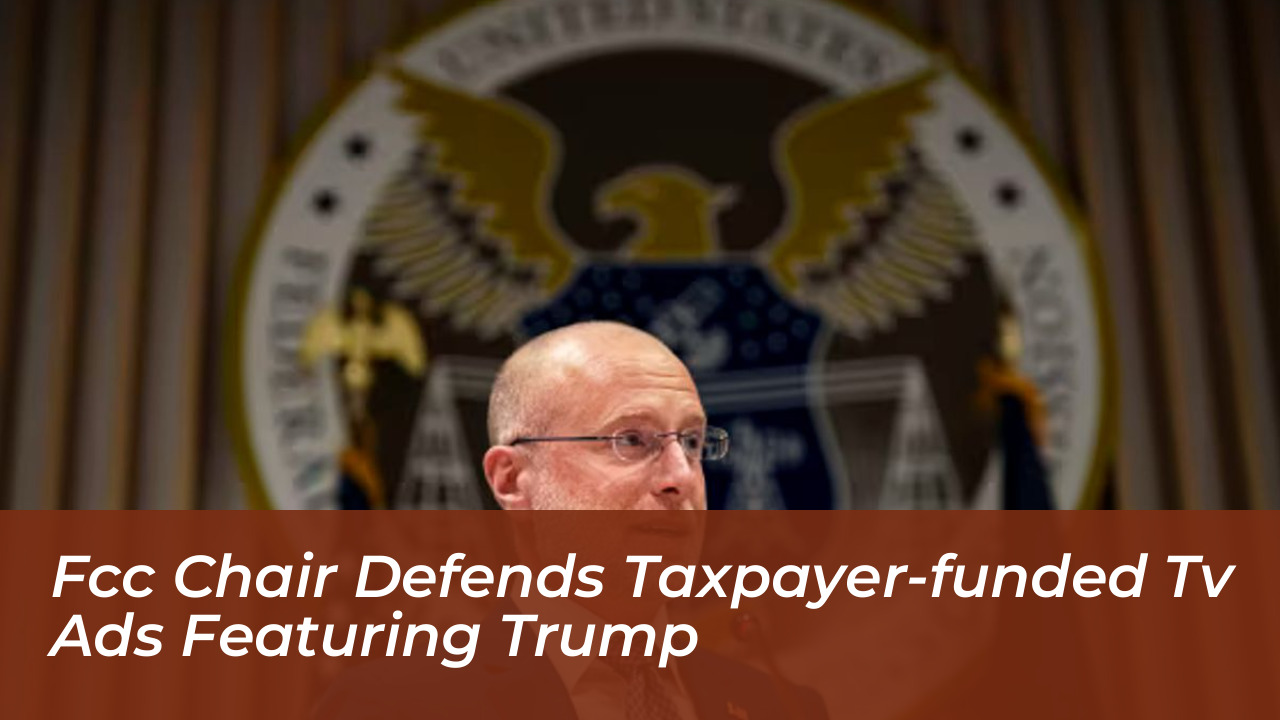
Federal Communications Commission Chair Brendan Carr defended new government-funded television advertisements featuring President Donald Trump. He asserted that the broadcasts are standard public service announcements that do not warrant regulatory oversight. Carr rejected calls for an official review after progressive advocacy group Public Citizen filed a formal complaint. The complaint alleges that the spots violate federal prohibitions against using public funds for partisan propaganda ahead of the upcoming midterm elections.
- Criticism and Allegations of Propaganda
- Brendan Carr Rejects Regulatory Review
- Partisan Divisions Within the FCC
- Frequently Asked Questions
- Who funded the television advertisements featuring Donald Trump?
- What did FCC Chair Brendan Carr say about the ads?
- Why are critics calling the ads illegal?
- Is Donald Trump running for office in the midterm elections?
- How has the White House defended the broadcast spots?
The controversy surrounds a series of nationally broadcast spots that celebrate what the administration terms a “golden age of America.” According to reports by outlets including The Wall Street Journal and Axios, the White House transferred millions of dollars in funds from the Department of Homeland Security-specifically U.S. Customs and Border Protection-to finance the campaign. The ads have aired dozens of times on major broadcast and cable networks, including Fox News, Newsmax, and CBS during high-profile programming like college and NFL football games.
Criticism and Allegations of Propaganda
Ethics experts, watchdog groups, and lawmakers from both political parties have criticized the commercials. Critics point out that one of the advertisements closely resembles a commercial utilized during Donald Trump’s 2024 presidential campaign. The primary modification is a closing disclaimer stating it was paid for by the U.S. government.
Another spot features Trump declaring that “America will never be a communist country” while a chorus repeats the words “love me.” A third commercial combines imagery of Mount Rushmore with audio of the president praising the country. Public Citizen argued in its complaint to the FCC and the Federal Trade Commission that the spots are designed to boost the personal image and character of Donald Trump using public money.
“Federal law explicitly prohibits using appropriated public funds for government propaganda, self-aggrandizement, or partisan political advertising. Yet, that is exactly the nature of Trump’s recent campaign ads,” Public Citizen wrote in its filing.
Democratic lawmakers have echoed these concerns. Representative Jamie Raskin suggested that government employees involved in producing or funding the spots could have violated the Hatch Act, a 1939 statute that bars federal employees from engaging in political activities. Even some Republicans voiced discomfort. Senator John Kennedy of Louisiana noted publicly that officials cannot spend public money to promote themselves.
Brendan Carr Rejects Regulatory Review
Despite the backlash, FCC Chair Brendan Carr maintained that the agency has no grounds to intervene. Appointed as head of the commission by Trump, Carr told reporters that the commercials fall within normal governmental practices.
“There’s nothing in there that strikes me to merit any sort of FCC review or any liability for any broadcaster for running a regular, normal public service announcement,” Carr said. He compared the spots to routine informational campaigns run by previous administrations.
The White House defended the campaign by publishing an online defense. It compared the current ads to historical public service announcements dating back to the Woodrow Wilson and Franklin D. Roosevelt administrations during world wars. It also cited outreach campaigns by George W. Bush, Barack Obama, and Joe Biden. The administration’s statement emphasized that Trump is not currently on a ballot and that the spots contain no explicit call to action, thereby disqualifying them as traditional campaign ads.
Partisan Divisions Within the FCC
The debate has highlighted sharp divisions within the FCC itself. Anna Gomez, the sole Democratic commissioner at the agency, distanced herself from Carr’s dismissal while noting that the commission is unlikely to launch an independent investigation.
“As a regular citizen, not as an FCC commissioner, I can see why people are thinking that these ads are political ads,” Gomez told reporters. She added that Congress-which retains ultimate authority over federal appropriations-is best positioned to examine the expenditure of taxpayer dollars.
Gomez also cautioned that the controversy underscores the dangers of expanding the FCC’s regulatory mandate. She pointed to recent agency probes into major television networks over news coverage and debate moderation as a troubling precedent for future administrations.
Frequently Asked Questions
Who funded the television advertisements featuring Donald Trump?
Reports indicate the ads were funded using roughly $20 million transferred from Department of Homeland Security funds, specifically involving U.S. Customs and Border Protection.
What did FCC Chair Brendan Carr say about the ads?
Brendan Carr defended the broadcasts as standard public service announcements and stated they do not raise red flags or warrant any regulatory review by the FCC.
Why are critics calling the ads illegal?
Advocacy groups like Public Citizen argue that the spots violate federal laws prohibiting the use of taxpayer funds for government propaganda, self-aggrandizement, or partisan political activity. They note that one ad mirrors a 2024 campaign spot.
Is Donald Trump running for office in the midterm elections?
No, Donald Trump is not on the ballot for the upcoming midterm elections, though critics argue the ads are designed to influence public opinion and boost the Republican Party’s political standing.
How has the White House defended the broadcast spots?
The White House released a statement comparing the spots to historical public service announcements from past presidential administrations. It asserted that the ads simply remind Americans to love their country and have no explicit call to action.