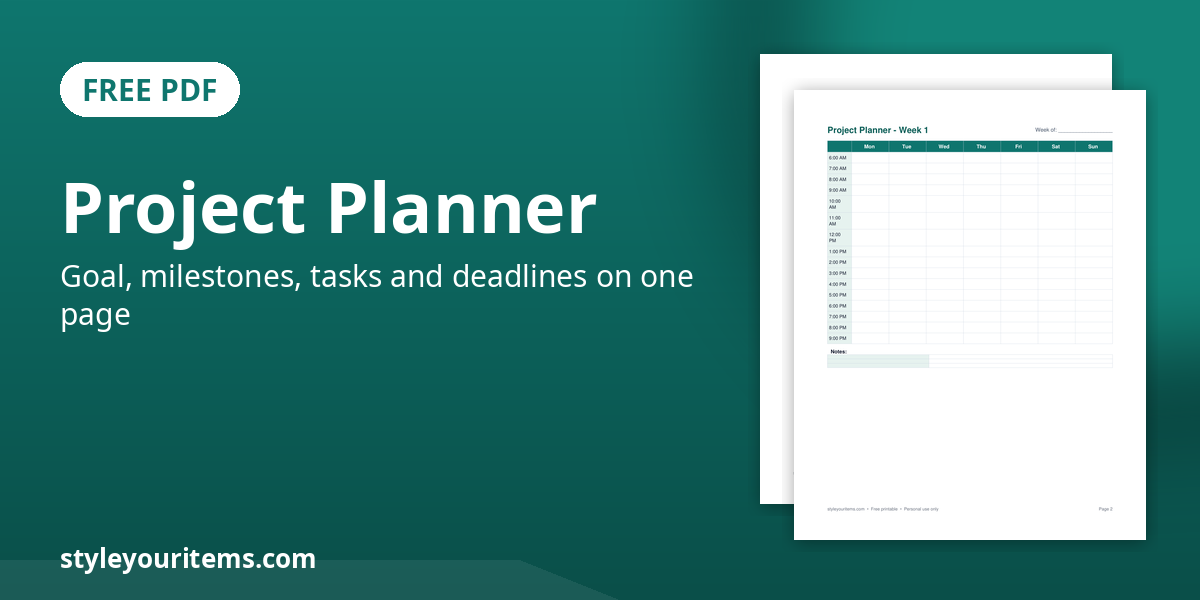
Most projects fail in the same quiet way: not with a big mistake, but with a slow drift. The goal was clear on day one, then the weeks blurred together, and by week three nobody could say what was supposed to be finished and what was still waiting. This free printable project planner PDF is built to stop that drift. It gives a project four weekly spreads, one for each week of a month, so the work stays visible week by week instead of disappearing into a single to-do list.
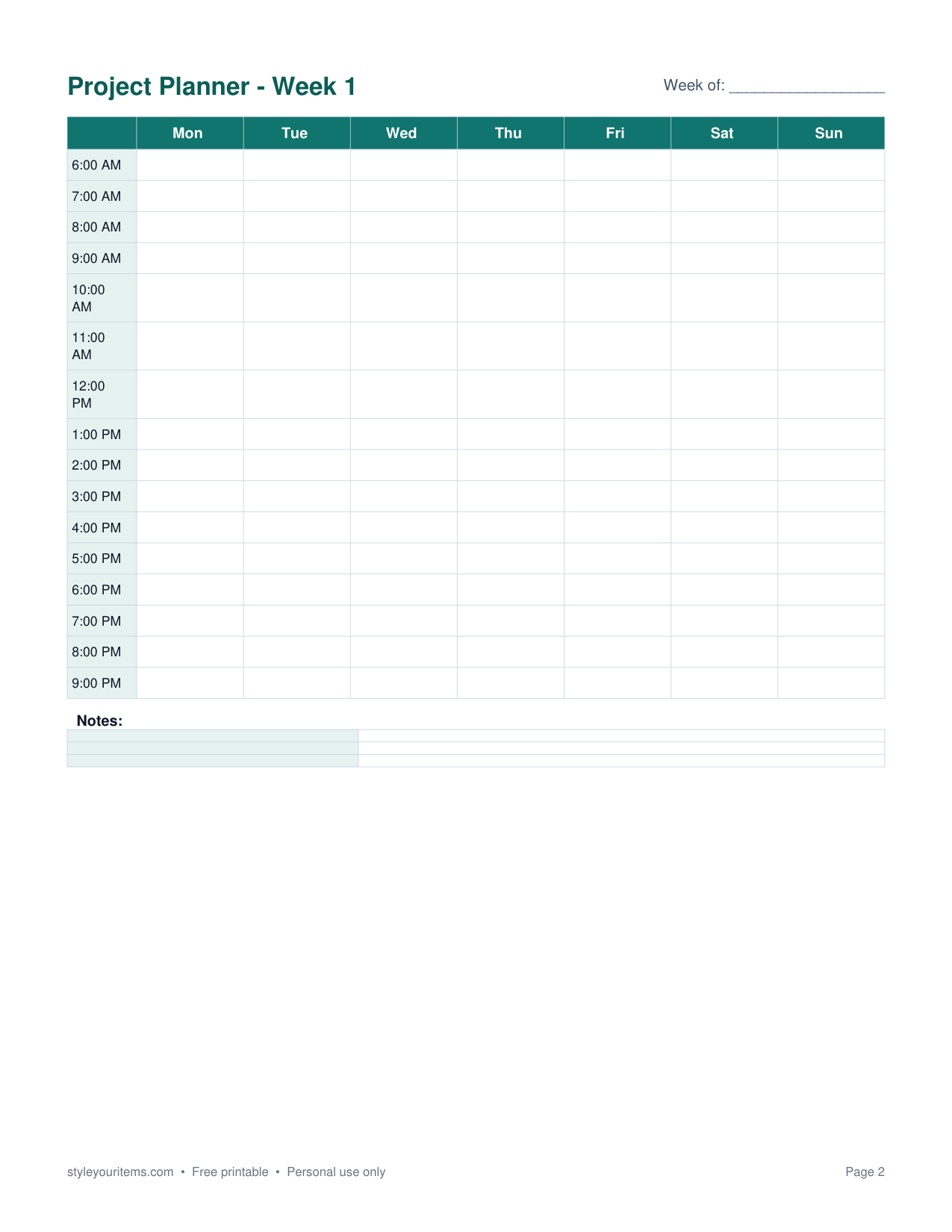
The PDF has five pages: a cover page, then four weekly spreads (Week 1 to Week 4), each running Monday to Sunday with hourly lines from 6am to 10pm and a “Week of” line at the top. It is a simple structure, and that is the point: a project plan that needs a manual will not be used, but a plan with four dated weeks will.
A Four-Week Project, Week by Week
Four weeks is the right length for most real projects: a school project, a work launch, a room renovation, a small event. Here is how the four spreads carry a project from start to finish.
| Week | Focus | What to write on the spread |
|---|---|---|
| Week 1 | Plan and gather | The goal at the top of the week, the materials or information needed, and the first small tasks. Nothing big is due yet. |
| Week 2 | Build the main part | The biggest block of work, scheduled in the mornings when energy is highest. Note any help you need from other people. |
| Week 3 | Finish and check | The remaining tasks, plus time to review what is done so far. This is the week where problems surface, so leave slack in it. |
| Week 4 | Deliver and tidy up | The deadline itself, the final checks, and the hand-over. Write the delivery date on the “Week of” line so it cannot be missed. |
Because each spread has hourly lines, the project fits around real life instead of pretending real life stops. A school project shares the week with classes, a home project shares it with work, and both stay visible on the same page.
Running the Project in Five Steps
A project planner only works if it is used every week, not just filled in once. This is the rhythm that keeps it alive.
- Write the goal and the deadline before anything else. One sentence for the goal, one date for the deadline, on the cover or on the first spread. Every task after that has to serve one of those two things.
- Break the goal into four weekly milestones. One milestone per week, written on the “Week of” line of each spread. A milestone is a finished thing, not an activity: “first draft done”, not “work on draft”.
- List the week’s tasks under the milestone. Three to five tasks per week is enough. More than that, and the week is already over-promised.
- Review every Sunday night. Ten minutes: what got done, what moved, and what next week actually needs. Cross out what is finished and move what is not, in pencil.
- Keep the deadline visible. Write it on every spread, not just the last one. A deadline that is only written once is a deadline that gets forgotten.
What to Write, and Where
The spreads are blank grids, so they take whatever you give them. These four uses keep the pages tidy instead of crowded.
- Milestones go on the “Week of” line. The top of each spread is the only place the whole week can be seen at once, so the milestone lives there.
- Tasks go on the hourly lines. A task gets a time, or it gets forgotten. Even a rough time, like “Tuesday morning”, is enough.
- Waiting-on items get a mark of their own. If a task depends on someone else, put a small star beside it. At the Sunday review, the stars are the first thing to check.
- Done means crossed out, not erased. A crossed-out task is proof of progress. A project that looks finished is a project that keeps going.
For the daily detail behind the weekly plan, the free printable to-do list PDF holds the day’s tasks with three must-do boxes at the top. When the project has a deadline that matters for the whole month, the free printable monthly goals planner PDF keeps the goal visible above the calendar. And if the project involves meetings, the free printable meeting agenda template PDF keeps decisions and actions in one place.
Questions People Ask
Is there a dedicated milestones box on the pages?
No. The pages are weekly spreads with hourly lines, so milestones go on the “Week of” line at the top of each spread, where the whole week is visible. That is the honest layout of this PDF.
What if my project is longer than four weeks?
Print the file again for the next month, and carry the unfinished milestone forward as the first milestone of the new month. The planner is undated, so months chain together cleanly.
Can I use it for a school project?
Yes. School projects are exactly the right size for four weekly spreads, and the Sunday review habit works well for students who leave things to the last week.
Does it print on A4 as well as Letter?
Yes. The PDF is designed for both US Letter and A4 paper, at 100% (Actual size).
Is the PDF really free?
Yes. The PDF is completely free, with no sign-up, no email address, and no account needed.
Details
- Format: free PDF download
- Paper size: US Letter and A4
- Pages: 5 – 1 cover page + 4 weekly spreads (Week 1 to Week 4, Monday to Sunday, hourly lines 6am to 10pm)
- Undated: use it for any project in any month, and print it again for the next one
- Cost: free – no sign-up, no email, and no account needed
- Print as many copies as you like, for personal use
More Free Printables
Looking for more free printables? Browse the full Planners & Calendars collection, or try these popular downloads: