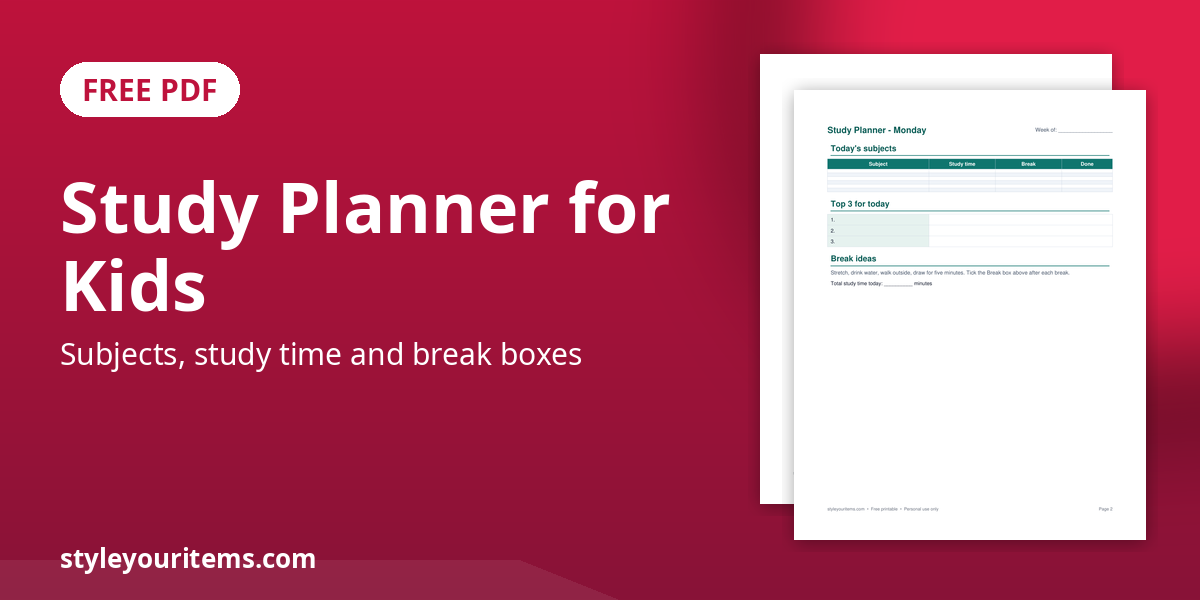
Homework goes wrong in two ways: either nobody knows what needs doing, or everybody knows and nobody can agree when to do it. This free printable study planner for kids fixes both problems on one page per school day. Each page has space for the subjects, the study time, a break, and a tick box when it is done, so your child can see the whole evening at a glance and you can stop asking what is left.
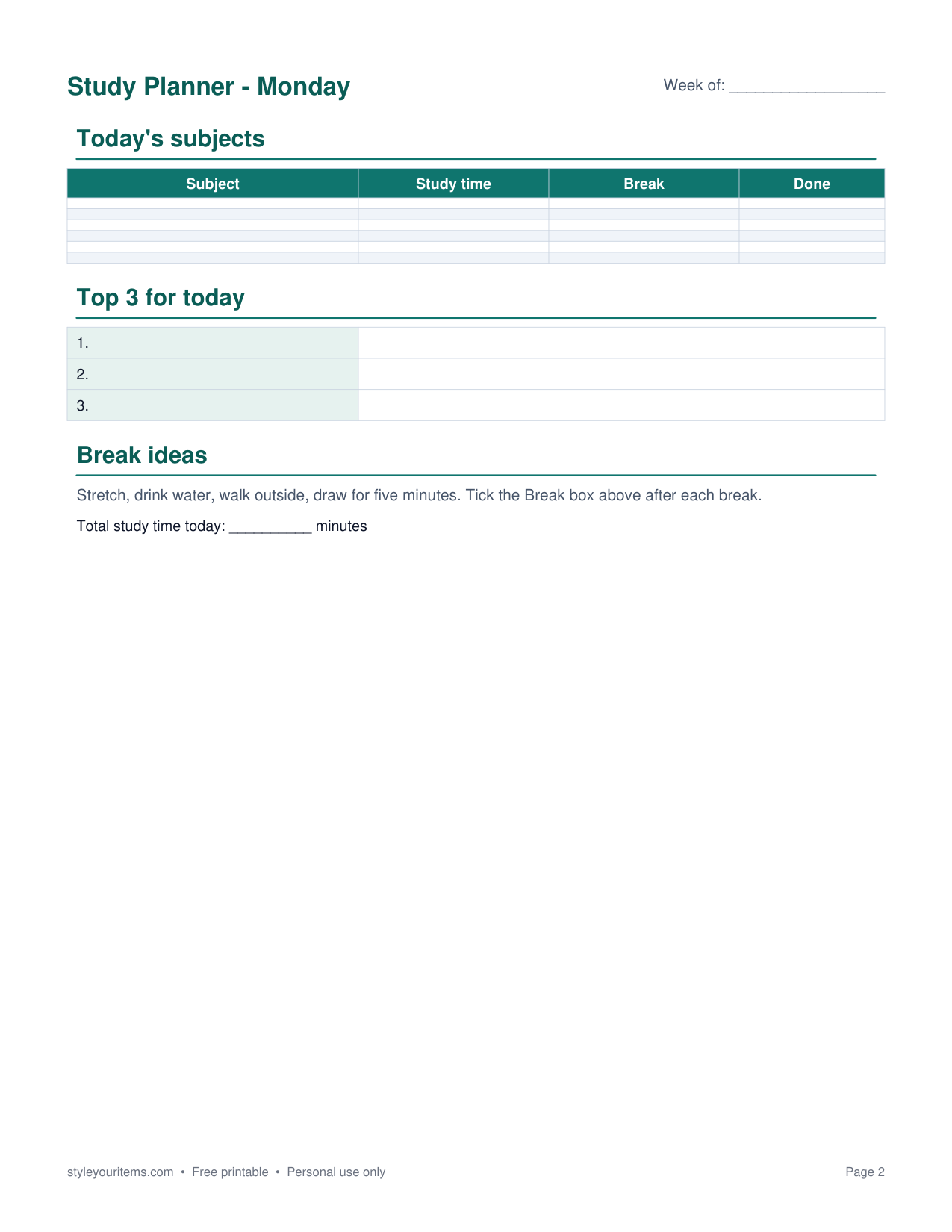
The planner covers Monday to Friday, one page per day, with the same layout every day so a child can use it without help after the first week. There is a top-3 list for the most important jobs, break ideas for when focus runs out, and a line at the bottom for the total study time. Print five pages for the week, or print the whole set and keep spares in a folder. If your child also needs somewhere to record finished homework, our free printable homework planner tracks subjects and due dates, while this planner plans the time itself.
What is on every day page
All five day pages look the same, so your child learns the layout once and uses it all week. The table below explains each part of the page.
| Part of the page | What it does |
|---|---|
| Today’s subjects | Six rows with columns for subject, study time, break and a done tick. One row per subject, so a busy evening still fits. |
| Top 3 for today | Three numbered lines for the most important jobs. If only three things get done, these are the three. |
| Break ideas | Stretch, drink water, walk outside, draw for five minutes. The ideas are printed on the page, so a stuck child can pick one without asking. |
| Total study time | A line at the bottom to add up the day. Seeing the total helps a child feel proud of a long day and honest about a short one. |
The week runs Monday to Friday only. There is no Saturday or Sunday page, because weekends are for rest, family and the reading that does not feel like homework. Our free printable reading log is a gentle weekend job: title, author and a star rating per book, with no time pressure at all.
A filled-in Monday
Here is what a Monday page looks like when it is filled in. This child is nine, comes home at half past three, and has about an hour and a half of homework before dinner.
| Subject | Study time | Break | Done |
|---|---|---|---|
| Maths worksheet | 30 minutes | Yes, 5 minutes | Yes |
| English reading | 20 minutes | Yes, 5 minutes | Yes |
| Science project | 25 minutes | No | Yes |
| Spelling list | 10 minutes | No | Yes |
| Total study time | 85 minutes |
Notice the breaks. Two short five-minute breaks sit between the longer jobs, and the two short jobs at the end run without a break. That pattern works well for most children: work for twenty to thirty minutes, break for five, then work again. The break column is a promise, not a reward. A child who knows a break is coming can concentrate for longer. If the total keeps creeping past ninety minutes, the load is too heavy, and the planner makes that easy to see and easy to raise with the teacher.
How to set up the week in ten minutes
- Print five pages on Sunday evening. One for each school day. Write the week dates at the top of each page so Monday never gets mixed up with Tuesday.
- Ask your child what is due this week. Copy the subjects and due dates from the school bag or the homework diary onto the right days. The free printable weekly to-do list is useful here too, since it shows the whole week of tasks at once.
- Pick the top 3 for each day together. Three jobs, no more. If everything is a top priority, nothing is, and the list loses its point.
- Agree the study time before the week starts. Twenty minutes for a younger child, up to an hour for an older one, with breaks built in. Write the times in the study time column so there is no argument later.
- Stick the page where homework happens. On the fridge, on the bedroom wall, or on the table itself. A plan nobody can see is a plan nobody follows.
Keeping homework calm
- Same time, same place, every day. Routine removes the daily negotiation about when homework starts. The planner just records the routine, it does not create it.
- Let your child tick the done box. The tick is the reward. Children who tick their own boxes finish more jobs than children whose parents tick for them.
- Stop at the agreed time. If the time is up and a job is unfinished, write it in tomorrow’s top 3. Working late every night teaches a child that homework never ends.
- Count the total, not the mistakes. Praise the 85 minutes worked, not the two wrong answers. The planner measures effort, and effort is what you want more of.
- Track the streak, not the day. A month of ticks is more motivating than a single good day. Our free printable monthly habit tracker turns daily study into a visible streak your child will want to protect.
Questions about the study planner
What age is it for?
Children from about seven to twelve use it best, because they can read the headings and write their own subjects. Younger children can use it with a parent filling in the subjects for them.
Does it work for home school?
Yes. Home school days are longer, so use one page per day and treat the six subject rows as six lessons. The break column matters even more at home, where there is no school bell.
Can I print it every week?
Yes, the planner is undated, so the same five pages work every week of the school year. You can browse the whole Kids, School &
Learning collection for more school printables.
When the evening does not go to plan
Homework rarely follows the plan on the page. A club runs late, a worksheet takes twice as long as expected, or a child comes home tired and the first subject feels impossible. The planner still helps on those evenings, because the six subject rows make the change visible instead of leaving it as a feeling that the whole evening failed.
Start by looking at the top 3. Those three lines are the promise for the day, and everything else is extra. If only one of the three gets done, the day still counts, and the other two move to tomorrow without a fresh argument. That one rule stops a late evening turning into a late night, and it keeps the planner from becoming a list of jobs that were never going to fit.
The table below covers the four evenings that come up most often. Each row gives the same treatment: change the page, move the job, and keep the total honest.
| What happened | What to write on the page | What moves |
|---|---|---|
| Ran out of time | Cross out the unfinished row and write its subject in tomorrow’s top 3 | The subject, not the whole evening |
| One subject took too long | Write the real time in the study time column and shorten the next row | A break, or the last subject |
| Too tired to start | Pick the shortest top 3 job first, then take a break from the printed ideas | The harder job, to tomorrow |
| A subject was forgotten | Add it in the last empty row, even if the time is short | Nothing, the total still counts |
Write the total even on a short evening. A total of 20 minutes is still 20 minutes of work, and a child who sees that number is more likely to try again tomorrow than a child who sees a blank line. The total line at the bottom of the page is for effort, not for a perfect day.
A Friday look back that takes five minutes
Friday is the only day when the whole week is on the table at once. Five pages, five totals, and five sets of top 3 lines tell a clearer story than any single evening, and the look back works best when it is short, calm, and done together.
- Add up the five totals and write the week total on the Friday page. The number itself matters less than the fact that it was counted.
- Ask which subject kept appearing in the top 3. That subject may need a regular slot next week, or a shorter daily job instead of one long session.
- Ask which break idea actually helped. Stretch, water, a short walk outside, and drawing are printed on the page for a reason, and the one that worked is worth keeping.
- Put the five pages in a folder and start Monday with a fresh set. A new week should not begin with last week’s unfinished rows staring back at a child.
That Friday check also tells you when the agreed study time needs to change. If every total is far below the agreed time, the time was too long. If every total is far above it, the child may be ready for a little more, with the same breaks in place. Either way, change the time on Sunday, not in the middle of a tired evening.