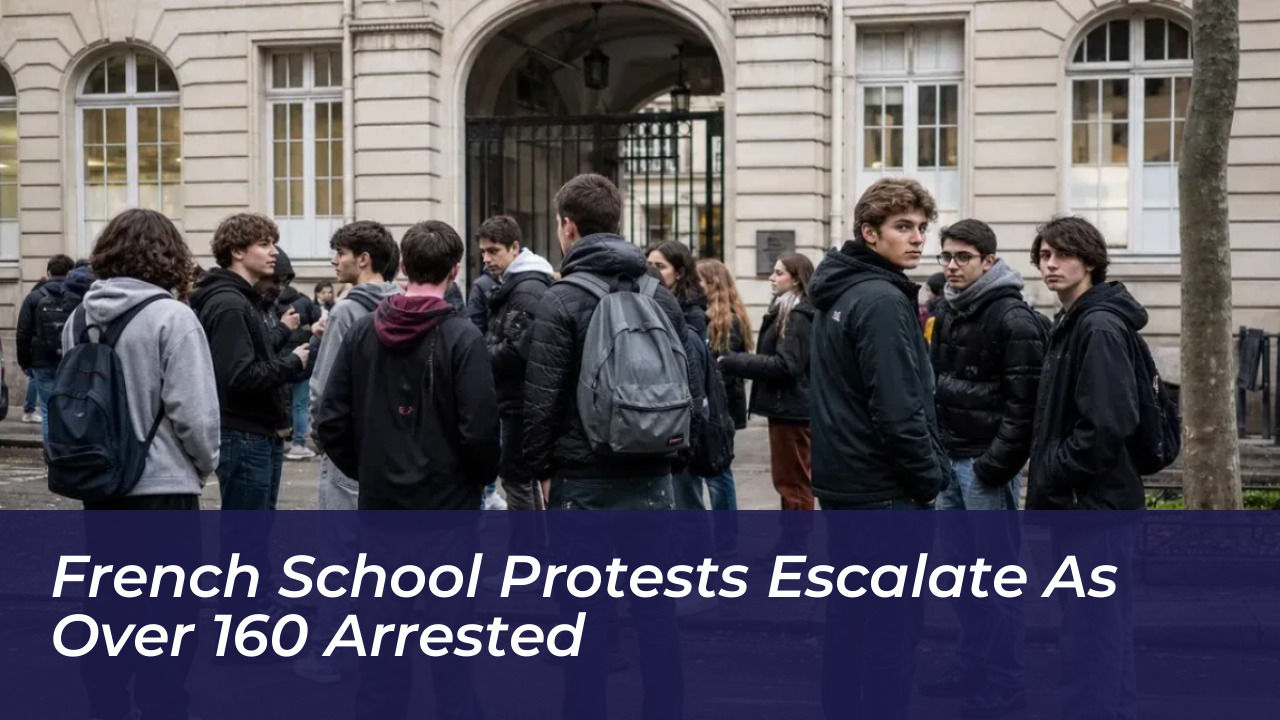
Tensions escalated across France on Monday, September 28, 2026, as law enforcement arrested at least 164 people during widespread high school blockades and protests. Demonstrators took to the streets to protest deteriorating educational conditions and budget cuts, setting the stage for a planned nationwide public sector strike.
The demonstrations originally began last week in the Île-de-France region surrounding Paris. By Monday, the unrest had affected roughly 180 schools and spread rapidly to major urban centers, including Marseille, Lille, Grenoble, Lyon, and regions near the southern border such as Alpes-Maritimes and Var.
Core Grievances Driving the Student Movement
High school students attending institutions known as lycées are demanding urgent systemic reforms and increased funding. According to student unions like the Union Syndicale Lycéenne, the demonstrations are a direct reaction to years of underinvestment and policy shortcomings.
Key grievances cited by student organizers include:
- Severe teacher shortages and a lack of support staff
- Overcrowded classrooms and stressful, packed schedules
- Dilapidated school facilities and poor maintenance
- High cafeteria prices and a general lack of campus resources
- Academic pressure and stress stemming from the Parcoursup higher education application platform
Government Response and Accusations of Urban Violence
French Interior Minister Laurent Nuñez reported that Monday’s demonstrations resulted in injuries to 12 security force members, eight school staff members-including three principals-and roughly a dozen students. Authorities noted that pupils blockaded 27 schools entirely and attempted to blockade around 50 others.
Nuñez condemned the shift in the nature of the gatherings, stating that what began as traditional activism quickly degenerated into urban violence.
“It wasn’t about making demands; it was really violence in its purest form. It is much more like urban violence, with a number of individuals who were masked, equipped with fireworks in tubes, equipped with projectiles, who clearly wanted to confront the internal security forces,” Nuñez said.
Prime Minister Sébastien Lecornu echoed these concerns, warning that any further escalation would be entirely irresponsible. In a post on X, Lecornu emphasized: “Fireworks, fires, violence near high schools: nothing justifies endangering students, staff, or police officers.”
At the same time, the prime minister acknowledged that legitimate underlying difficulties within high schools must be heard and addressed. However, he insisted that violence must be unequivocally condemned and perpetrators held accountable.
Political Clash Over Alleged Instrumentalization
The escalation of student protests has triggered a sharp political confrontation in France, arriving just seven months ahead of a crucial presidential election.
Prime Minister Lecornu accused the far-left party La France Insoumise of actively urging students to expand the movement for political gain. Education Minister Edouard Geffray similarly claimed that a classic student movement was being hijacked by radical political elements.
In response, LFI leader Jean-Luc Mélenchon strongly defended the youth, blaming the government for ordering a heavy-handed crackdown. Mélenchon claimed the protesting teenagers were harmless and described government measures as having “obvious racist undertones”-a remark that Lecornu condemned as an insulting attempt to racialize a debate on security and student welfare.
Meanwhile, local councils run by left-wing politicians, such as in the Parisian suburb of Saint-Denis, defended the youth as fully capable of organizing and fighting for their own futures.
Outlook Ahead of Nationwide Strikes
The student movement shows no immediate sign of abating. The Union Syndicale Lycéenne has called on students to continue blockades in defense of their rights and against budget austerity.
Tuesday’s demonstrations are projected to merge with a broader, nationwide strike involving teachers, hospital workers, and civil servants walking out over stagnant wages, inflation, and poor working conditions. French primary school teacher unions have already indicated that roughly 40% of their workforce is expected to participate in the walkouts.