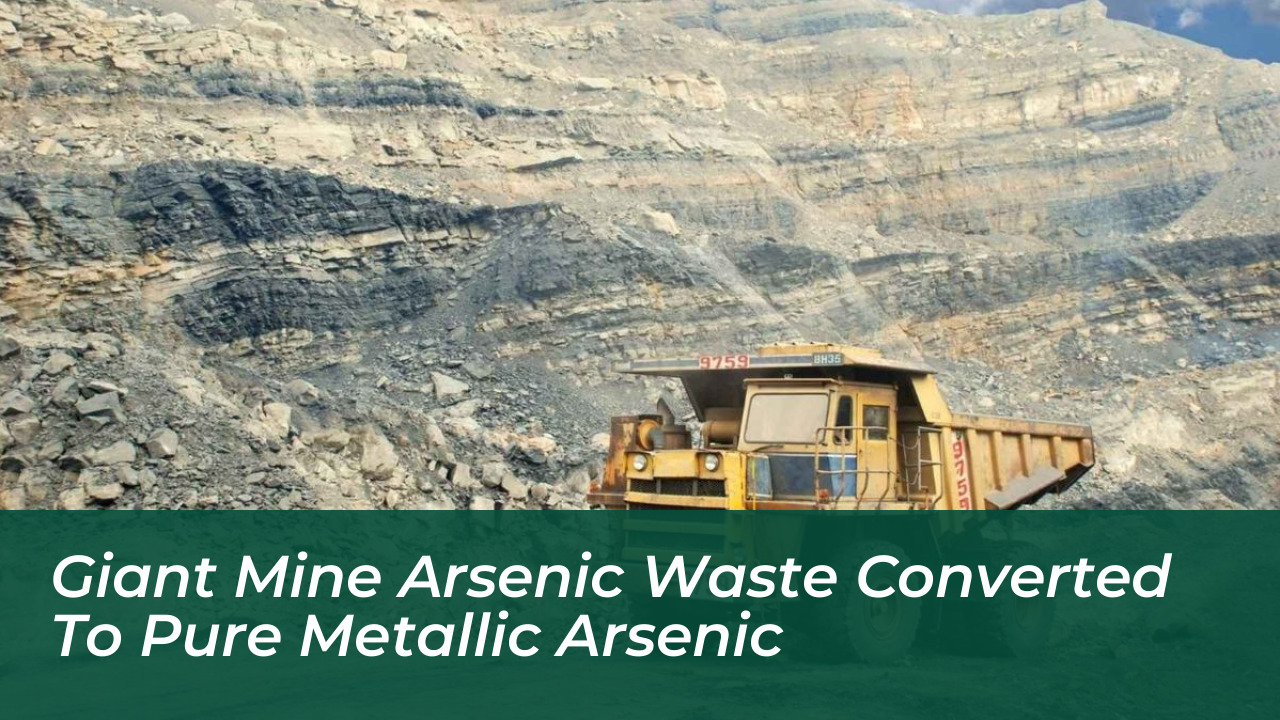
Researchers have successfully converted toxic arsenic waste stored beneath a closed northern mine into metallic arsenic with a purity exceeding 99 percent. The breakthrough could transform a massive environmental liability into a valuable resource for advanced technology manufacturing, including semiconductors, solar panels, and electronic appliances.
The work focuses on the legacy waste at Giant Mine, a former gold mining operation located on the edge of Yellowknife in Canada’s Northwest Territories. Between 1948 and 2004, the mine produced 7.6 million ounces of gold. Because the gold was trapped inside arsenopyrite ore, processing required high-temperature roasting. This step released toxic arsenic gas, which was captured as arsenic trioxide dust and deposited into chambers up to 250 feet below ground. Today, an estimated 237,000 to 261,000 tonnes of the hazardous dust remain stored underground, kept frozen in place to prevent environmental contamination.
How the Chemical Conversion Process Works
A joint research team involving the University of British Columbia (UBC), the Geological Survey of Denmark and Greenland, and the Canadian Light Source (CLS) synchrotron facility in Saskatoon developed the refining technique. The chemical process is relatively straightforward in a laboratory setting:
- Dissolution: The arsenic trioxide waste is dissolved in water.
- Separation: A chemical reductant is introduced to isolate the pure metallic element from the chemical compound.
- Precipitation: The result is high-purity metallic arsenic, forming small grey stones that can be processed for industrial supply chains.
Analysis conducted at the Canadian Light Source synchrotron confirmed that the recovered metal achieves over 99 percent purity. However, tests also revealed that the material possesses an unusual atomic structure compared to commercially produced metallic arsenic. Further testing is underway to determine how this unique structure impacts its performance as a semiconductor material in microchips and solar cells.
Economic and Environmental Prospects
Managing the Giant Mine site is one of the most expensive environmental projects in Canadian history, with long-term site remediation costs estimated at roughly C$4.4 billion. Converting the dust into a commercial material could alter the economic outlook for long-term monitoring.
| Factor | Standard Frozen Storage | Metallic Conversion Route |
|---|---|---|
| Long-term Risk | Requires perpetual monitoring and freezing | Permanently removes hazardous dust from site |
| Market Opportunity | None (pure liability) | Supplies semiconductors and solar tech |
| Mineral Recovery | No additional recovery | Residual gold in waste remains insoluble and can be extracted |
| Implementation Time | Active ongoing operations | Estimated 10 years to full operational plant |
Tamara Etmannski, an environmental engineer at UBC, noted that while bringing the dust to the surface involves strict safety protocols, handling the chemical process itself presents risks similar to managing concentrated household bleach. “You’re never going to get away from the fact that arsenic is a carcinogen,” Etmannski acknowledged, emphasizing that full-scale worker safety and environmental protection controls would be paramount.
Broader Research and Alternative Solutions
The Giant Mine Oversight Board (GMOB), an independent body tasked with finding a permanent resolution for the site, is exploring multiple avenues alongside the metallic conversion initiative. Graeme Clinton, chair of GMOB, expressed optimism about finding permanent solutions that would eliminate the need for taxpayers to monitor the underground chambers indefinitely.
In addition to metallic arsenic recovery, GMOB is currently funding several parallel research streams:
- Vitrification: Heating the arsenic dust to turn it into stable glass blocks, with field testing scheduled under harsh northern winter conditions to check for long-term leaching.
- Sulfidation: Using naturally occurring wetland bacteria to produce sulfides, converting the dust into stable arsenic sulfide minerals.
- Robotic Extraction: Researching automated and remote-controlled mining machinery to safely retrieve the underground dust without exposing human workers to hazardous conditions.
Researchers caution that scaling up from laboratory prove-of-concept to a full industrial facility will take time. If funded, building a commercial processing facility near Yellowknife could take up to a decade. Additionally, because world demand for metallic arsenic is limited, selling the metal might not completely cover the upfront construction costs of a processing plant. However, experts emphasize that permanently eliminating the site’s environmental hazards offers substantial economic savings over the lifetime of the cleanup program.