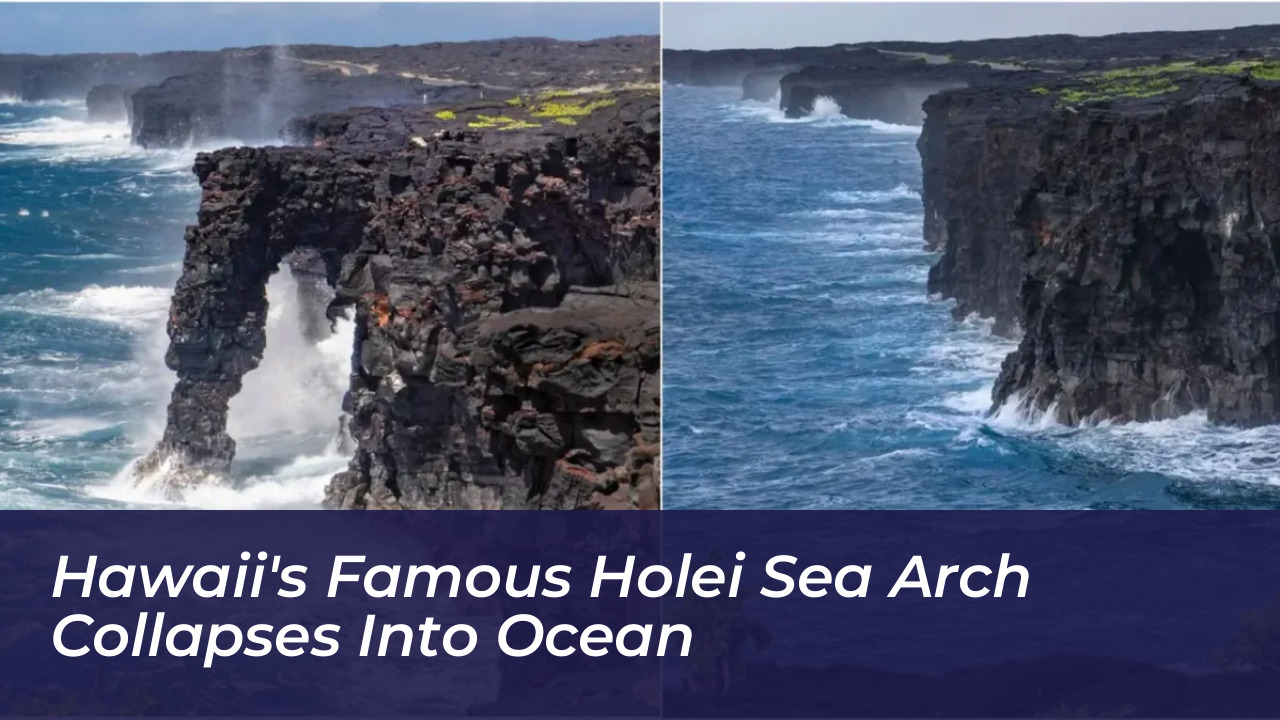
Hawaii’s famous 90-foot Hōlei Sea Arch, located within Hawaii Volcanoes National Park on the Big Island, has collapsed into the Pacific Ocean. Park officials confirmed the loss after reopening the park, which had been temporarily closed due to severe weather conditions brought by Tropical Storm Nolo.
Due to high traffic on this story, please verify you are not a bot to instantly unlock the remaining content. Takes only 5 seconds!
Verify & Continue ReadingPark management reported that the natural rock formation gave way sometime between September 23 and September 27. Standing roughly 90 feet above the ocean waves, the iconic arch was carved over centuries from ancient lava flows and continuous ocean erosion. Experts estimated its age at approximately 550 years.
Geological Factors Behind the Collapse
While the sudden disappearance of the landmark surprised many visitors, geologists and park experts had anticipated the collapse for years. A series of major geological and meteorological events over the past decade severely compromised the structural integrity of the surrounding coastal cliffs.
- 2018 Kīlauea Eruption: Significant earthquakes during the 2018 eruption weakened the foundational rock structures along the coastline.
- 2020 Structural Cracks: New and expanding cracks identified in the arch’s support structures signaled accelerated erosion.
- Recent Severe Storms: Heavy surf and high winds from Pacific weather systems, including Tropical Storm Darby and Hurricane Nolo, dealt the final blow to the weakened basalt formation.
History and Significance of the Hōlei Sea Arch
The Hōlei Sea Arch was one of the most photographed geological features along Chain of Craters Road, a popular scenic drive within Hawaii Volcanoes National Park. Thousands of tourists visited the site annually to witness the raw power of ocean waves crashing beneath the natural stone bridge.
Sea arches form through a natural process called differential erosion. Ocean waves relentlessly pound against coastal headlands, exploiting weaknesses and fractures in hardened basalt lava. Over hundreds of years, the water cuts entirely through the rock to form a sea cave, which eventually breaks through to create an arch. Gravity and ongoing erosion then cause the top of the arch to collapse, leaving behind isolated sea stacks.
Impact on Hawaii Volcanoes National Park Visitors
Park rangers noted that while the loss of the Hōlei Sea Arch marks the end of a beloved landmark, it serves as a powerful reminder of the active, ever-changing nature of the Hawaiian landscape. Hawaii Volcanoes National Park remains open to visitors, though officials continue to monitor coastal areas for safety hazards following recent storm activity and ongoing seismic shifts.
Visitors traveling along Chain of Craters Road can still view the coastline where the arch once stood, observing the dynamic forces of nature that continually reshape the island’s shores.