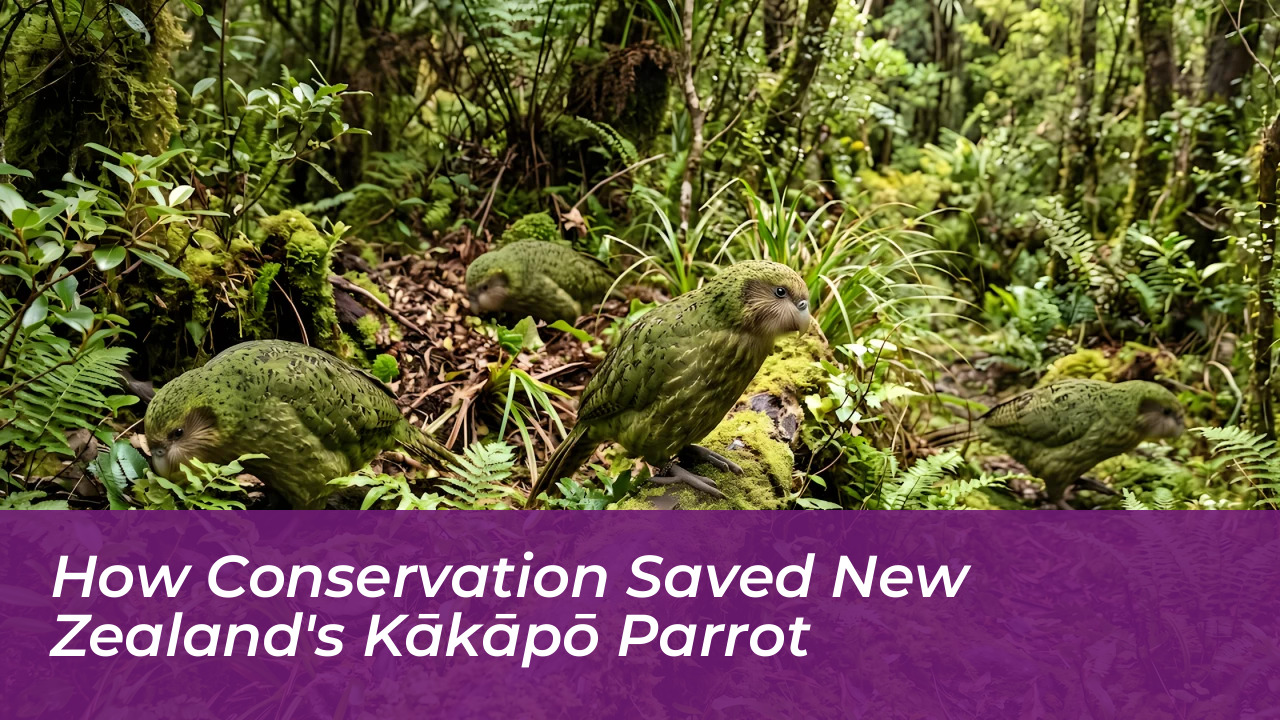

In the thick brush atop Sanctuary Mountain, an inquisitive green face poked its head out of a transport bag. The kākāpō, a moss-colored, flightless parrot named Motupōhue, looked around the dense New Zealand forest before leaping into the undergrowth. As he disappeared into the foliage, he became the first of his kind to step foot onto New Zealand’s mainland in half a century. This momentous release marks a major milestone in one of the world’s most intensive and successful wildlife rescue operations, proving that targeted conservation can pull a species back from the very brink of extinction.
According to recent environmental assessments, including the 2026 Living Planet Report, dedicated protection, breeding, and monitoring initiatives have prevented the extinction of dozens of bird and mammal species worldwide since 1993. Among these conservation success stories, the journey of New Zealand’s critically endangered kākāpō-often referred to as the owl parrot or night parrot-stands out as a powerful to the resilience of nature when paired with relentless human dedication.
A Brief History of the World’s Heaviest Parrot
The kākāpō is an extraordinary and eccentric bird native to New Zealand. As the world’s heaviest parrot, it is entirely flightless, predominantly nocturnal, and famous for its unique booming mating calls that can travel for hundreds of meters through the dark forest. For millennia, these birds thrived without natural mammalian predators. However, human settlement brought significant habitat destruction and invasive predators such as rats, cats, stoats, and possums, which decimated the vulnerable, slow-moving birds.
By the mid-1990s, the species faced near-certain annihilation. In 1995, the global kākāpō population plummeted to an alarming low of just 51 individuals, consisting of 31 males and a mere 20 females. Recognizing that inaction would mean losing the species forever, the New Zealand Department of Conservation (DOC), alongside local Indigenous Māori tribes, initiated the comprehensive Kākāpō Recovery Program.
Innovative Strategies and Scientific Intervention
Saving the kākāpō required moving far beyond traditional wildlife management. In the early stages of the recovery effort, conservation teams evacuated the remaining birds to three tiny, predator-free offshore islands: Whenua Hou (Codfish Island), Pukenui (Anchor Island), and Chalky Island. When natural population growth failed to meet expectations, scientists and rangers introduced a suite of hands-on techniques.
- Supplementary Feeding: Providing extra food during lean years to ensure female birds maintained optimal nutrition for breeding.
- Intensive Monitoring: Equipping every single bird with radio transmitters and smart sensors to track health, behavior, and nesting activity.
- Genomic Sequencing: Sequencing the DNA of all living individuals to carefully manage breeding pairs, maximize genetic diversity, and combat inbreeding depression.
- Assisted Reproduction: Utilizing artificial insemination, foster mothers, and hand-rearing for vulnerable or abandoned chicks.
These interventions directly addressed biological hurdles, such as low hatching success caused by early embryo mortality. Through constant monitoring and adaptive management, the population steadily climbed. By September 2026, after 90 new chicks successfully joined the count, the official total reached 325 individuals-a more than sixfold increase from the dark days of 1995.
Cultural Partnerships and Indigenous Leadership
A crucial pillar of the kākāpō’s recovery is the deep collaboration between government conservationists and the Indigenous Ngāi Tahu tribe, whose traditional territory encompasses the southern islands where the birds found refuge. For Māori, the kākāpō is a cherished taonga (treasure) deeply tied to cultural identity and genealogical heritage (whakapapa).
Initially, Western scientific methods and Indigenous values occasionally clashed-such as when traditional leaders questioned whether artificial insemination was too unnatural. However, through open dialogue and shared stewardship, the partnership flourished. Today, tribal members work side-by-side with rangers on the sanctuary islands, guiding the ethical care, management, and future reintroductions of the birds.
Returning to the Mainland: Challenges and the Path Ahead
Despite these remarkable triumphs, the kākāpō recovery program faces new operational challenges. With populations growing on the offshore sanctuary islands, space has become critically limited. Additionally, the birds’ breeding cycles remain tightly linked to the erratic “masting” or fruiting schedules of native podocarp trees like the rimu, meaning population booms only happen every few years.
To relieve island overcrowding and test the feasibility of returning birds to their historical homes, conservationists undertook a bold experiment. In July and September, teams relocated select kākāpō to Sanctuary Mountain Maungatautari, a massive fenced, predator-free sanctuary on the North Island mainland. This move represents a vital step toward New Zealand’s ambitious national goal of eradicating major mammalian predators nationwide by 2050.
“We’ve just released kākāpō into a place where they hadn’t been for hundreds of years,” said conservation scientist Andrew Digby. “This is how things were once, and how they could be again.”
A Global Symbol of Hope
The story of the kākāpō demonstrates that environmental decline is not always a permanent sentence. While global ecosystems face severe pressures from habitat loss and climate change, the resurrection of this flightless parrot proves that grounded, realistic hope combined with continuous action can reverse foretold extinctions. As researchers look to the future, the lessons learned from the Kākāpō Recovery Program offer an inspiring blueprint for endangered species management across the globe.