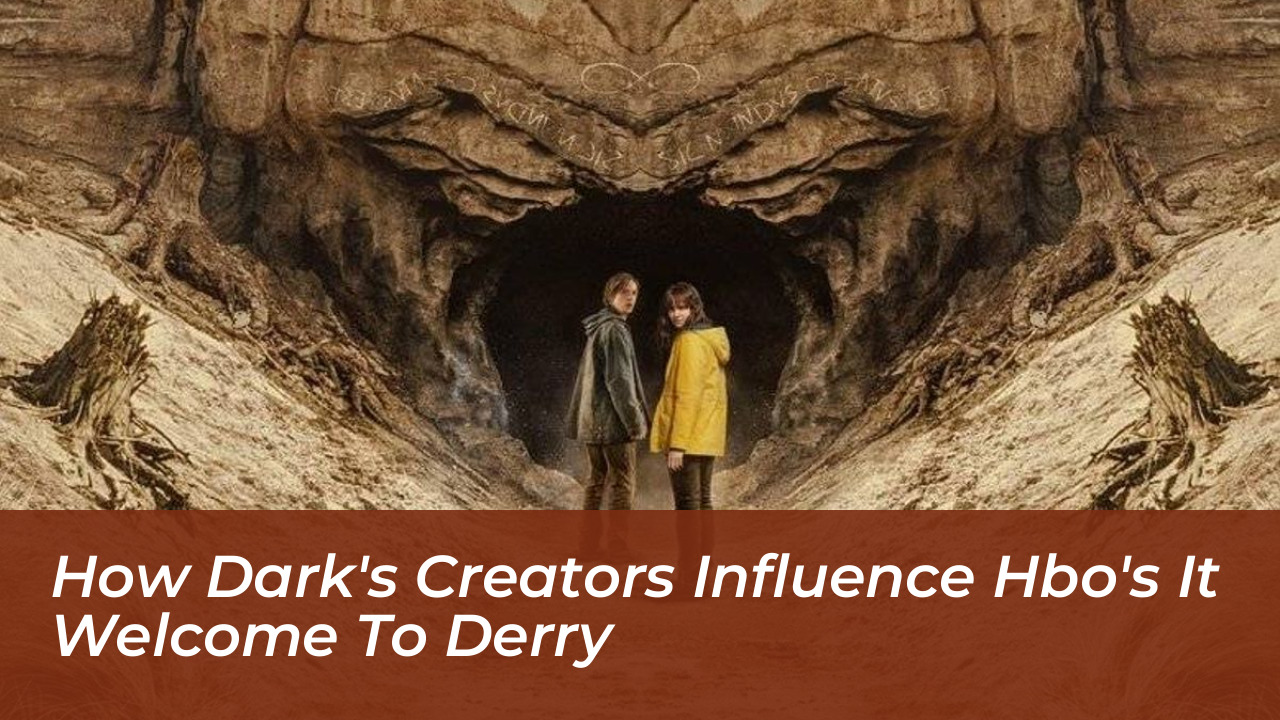
The television landscape rarely witnesses a creative crossover as conceptually aligned as the integration of the minds behind the Netflix sci-fi series Dark into the writing room of HBO’s upcoming horror prequel. Baran bo Odar and Jantje Friese, the German creative duo who orchestrated three meticulous seasons of temporal loops and existential dread in Winden, are bringing their architectural approach to narrative design into the Stephen King multiverse. This collaboration marks a definitive shift for the streaming franchise. The production moves away from traditional linear monster tropes and toward a complex multi-generational sci-fi puzzle box. Understanding this transition requires looking past the surface-level contrast between a quaint German village plagued by nuclear fallout and a cursed Maine town terrorized by an ancient cosmic entity.
- Deconstructing the Narrative DNA: Why Dark and IT Speak the Same Language
- Isolated Small Towns as Living Characters
- Generational Complicity and Willful Ignorance
- Comparative Structural Table
- The Mechanics of Reverse Storytelling and Time Travel
- Applying Predestination to Cosmic Horror
- Expanding the Stephen King Multiverse with Prestige Sci-Fi Talent
- Unique Analytical Perspectives on the Crossover
- Frequently Asked Questions
- Are the creators of Dark running the entire show?
- Will It: Welcome to Derry feature actual time travel?
- Where can I stream It: Welcome to Derry?
Both storytelling universes rely on the same fundamental engine: the inescapable gravity of generational trauma, societal complicity, and the terrifying realization that human beings are often the most destructive architects of their own suffering. By infusing the horrific lore of Pennywise with the rigorous mechanics of predestination and cyclical history, the creative team redefines what prestige horror television can achieve.
Deconstructing the Narrative DNA: Why Dark and IT Speak the Same Language
To casual observers, Netflix’s Dark and Stephen King’s IT occupy different aesthetic domains. One is a high-concept science fiction thriller anchored by nuclear physics, bootstrap paradoxes, and missing children in a perpetual rain-soaked forest. The other is a cornerstone of supernatural horror, featuring a shape-shifting predator that feeds on the fears of children every 27 years. Yet, a rigorous structural analysis reveals profound narrative parallels that make the involvement of bo Odar and Friese a stroke of genius.
Isolated Small Towns as Living Characters
Both narratives establish isolated small towns that function as active, living characters rather than passive backdrops. Winden conceals a complex network of caves serving as temporal gateways, while Derry hides an equally intricate subterranean maze of sewers and tunnels that symbolize the town’s collective moral decay. In both locations, the adults choose willful ignorance, allowing localized tragedies to fester into generational curses.
The setting dictates the rules of survival. Residents cannot simply pack their bags and leave because the geographic boundaries act as gravitational wells. Every street corner, industrial plant, and abandoned well holds historical baggage that actively pulls new generations into old cycles of violence.
Generational Complicity and Willful Ignorance
Systemic denial is the primary fuel for both Winden and Derry. In Dark, parents commit unspeakable acts to protect their children, ultimately causing the very temporal fractures they try to prevent. Similarly, the citizens of Derry collectively look away from the horrific acts committed within their borders, allowing an ancient entity to feast in plain sight.
This psychological weight transforms the stories from standard supernatural adventures into deep examinations of societal accountability. The true terror does not stem solely from the entity in the dark, but from the smiling neighbors who refuse to acknowledge the rot beneath their floorboards.
Comparative Structural Table
| Narrative Element | Netflix’s Dark (Winden) | HBO’s It: Welcome to Derry |
|---|---|---|
| Primary Catalyst | Disappearance of local child Mikkel Kahnwald | Mysterious disappearance of young boys in 1962 |
| Temporal Framework | 33-year deterministic time loops | 27-year historical feeding cycles |
| Hidden Infrastructure | Winden caves and nuclear power plant God particle | The sewers, Neibolt Street house, and deep tunnels |
| True Monster | The inescapable causal knot and human hubris | Cosmic entities fueled by human bigotry and trauma |
| Atmospheric Signature | Muted stone-blue tones, cold rain, perpetual gloom | Sunny 1960s American Gothic facade masking deep rot |
The Mechanics of Reverse Storytelling and Time Travel
The structural ambition of the new HBO prequel relies heavily on a reverse chronology. By peeling back 27 years of history with each subsequent installment, moving from the 1962 events backward toward the 1935 Bradley Gang Massacre and earlier milestones like the burning of the Black Spot, the show establishes a tragic inevitability. The audience already knows the ultimate fate of Derry because the events of the modern feature film timeline loom in the future.

This is precisely where the expertise of the creators from the Netflix sci-fi series Dark changes the game. In their previous work, characters frequently interacted with older or younger versions of themselves, fighting desperately against an immutable timeline only to realize that their resistance is the very catalyst that ensures the loop closes.
Applying Predestination to Cosmic Horror
Applying this philosophy to Pennywise transforms the entity from a simple nocturnal predator into a master of temporal chess. If the cosmic entity possesses awareness of its eventual defeat by the Losers’ Club in 1989, every strategic retreat and every psychological attack across the decades becomes a calculated move in a multi-generational war against time.
Characters are no longer just running from a monster in clown makeup. They grapple with the crushing weight of predestination and ask whether free will can exist within a closed causal loop. This philosophical depth elevates horror television into cerebral science fiction.
Expanding the Stephen King Multiverse with Prestige Sci-Fi Talent
Beyond the temporal mechanics, the integration of prestige sci-fi writing talent allows HBO to expand the broader Stephen King multiverse with unprecedented cohesion. Season 1 plants seeds connecting the lore directly to elements reminiscent of The Shining and Doctor Sleep through the historical background of characters like Dick Hallorann. Future seasons are positioned to weave in deeper cosmic mythologies, drawing casual viewers and die-hard literary fans alike into a web of interconnected nightmares.
The economic success of the recent cinematic adaptations provided Warner Bros. Discovery with the financial validation necessary to invest in a serialized streaming model. This ensures that complex world-building receives the proper production windows required for high-end television, moving far beyond rushed box office timelines.
Unique Analytical Perspectives on the Crossover
Analyzing this creative convergence requires looking at how nostalgia is weaponized. While Dark used bleak, rain-soaked cinematography to openly broadcast its existential gloom, Welcome to Derry employs a deceptive American Gothic aesthetic from the 1960s. Cheerful vintage facades act as visual bait-and-switch mechanisms to mask systemic rot.
, the weaponization of real-world societal guilt plays a major role. Historical touchstones like Cold War paranoia and racially motivated local tragedies posit that human bigotry is the primary catalyst that feeds the cosmic entity. The monster does not create the evil; it merely harvests the yield of human cruelty.
Frequently Asked Questions
Are the creators of Dark running the entire show?
The production features a collaborative writers room. Baran bo Odar and Jantje Friese bring their sci-fi sensibilities alongside Andy Muschietti, Barbara Muschietti, Jason Fuchs, and Brad Caleb Kane to blend horror with intricate plotting.
Will It: Welcome to Derry feature actual time travel?
While the series stays grounded in Stephen King’s cosmic mythology, the narrative structure heavily incorporates multi-generational temporal mechanics, cyclical history, and structured causal loops inspired by deterministic storytelling.
Where can I stream It: Welcome to Derry?
The series is available for streaming exclusively on HBO and Max, following Warner Bros. Discovery’s prestige television distribution model.