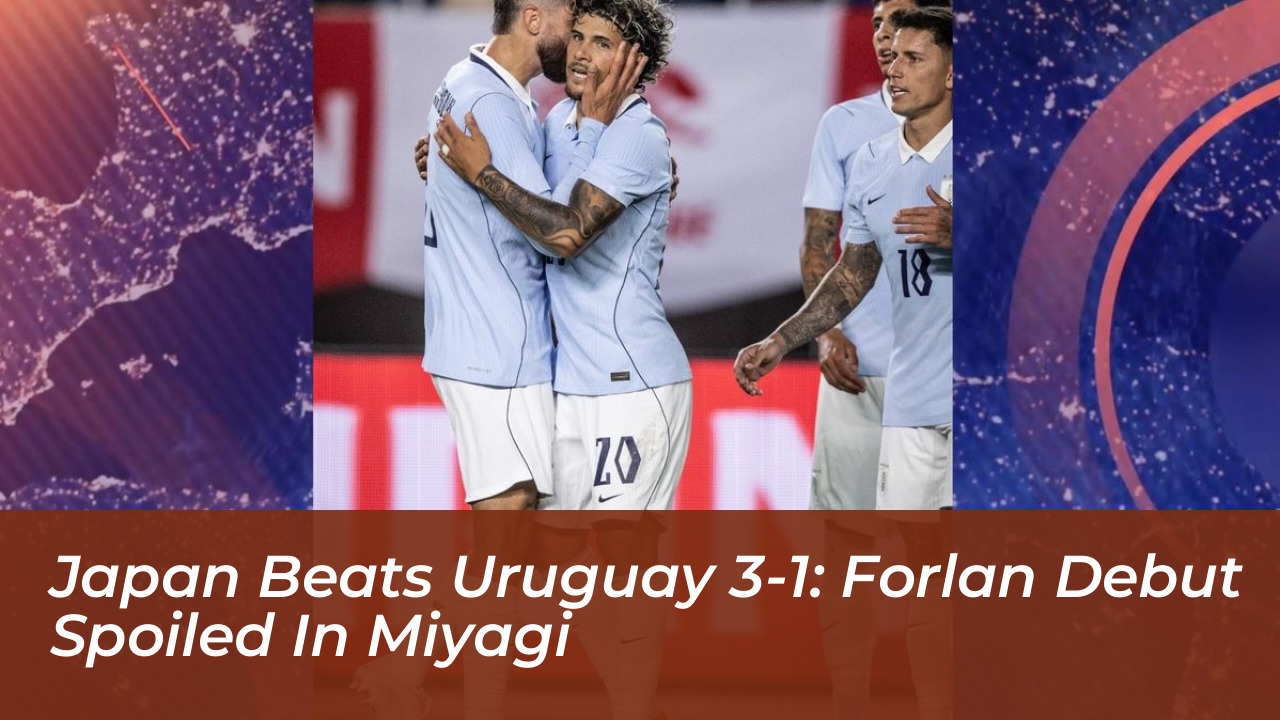
The international friendly fixture at the Q&A Stadium in Miyagi delivered a harsh reality check for La Celeste, as Japan defeated Uruguay 3-1 to spoil the managerial debut of former national team icon Diego Forlan. Stepping into the interim head coach role following a difficult 2026 World Cup campaign, Forlan sought to instill a fresh tactical identity for the South American squad. However, late defensive collapses exposed lingering structural vulnerabilities, handing the Asian side a deserved victory in the opening leg of their autumn tour.
- Match Overview: Late Stoppage-Time Drama in Miyagi
- Tactical Setup: Japan’s 3-4-2-1 vs Uruguay’s Traditional 4-4-2
- Japan’s Fluid 3-4-2-1 Formation
- Diego Forlan’s 4-4-2 Structural Plan
- First Half Analysis: Early Japanese Dominance and Uruguayan Reaction
- Kuryu Matsuki’s Early Breakthrough (11th Minute)
- Uruguay’s Recovery and Maximiliano Araujo’s Equalizer (42nd Minute)
- Second Half Equilibrium and Strategic Adjustments
- Midfield Battle and Bentancur’s Controlling Influence
- Coaching Modifications and Personnel Changes
- Stoppage-Time Breakdown: Structural Collapses in the Final Moments
- Kento Shiogai’s Go-Ahead Goal and VAR Review (92nd Minute)
- Ayase Ueda Seals Victory (96th Minute)
- Key Individual Performance Metrics and Tactical Takeaways
- Japan’s Standout Players
- Uruguay’s Areas for Immediate Improvement
- Uruguay’s Autumn Tour Roadmap and Next Steps
- Upcoming Fixture: South Korea in Seoul
- Concluding Match: India in October
- Frequently Asked Questions
- Who scored the goals in Japan’s 3-1 victory over Uruguay?
- Why is Diego Forlan managing Uruguay?
- What was the crucial VAR decision in the 92nd minute?
- When does Uruguay play next on their international tour?
Match Overview: Late Stoppage-Time Drama in Miyagi
Diego Forlan’s managerial debut for Uruguay ended in a 3-1 defeat to Japan on September 24, 2026, as two late stoppage-time goals broke a long-standing second-half tie. The match began at a blistering pace, with Kuryu Matsuki putting the hosts ahead early in the first half. Maximiliano Araujo managed to equalize for the visitors before the halftime interval, creating an intense atmosphere for the final forty-five minutes. Just as the match appeared destined for a draw, late strikes from Kento Shiogai and Ayase Ueda punished Uruguay’s defensive lapses in dramatic fashion.
To fully understand how the match unfolded from a statistical and structural standpoint, the official match summary highlights the key components of the fixture:
| Metric | Japan | Uruguay |
|---|---|---|
| Final Score | 3 | 1 |
| Goalscorers | Matsuki (11′), Shiogai (92′), Ueda (96′) | Maximiliano Araujo (42′) |
| Venue | Q&A Stadium, Miyagi, Japan | |
| Date | September 24, 2026 | |
| Formation | 3-4-2-1 | 4-4-2 |
Tactical Setup: Japan’s 3-4-2-1 vs Uruguay’s Traditional 4-4-2
Japan’s Fluid 3-4-2-1 Formation
Japan utilized wide wing-backs and twin attacking midfielders to stretch Uruguay’s defensive shape from the opening whistle. This tactical framework allowed the home side to exploit the half-spaces situated directly between Uruguay’s midfield line and back four. High-tempo ball circulation and intelligent rotational movement designed to tire out the opposition formed the backbone of Japan’s strategic dominance.
Diego Forlan’s 4-4-2 Structural Plan
Forlan established an initial tactical identity built on a conventional 4-4-2 structure. Santiago Mele guarded the goal behind a defensive line consisting of Nahitan Nandez, Ronald Araujo, Mathias Olivera, and Juan Manuel Sanabria. The central midfield partnership of Lucas Torreira and Rodrigo Bentancur worked alongside Brian Rodriguez and Maximiliano Araujo on the flanks, while Darwin Nunez and Federico Vinas operated as a direct target tandem up front.
First Half Analysis: Early Japanese Dominance and Uruguayan Reaction
Kuryu Matsuki’s Early Breakthrough (11th Minute)
The deadlock broke when Keito Nakamura delivered a pinpoint cross-field pass from the left wing. Kuryu Matsuki gathered the ball, drove inward with a diagonal run, and unleashed a low left-footed finish past Santiago Mele. This early goal triggered a central midfield disconnection within the Uruguayan ranks, leaving the team scrambling to regain composure during the opening half-hour.
Uruguay’s Recovery and Maximiliano Araujo’s Equalizer (42nd Minute)
Rodrigo Bentancur eventually dropped deeper to orchestrate build-up play and calm possession. Nahitan Nandez provided necessary width down the right flank, creating productive double-team scenarios against Japan’s defense. Goalkeeper Tomoki Hayakawa made crucial initial saves from Maximiliano Araujo, Brian Rodriguez, and Federico Vinas to keep the hosts ahead. However, just before the break, Maximiliano Araujo converted the rebound off Vinas’ blocked effort to level the score at 1-1.
Second Half Equilibrium and Strategic Adjustments
Midfield Battle and Bentancur’s Controlling Influence
The middle thirty minutes of the match featured a balanced contest as Uruguay established better passing sequences across the pitch. Bentancur assumed a commanding defensive pressing role, effectively disrupting Japan’s initial build-up play from the back line and neutralizing several dangerous counter-attacking sequences.
Coaching Modifications and Personnel Changes
Seeking to alter the momentum, Forlan introduced Giorgian de Arrascaeta in the 68th minute to replace Federico Vinas, aiming to bolster creative ball retention in the final third. Simultaneously, Japan refreshed their forward line to maintain relentless physical pressing against Uruguay’s fullbacks, setting the stage for a frantic conclusion.
Stoppage-Time Breakdown: Structural Collapses in the Final Moments
Kento Shiogai’s Go-Ahead Goal and VAR Review (92nd Minute)
Defensive organization eroded completely in the final moments as Japan exploited wide gaps between Uruguay’s central defenders and fullbacks. Substitute Kento Shiogai found space inside the penalty box and delivered a clinical finish past Mele in the 92nd minute. Vigorous protests regarding an offside infraction ensued, but a video assistant referee review confirmed that Mathias Olivera played Shiogai comfortably onside.
Ayase Ueda Seals Victory (96th Minute)
Any remaining hopes of a late comeback evaporated four minutes later. Takefusa Kubo launched an aggressive turnover press on the right wing to dispossess the Uruguayan backline. Kubo then slid a low pass across the face of the goal, finding Ayase Ueda completely unmarked for a simple tap-in into an empty net, finalizing the 3-1 margin.
Key Individual Performance Metrics and Tactical Takeaways
Japan’s Standout Players
- Kuryu Matsuki: Provided a clinical opening finish and maintained an exceptional work rate in transition.
- Tomoki Hayakawa: Executed a vital multi-save sequence in the first half to preserve early momentum.
- Takefusa Kubo: Delivered a game-ending defensive effort and unselfish assistance in the final minutes.
Uruguay’s Areas for Immediate Improvement
- Defensive positioning along the back four during fast-break transitions requires urgent refinement.
- Fullbacks exhibited a lack of spatial awareness during late-game offside traps.
- Midfield service to Darwin Nunez remained largely ineffective, leaving the striker isolated throughout the fixture.
Uruguay’s Autumn Tour Roadmap and Next Steps
Upcoming Fixture: South Korea in Seoul
Forlan and his squad face a rapid turnaround as they travel to the Seoul World Cup Stadium. The September 28, 2026 clash against South Korea demands immediate tactical adjustments on short rest to patch up the defensive holes exposed in Miyagi.
Concluding Match: India in October
The Asian tour concludes on October 6, 2026, with a fixture against India. This match provides the coaching staff with a final opportunity to evaluate squad depth and test secondary defensive options before official competitive qualifiers resume.
Frequently Asked Questions
Who scored the goals in Japan’s 3-1 victory over Uruguay?
Kuryu Matsuki opened the scoring in the 11th minute, Kento Shiogai added a second in the 92nd minute, and Ayase Ueda sealed the win in the 96th minute. Maximiliano Araujo scored the sole goal for Uruguay in the 42nd minute.
Why is Diego Forlan managing Uruguay?
Diego Forlan took over the interim head coach position following the departure of the previous coaching staff after Uruguay’s exit from the 2026 World Cup.
What was the crucial VAR decision in the 92nd minute?
A video assistant referee review confirmed that Mathias Olivera played Kento Shiogai onside during the build-up to Japan’s second goal.
When does Uruguay play next on their international tour?
Uruguay plays South Korea in Seoul on September 28, 2026, followed by a final tour match against India on October 6, 2026.