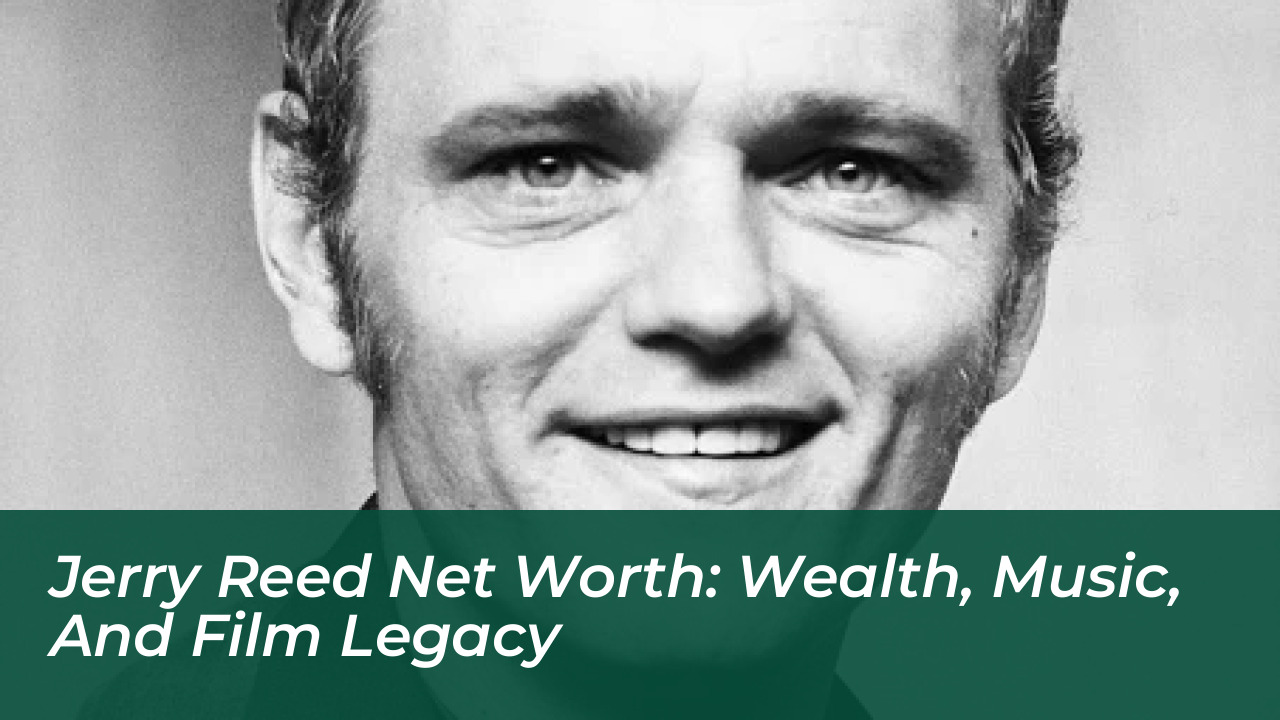
Jerry Reed was an iconic American country singer, songwriter, virtuoso guitarist, actor, and producer who had an estimated net worth of $3 million at the time of his death on September 1, 2008. Over a career spanning more than five decades, Reed cemented his status as one of country music’s most unique entertainers. He combined extraordinary, syncopated fingerpicking technique with witty comic storytelling, hit songwriting, and a successful Hollywood movie career.
While online estimates vary-with some adjusted estate projections reaching closer to $4 million when factoring in inflation and ongoing post-mortem royalties-his foundational lifetime accumulation of wealth derived primarily from chart-topping records, lucrative songwriting credits, extensive touring, and blockbuster film appearances alongside lifelong friend Burt Reynolds.
To fully understand how Jerry Reed built his financial standing and enduring cultural footprint, we must examine his journey from humble beginnings to multi-industry success.
Early Life and Musical Beginnings
Born Jerry Reed Hubbard on March 20, 1937, in Atlanta, Georgia, his early life was marked by economic hardship. His parents separated shortly after his birth, causing Reed and his sister to spend years living in foster homes and orphanages before finally reuniting with their mother and stepfather in 1944.
Music offered an essential escape. His mother managed to save several dollars to purchase him a secondhand guitar when he was a boy. By his teenage years, Reed was actively writing songs and performing on local shows alongside established country acts like Ernest Tubb and Faron Young. At age 17, his exceptional talent caught the attention of Atlanta music publisher Bill Lowery, leading to a recording contract with Capitol Records.
Songwriting Success and RCA Records
Reed’s early singles for Capitol in the mid-1950s blended country and rockabilly elements but failed to launch him into mainstream superstardom immediately. Fortunately, his songwriting proved much more lucrative.
In 1958, Gene Vincent recorded Reed’s song “Crazy Legs.” Shortly after, while Reed served in the U.S. Army, Brenda Lee turned his composition “That’s All You Gotta Do” into a major Top 10 pop hit. Following his military service, Reed moved to Nashville with his wife, Priscilla Mitchell, where he worked extensively as a session musician and songwriter.
A massive career breakthrough occurred when legendary guitarist and producer Chet Atkins recognized Reed’s unique syncopated “claw style” fingerpicking technique and signed him to RCA Records. Reed’s ability to play bass lines, rhythm, and melody simultaneously made him an elite, in-demand Nashville session player. He contributed guitar tracks for industry giants, including:
- Elvis Presley (“Guitar Man,” “U.S. Male”)
- Johnny Cash (“A Thing Called Love”)
- Waylon Jennings
- Willie Nelson
- Dolly Parton
- Bobby Bare
- Ringo Starr
Porter Wagoner also took Reed’s composition “Misery Loves Company” to the number-one spot on the country charts in 1962, generating steady royalty streams even before Reed broke out as a solo recording star.
Breakthrough as a Solo Star and Chart Hits
By the late 1960s and early 1970s, Reed cultivated a distinct recording persona blending humor, Southern slang, and dazzling guitar work. His 1970 single “Amos Moses” became a massive crossover hit. The following year, “When You’re Hot, You’re Hot” hit #1 on the country charts, crossed into the pop Top 10, and earned Reed his first Grammy Award for Best Country Vocal Performance, Male.
Additional major charting hits throughout his career included:
- “Ko-Ko Joe”
- “Lord, Mr. Ford”
- “The Bird”
- “She Got the Goldmine (I Got the Shaft)” (Hit #1 country in 1982)
Reed also won additional Grammy Awards for his instrumental guitar collaborations with Chet Atkins on albums like Me and Jerry and Sneakin’ Around. The Country Music Association honored him as Instrumentalist of the Year in both 1970 and 1971.
Hollywood Stardom and “Smokey and the Bandit”
Reed’s larger-than-life personality naturally translated to television and film. Frequent appearances on The Glen Campbell Goodtime Hour boosted his national visibility, paving the way for movie collaborations with Burt Reynolds in films like W.W. and the Dixie Dancekings and Gator.
In 1977, Reed achieved global cinematic fame playing truck driver Cledus “Snowman” Snow in the massive box office smash Smokey and the Bandit, starring alongside Burt Reynolds, Sally Field, and Jackie Gleason. Produced on a modest budget, the film grossed over $126 million domestically, trailing only Star Wars that year.
Beyond acting, Reed co-wrote and performed the movie’s signature theme song, “East Bound and Down,” which became one of the defining musical hits of his career. He reprised his role in Smokey and the Bandit II (1980) and took on a lead role in Smokey and the Bandit Part 3 (1983).
His diverse filmography also included features like High-Ballin’, Hot Stuff, Bat*21 alongside Gene Hackman, and a memorable turn as Coach Red Beaulieu in Adam Sandler’s 1998 comedy hit The Waterboy.
Jerry Reed Net Worth Breakdown At-A-Glance
| Financial Metric | Details |
|---|---|
| Estimated Net Worth (At Death) | $3 Million (2008) |
| Adjusted Estate Valuation | Estimated $4 Million (accounting for inflation and post-mortem royalties) |
| Primary Wealth Sources | Music royalties, songwriting credits, record sales, acting salaries, and concert touring |
| Major Career Accolades | 3x Grammy Award Winner, 9 Nominations, Nashville Songwriters Hall of Fame (2005), Country Music Hall of Fame (2017) |
Personal Life and Legacy
Jerry married singer Priscilla Mitchell in 1959, and the couple remained happily married for nearly 50 years until his passing, raising two daughters, Seidina and Lottie.
Even as his film career slowed down, Reed continued touring and recording well into the 2000s. He passed away on September 1, 2008, at his home in Nashville, Tennessee, due to complications from emphysema at the age of 71.
Posthumously, his monumental contributions to guitar craftsmanship and songwriting were cemented when he was inducted into the Nashville Songwriters Hall of Fame in 2005 and elected to the Country Music Hall of Fame in 2017. His intricate fingerstyle techniques continue to inspire generations of modern guitarists.
Frequently Asked Questions About Jerry Reed
What was Jerry Reed’s net worth when he died?
At the time of his death in September 2008, Jerry Reed had an estimated net worth of $3 million, accumulated through decades of successful music sales, songwriting royalties, and Hollywood film roles.
What was Jerry Reed’s biggest hit song?
Reed’s most famous signature song is widely considered to be “East Bound and Down,” which served as the iconic theme song for the 1977 blockbuster film Smokey and the Bandit. Other major solo hits included “Amos Moses” and “When You’re Hot, You’re Hot.”
Did Jerry Reed write songs for Elvis Presley?
Yes. Jerry Reed wrote iconic songs recorded by Elvis Presley, most notably “Guitar Man” and “U.S. Male.” Presley personally requested that Reed play the intricate guitar parts on the recording sessions because other session players struggled to replicate Reed’s unique style.
Who was Jerry Reed married to?
Jerry Reed was married to country singer Priscilla Mitchell from 1959 until his death in 2008. They shared two daughters, Seidina and Lottie.
What awards did Jerry Reed win?
Reed won three Grammy Awards during his lifetime, received two Country Music Association (CMA) Instrumentalist of the Year awards, was inducted into the Nashville Songwriters Hall of Fame in 2005, and was posthumously inducted into the Country Music Hall of Fame in 2017.