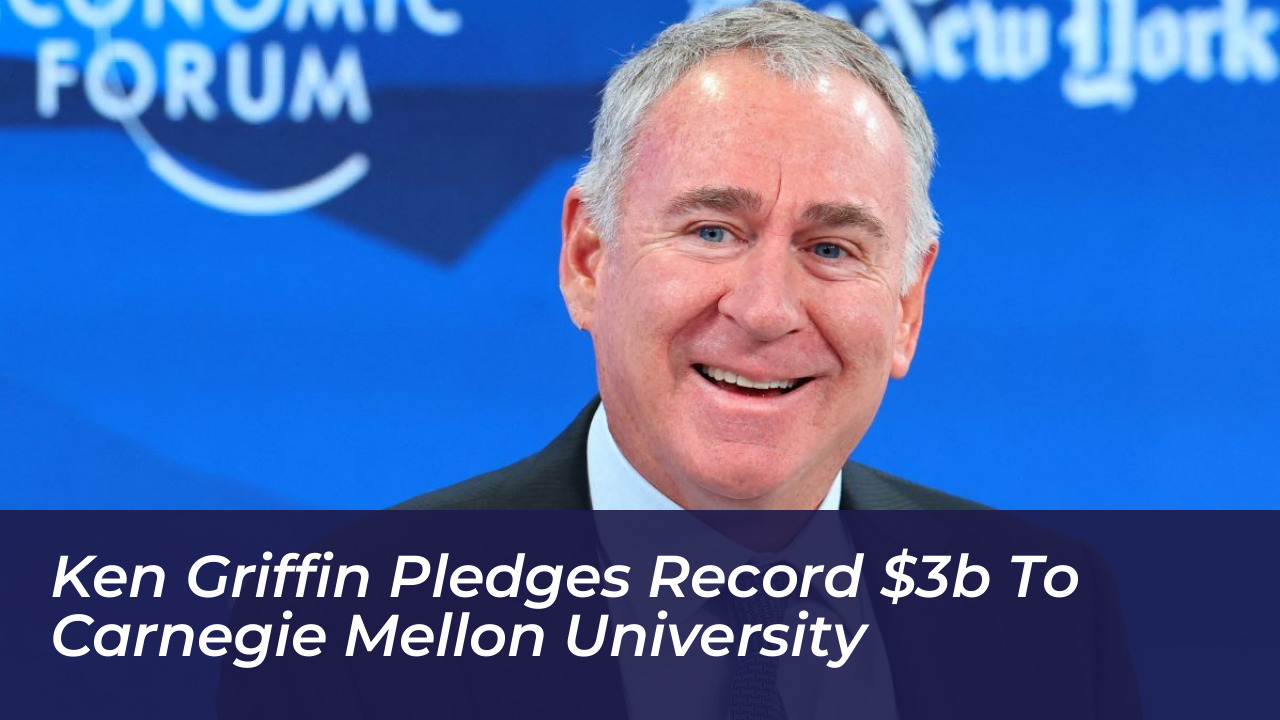
Citadel CEO Ken Griffin has committed a historic $3 billion to Carnegie Mellon University. This marks the largest individual donation in higher education history. Announced on Wednesday, September 30, 2026, the unprecedented gift will expand the university’s footprint. It will establish a brand-new campus in Miami, Florida, and inject major capital into its flagship institution in Pittsburgh, Pennsylvania.
The monumental funding splits into two primary allocations. Carnegie Mellon will receive $2 billion to design, construct, and launch a comprehensive new campus in Miami. The remaining $1 billion is designated for the Pittsburgh home base. Half of this goes toward general institutional flexibility. The other $500 million is earmarked specifically for its top-ranked School of Computer Science, which will be renamed the Kenneth C. Griffin School of Computer Science.
A New Paradigm for Higher Education in Miami
The new Carnegie Mellon University Miami campus will span a 35-acre site in the vibrant Wynwood neighborhood. This area is globally recognized for its dynamic art scene and urban renewal. Construction on the state-of-the-art facilities is slated to begin in 2027. The university aims to enroll its first cohort of students by 2028.
Once fully operational, the Miami location is projected to support more than 3,500 students across undergraduate, master’s, and doctoral programs. It will also host nearly 300 faculty members and over 600 staff personnel. Unlike traditional university expansions that simply replicate existing departmental structures, CMU Miami will invert conventional academic frameworks. The curriculum and research initiatives will focus directly on pressing societal challenges rather than standard academic majors.
At launch, the academic focus areas will center on:
- Human health and biological discovery
- National security and strategic capabilities
- Energy and climate resilience
- Advanced manufacturing and industrial transformation
Surpassing Previous Philanthropic Milestones
Griffin’s $3 billion contribution resets the ceiling for individual philanthropic support within American higher education. The previous benchmark was set in August 2025. At that time, Nike co-founder Phil Knight and his wife, Penny, donated $2 billion to Oregon Health & Science University. That gift had previously surpassed the long-standing $1.8 billion donation made by Michael Bloomberg to Johns Hopkins University in 2018.
Griffin’s net worth is estimated at $57.5 billion by Bloomberg. This donation represents his largest charitable endeavor to date. It is channeled through Griffin Catalyst, his civic engagement initiative dedicated to funding transformative societal solutions. As part of his deepened commitment to the institution, Griffin will also join Carnegie Mellon’s Board of Trustees.
“The opportunity to bring Carnegie Mellon to Miami places our city at the heart of humanistic and scientific advancement and amplifies the University’s international reach and impact,” said Ken Griffin during the announcement. “CMU Miami will cultivate the talent, knowledge, and expertise to launch new enterprises, contribute to Miami’s economy and community, and advance the prosperity of our nation.”
Deepening Ties to South Florida
The establishment of the Miami campus builds upon Griffin’s extensive philanthropic and civic investments in South Florida. He relocated Citadel’s corporate headquarters from Chicago to Miami in 2022. Over the past four years, Griffin has deployed tens of millions of dollars into regional institutions. This includes $50 million gifts to the University of Miami’s cancer center, the Baptist Health Foundation’s neuroscience institute, and Success Academy to fund charter school expansions locally.
Carnegie Mellon President Farnam Jahanian praised the partnership, emphasizing the institution’s historical willingness to pioneer novel educational models. “Artificial intelligence represents one of the defining intellectual developments of our time, and it demands that we rethink how we educate students, conduct research, and partner with others,” Jahanian noted. “Together, we have an opportunity to extend the very qualities that have long distinguished Carnegie Mellon… to build a new model for higher education that meets the urgency of this moment.”
As planning moves forward, regulatory approvals are currently underway. These approvals will clear the path for the 2027 construction timeline and the anticipated 2028 student enrollment date, signaling a transformative new chapter for both Carnegie Mellon University and the city of Miami.