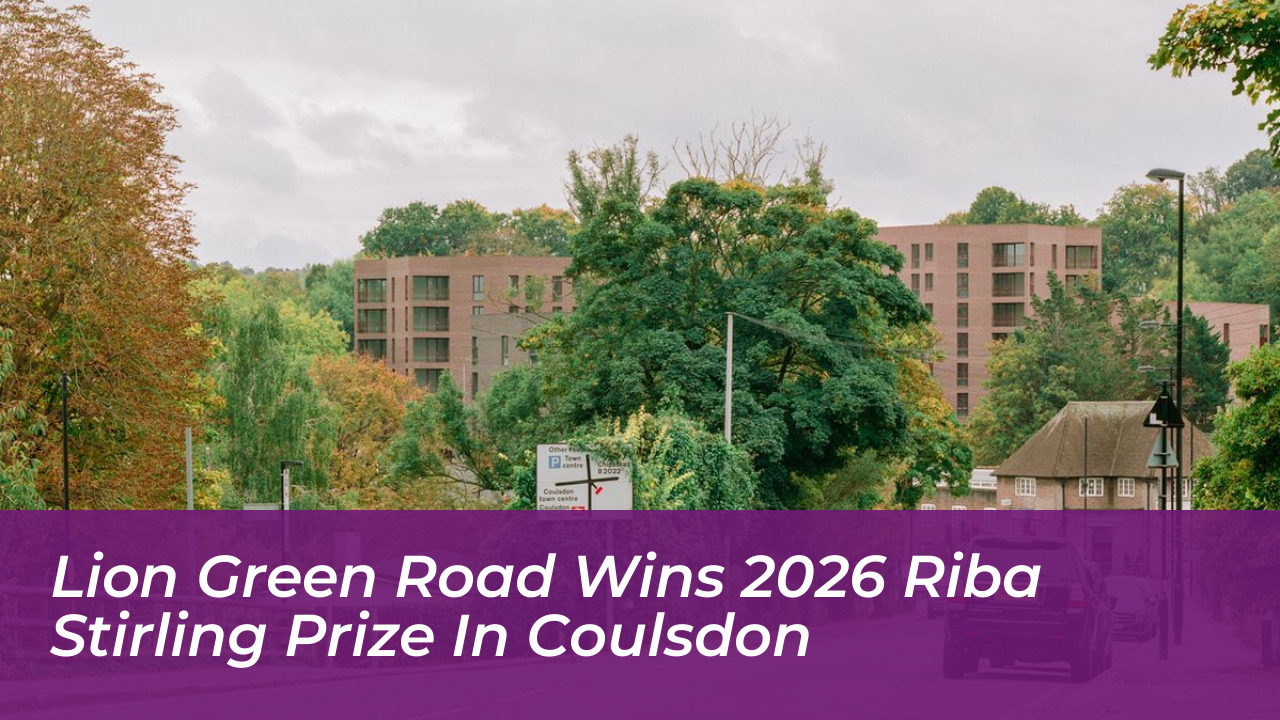

A 157-home residential development in Coulsdon, south London, has officially won the prestigious 2026 RIBA Stirling Prize. Designed by Mary Duggan Architects in collaboration with RUFF Architects for Croydon Council, Lion Green Road triumphed over a competitive shortlist to claim the United Kingdom’s highest architectural honor for a new building.
The winner was announced on October 15, 2026, at a ceremony held at Old Billingsgate in London. This event marked the 30th anniversary of the award established by the Royal Institute of British Architects (RIBA). The project was selected from a final six-project shortlist announced in July, edging out prominent educational and transport schemes across the country.
Transforming a Challenging Sloping Site
Built on a former council-owned car park, Lion Green Road addresses a remarkably difficult topographical site where the ground level changes by eight meters. Rather than leveling the terrain, the design team utilized the steep slope to shape the layout of five distinctive 13-sided residential blocks, accommodating up to 635 residents.
The faceted, star-shaped blocks are rotated and staggered to respond to the natural landscape. They offer expansive views toward local parkland and a surviving fragment of the historic Surrey Iron Railway, which is recognized as the world’s first fully independent public railway. This strategic orientation ensures that every single apartment is dual-aspect, maximizing natural daylight while preventing direct overlooking between neighboring properties.
A Sustainable ‘Living Landscape’ and Community Focus
Commissioned to address pressing national demands for housing, the development evenly splits 157 dwellings between privately owned and socially rented homes. The buildings are clad in a complementary trio of brown brick types. This unifies the neighborhood visually while giving each block its own subtle identity through varied brickwork patterns and heights.
The scheme weaves shared outdoor spaces directly into the architecture, introducing a new public pathway connecting the busy street to nature trails beyond. Residents have access to children’s play areas, sensory gardens, and community allotments, promoting everyday social interaction and bolstering local biodiversity.
Environmental performance was a core priority for the project. By implementing efficient construction methods, streamlined building processes, and simple finishes, the design team successfully lowered carbon emissions during delivery.
Praise from the RIBA Jury and Industry Leaders
RIBA President and jury chair Chris Williamson commended the project for proving that high-density housing can be successfully delivered without sacrificing spatial quality or individual privacy.
“At a time when we urgently need to deliver more homes, Lion Green Road shows that density can be achieved without compromising the quality of the places we create. Through a consistent specification, with subtle variation in height and orientation, it offers housing at scale without uniformity,” Williamson said.
Mary Duggan, director of Mary Duggan Architects, emphasized the social value embedded within the architecture. She stated that the project’s success relies on the everyday lived experience of its occupants rather than architectural spectacle.
Lion Green Road joins an elite group of previous Stirling Prize winners, following the Appleby Blue Almshouse in 2025, London’s Elizabeth Line in 2024, and Goldsmith Street in Norwich in 2019. The 2026 ceremony also recognized several special award recipients, including Satish Jassal Architects for Rowan Court (Neave Brown Award for Housing) and Architectural Thread for The Buttermarket (Stephen Lawrence Prize).
Frequently Asked Questions
What is Lion Green Road housing?
Lion Green Road is a 157-home residential development located in Coulsdon, south London, commissioned by Croydon Council and designed by Mary Duggan Architects with RUFF Architects.
Who won the 2026 RIBA Stirling Prize?
Mary Duggan Architects and RUFF Architects won the 2026 RIBA Stirling Prize for their design of the Lion Green Road housing scheme in south London.
How many homes are in the Lion Green Road development?
The development comprises 157 homes, evenly divided between private ownership and social rent, accommodating up to 635 residents across five residential blocks.
What makes the Lion Green Road site challenging?
The project was constructed on a steeply sloped former car park plot that features an eight-meter elevation change from top to bottom.
What are the key architectural features of the winning project?
The complex features five 13-sided, star-shaped blocks rotated to maximize views and light, dual-aspect layouts, earth-toned brick cladding, shared green spaces, allotments, and children’s play areas.