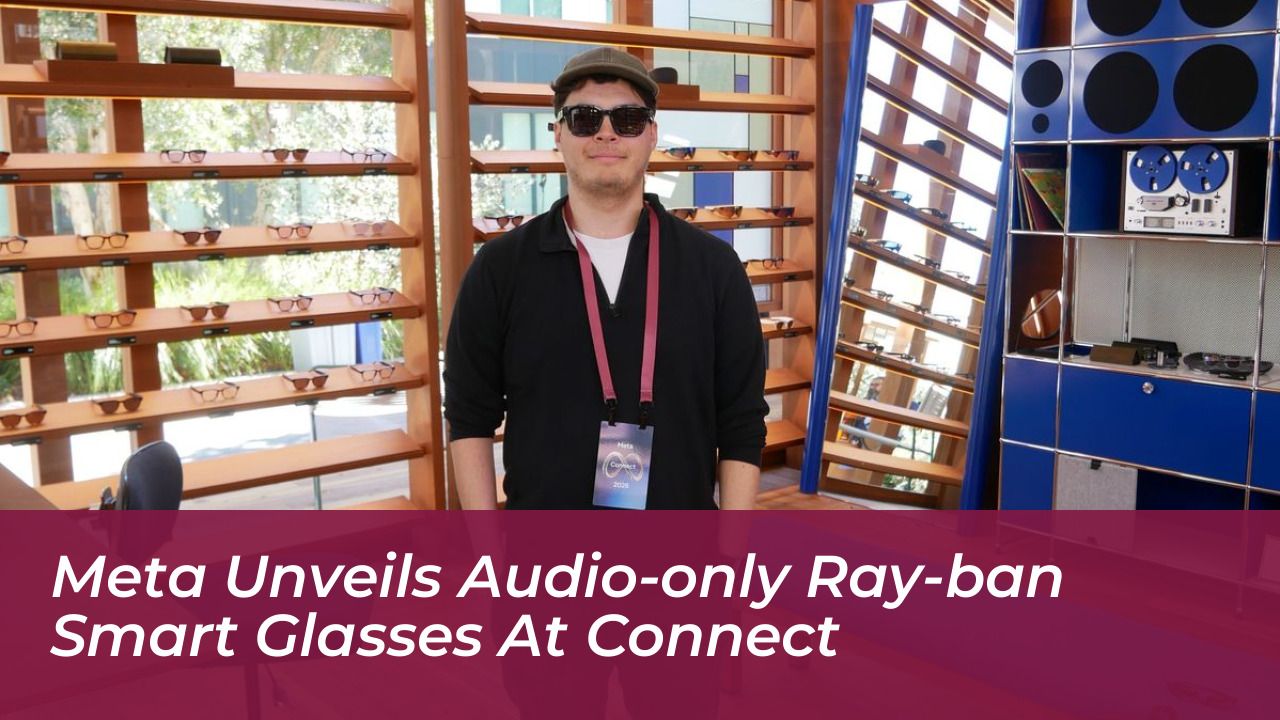
Meta disrupted the wearables market at its annual Meta Connect conference by introducing a new category of camera-free hardware. The newly unveiled Ray-Ban Meta audio glasses eliminate visual recording components entirely. This strategic pivot addresses mounting global scrutiny regarding covert surveillance. By removing the camera, engineers reduced the physical weight to a mere 43 grams while significantly improving battery longevity. These spectacles integrate deeply with Muse, Meta’s proprietary personal artificial intelligence system, offering voice-driven assistance without the social friction of recording devices.
- The Strategic Shift: Why Meta Dropped the Camera
- Responding to Global Regulatory Pressures
- Capturing the Risk-Averse Consumer Segment
- Engineering and Design Specifications of Ray-Ban Meta Audio
- Shedding Weight Through Optical Elimination
- Acoustic Architecture and Battery Longevity
- Integration with Muse Personal AI System
- Moving Beyond Simple Voice Queries
- Interactive Avatars and Voice Control Mechanics
- FDA-Cleared Hearing Enhancement and Accessibility
- Bridging the Gap in Hearing Health Economics
- Acoustic Modes for Complex Environments
- Market Positioning and Competitive Landscape
- Pricing Strategy and Tiered Product Lineup
- Frequently Asked Questions
- Do the new Meta audio glasses contain any cameras?
- How long does the battery last on a single charge?
- Can the hearing enhancement feature replace prescription hearing aids?
- What is the price of the audio-only smart glasses?
The Strategic Shift: Why Meta Dropped the Camera
Responding to Global Regulatory Pressures
European privacy investigations into non-consensual public filming created massive hurdles for early camera-equipped wearables. Public surveillance friction forced technology companies to rethink how smart hardware integrates into daily life. Chief Technology Officer Andrew Bosworth confirmed that the company accelerated its camera-free roadmap to navigate this evolving regulatory environment.
Balancing consumer utility with public comfort remains a primary challenge for wearable manufacturers. By stepping away from visual recording, Meta successfully removes the stigma associated with smart eyewear. Users can now wear advanced computational audio devices in restaurants, boardrooms, and crowded streets without causing public anxiety.
Capturing the Risk-Averse Consumer Segment
Previous models often faced rejection from privacy-conscious buyers who feared voyeurism and unauthorized data collection. This new camera-free audio device specifically targets that risk-averse consumer segment. Meta commands over 80 percent of global smart glasses shipments, and this hardware expansion strengthens that market dominance.
The elimination of optical sensors broadens the consumer base significantly. Individuals who previously avoided smart glasses due to privacy concerns now have a comfortable, lightweight alternative that delivers high-performance audio and artificial intelligence assistance without a camera lens staring at strangers.
Engineering and Design Specifications of Ray-Ban Meta Audio
Shedding Weight Through Optical Elimination
Engineering a lighter chassis required stripping away heavy optical sensors and camera modules. The resulting 43-gram frame represents the slimmest profile in Meta’s wearable lineup to date. Customizable temple tips, adjustable nose pads, and overextension hinges ensure ergonomic comfort for all-day wear.
Compared to heavier camera-equipped variants weighing between 50 and 70 grams, this reduction in mass feels substantial during extended use. Users no longer experience nose bridge fatigue or temple pressure during long listening sessions or work shifts.
Acoustic Architecture and Battery Longevity
Internal hardware relies on a sophisticated six-microphone array. These microphones capture voice commands with high precision while filtering out ambient environmental noise. Sound delivery utilizes open-ear speakers that bypass the need for traditional earbuds, letting users stream music and take calls while remaining fully aware of their physical surroundings.
Battery performance sees a dramatic improvement thanks to the lack of power-hungry camera sensors. The hardware delivers up to 12 hours of continuous playback on a single charge. The included charging case provides up to 48 additional hours of reserve power for uninterrupted daily usage.
| Specification | Camera-Equipped Variant | New Audio-Only Model |
|---|---|---|
| Weight | 50g to 70g | 43 grams |
| Optics | Integrated camera modules | Zero cameras, zero visual recording |
| Microphones | Standard voice array | 6 built-in directional microphones |
| Battery Life | 3 to 4 hours | Up to 12 hours continuous playback |
Integration with Muse Personal AI System
Moving Beyond Simple Voice Queries
The audio-only glasses serve as the primary hardware interface for Muse, Meta’s new agentic artificial intelligence platform. Unlike standard voice assistants that merely retrieve web search results, Muse executes multi-step digital workflows on behalf of the user. Wearers can speak directly to the platform to draft emails, compile to-do lists, and manage calendar appointments while commuting.
Agentic artificial intelligence represents a major evolution in human-computer interaction. Instead of opening multiple applications on a smartphone, users delegate administrative tasks entirely through spoken commands. The software manages backend API calls and cross-platform syncing autonomously.
Interactive Avatars and Voice Control Mechanics
Meta introduced customizable digital avatars to represent the Muse agent during interactive sessions. These visual representations appear on paired smartphone screens to provide feedback during complex workflows. Operational testing reveals that the voice interface demands explicit, direct commands to prevent accidental activation during casual conversations.
Contextual awareness algorithms evaluate environmental cues and spoken phrasing patterns. This prevents the artificial intelligence from misinterpreting general dialogue as a command, ensuring privacy and reliable operation in noisy public areas.
FDA-Cleared Hearing Enhancement and Accessibility
Bridging the Gap in Hearing Health Economics
Beyond entertainment and productivity, Meta introduced a specialized medical-grade hearing enhancement feature. Engineered over a five-year development cycle, the glasses function as US Food and Drug Administration certified assistive devices for individuals with mild to moderate hearing loss. Traditional hearing aids often cost upwards of $800 to $1,600, creating a significant financial barrier for millions of consumers.
Meta prices this accessibility tier starting at $150 or makes it available via subscription models. This disruptive pricing strategy democratizes hearing health technology, making assistive audio devices accessible to budget-conscious demographics who previously went untreated.
Acoustic Modes for Complex Environments
Users can toggle between specialized listening modes depending on their immediate environment. Focused amplification isolates the voice of a person directly in front of the user during one-on-one conversations. Omnidirectional amplification optimizes sound intake for complex acoustic settings like restaurants or lecture halls.
Software algorithms process incoming audio signals in real time. This ensures speech clarity while suppressing background clatter, engine noise, and sudden loud impacts without requiring bulky medical hardware.
Market Positioning and Competitive Landscape
Pricing Strategy and Tiered Product Lineup
Meta maintains a commanding lead in wearable tech shipments, but diversified pricing ensures continued market capture. The core audio-only model retails at $349, while the specialized accessibility variant starts at $150. This tiered approach targets casual tech buyers, enterprise workers, and health-conscious consumers simultaneously.
Competitors are actively preparing counter-strategies as the audio wearable sector gains momentum. Samsung and Google are forging partnerships with luxury eyewear brands like Warby Parker and Gentle Monster. Meanwhile, Apple is advancing its own optical wearable projects for upcoming release cycles.
Frequently Asked Questions
Do the new Meta audio glasses contain any cameras?
No. The Ray-Ban Meta audio glasses feature zero visual recording capabilities or cameras. They rely entirely on a six-microphone array for audio streaming and voice commands.
How long does the battery last on a single charge?
The glasses deliver up to 12 hours of continuous audio playback or assistant usage on a single charge. The included charging case supplies an additional 48 hours of reserve power.
Can the hearing enhancement feature replace prescription hearing aids?
The device functions as a US FDA-cleared hearing enhancement tool designed specifically for individuals experiencing mild to moderate hearing loss, offering an affordable alternative to traditional medical equipment.
What is the price of the audio-only smart glasses?
The core audio-only smart glasses retail at $349, while the specialized hearing assistance variant starts at $150 or through a recurring subscription model.