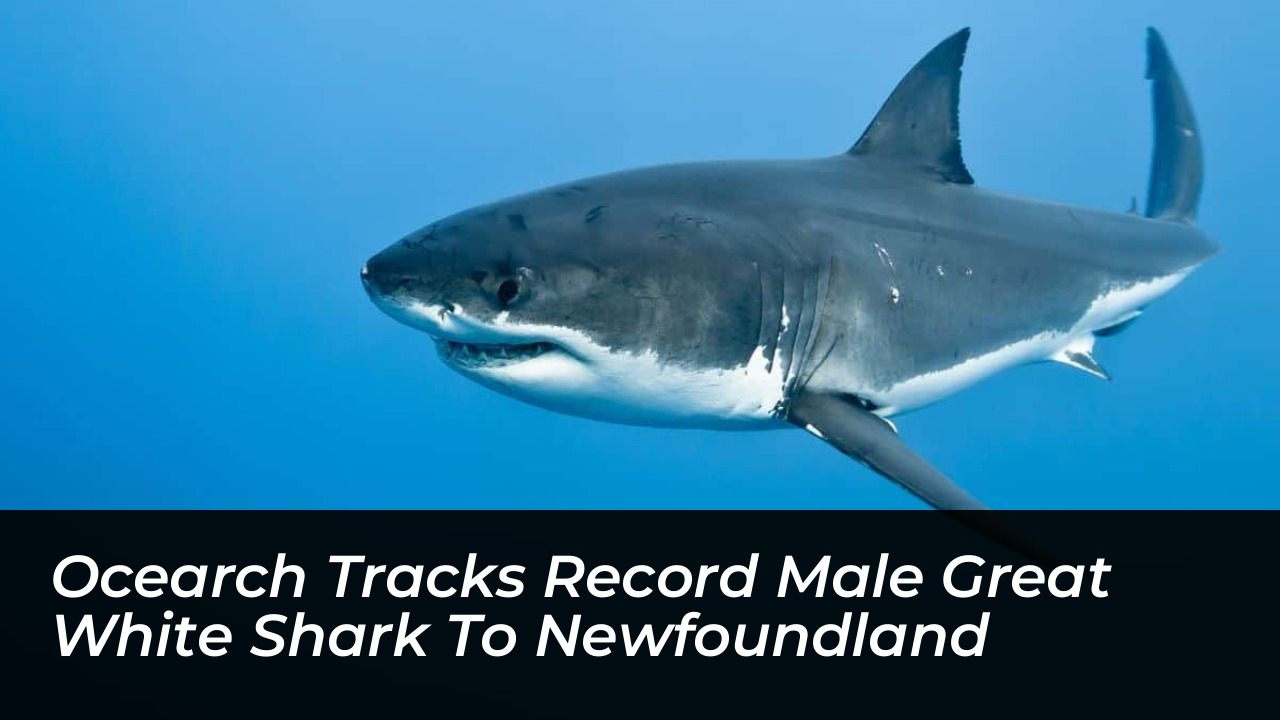

A satellite-tagged male great white shark measuring 13.8 feet has traveled from waters off the southeastern United States to Newfoundland. This journey provides researchers with vital new information about the movements of large marine predators in the western North Atlantic. The non-profit research organization OCEARCH identified the shark, named Contender, as the largest male white shark the group has ever tagged in the region.
Researchers captured Contender on January 17, 2025, about 45 miles off the coast near the Georgia-Florida border. According to OCEARCH, the apex predator weighed an estimated 1,653 pounds when the team brought him onto a research vessel for examination, biological sampling, and tagging.
Scientific Findings and Biological Sampling
During the handling process, the scientific team collected comprehensive biological samples to investigate Contender’s reproductive biology, overall health, and exposure to environmental toxins. Dr. Harley Newton, OCEARCH’s chief veterinarian and senior veterinary scientist, noted that male white sharks typically reach maturity at about 11.5 feet and 26 years of age. At nearly 14 feet, Contender is estimated to be an adult male in his early 30s, placing him early in his reproductive life.
“He is an important part of the effective breeding population and will hopefully contribute to the rebuilding of the western North Atlantic white shark population,” Dr. Newton explained.
To monitor his journey, researchers attached two types of tracking equipment:
- A SPOT (Smart Position and Temperature) satellite tag mounted to his dorsal fin. This tag transmits GPS location data whenever the fin breaks the surface and is expected to operate for about five years.
- A temporary PSAT (pop-up satellite archival tag) attached to the body wall. This tag records depth and water temperature profiles over a six-month period.
Migration Patterns and Canadian Waters
Contender’s long-distance migration highlights the extensive connectivity of marine habitats along the eastern seaboard. Data from OCEARCH’s tracking platform shows that about 88% of white sharks tagged in the U.S. Southeast eventually journey to Atlantic Canada for seasonal feeding and residency.
After moving north, Contender spent time in the northern tip of the Bay of St. Lawrence and near Cape Breton Island, Canada. Scientists view these colder, nutrient-rich waters as a critical summer and fall habitat. Monitoring his trajectory toward areas like the Strait of Belle Isle helps researchers understand how apex predators adapt to changing ocean temperatures and utilize interconnected marine corridors.
Public Tracking and Conservation Impact
Named after project partner Contender Boats, the shark has captured international public interest, attracting tens of thousands of followers on the free OCEARCH Global Shark Tracker app. Expedition leader Chris Fischer emphasized that every data point contributes to a broader understanding of ocean health.
“When we began this work, we never imagined we would one day reach 100 tagged white sharks in this population,” Fischer said. “That milestone represents not only scientific progress, but a growing global community united in understanding and protecting these apex predators and the oceans they sustain.”