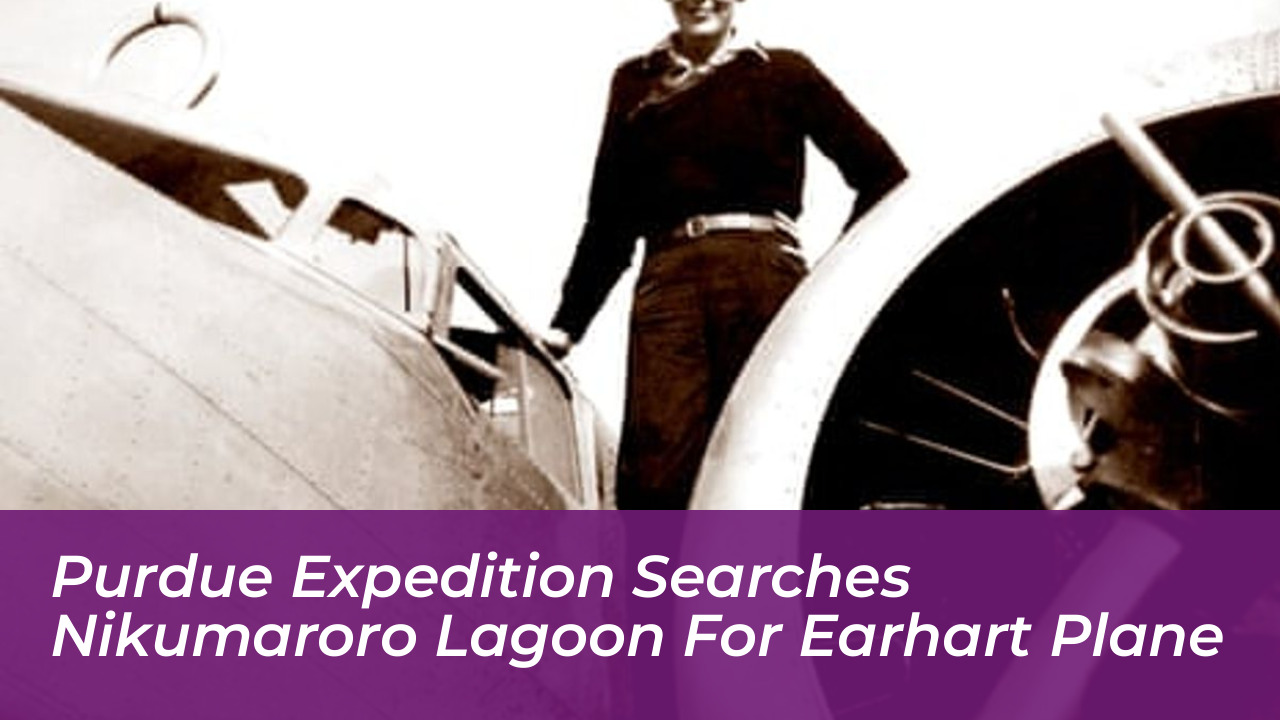

A research team backed by Purdue University and the Archaeological Legacy Institute (ALI) has arrived at the remote, uninhabited atoll of Nikumaroro in Kiribati to launch a critical phase of fieldwork. The 14-member expedition is tasked with investigating a submerged feature known as the Taraia Object. Researchers believe this could be the long-lost Lockheed Model 10-E Electra aircraft flown by aviation pioneer Amelia Earhart.
The team completed a five-day, 830-nautical-mile voyage across the South Pacific aboard the vessel Marin Mainiku before anchoring near the western side of the atoll. The current expedition centers on resolving a mystery that began on July 2, 1937, when Earhart and navigator Fred Noonan vanished during their attempt to circumnavigate the globe at the equator.
The Target: The Taraia Object
The primary focus of the operation is an elongated shape identified in satellite images near the southern side of Nikumaroro’s lagoon. Researcher Michael Ashmore first noticed it in Apple Maps satellite imagery in 2020. Subsequent analysis revealed the feature was visible in aerial photographs of the island dating back to 1938.
According to expedition projections, the Taraia Object rests approximately 10 feet offshore in roughly five feet of water, buried beneath an unknown depth of sediment. Project leader Rick Pettigrew, executive director of ALI, noted that the mission builds upon decades of research surrounding the “castaway hypothesis” originally championed by The International Group for Historic Aircraft Recovery (TIGHAR).
“It is incredibly rewarding to be this close to completing our inspection of the Taraia Object and potentially solving, at long last, the outstanding mystery of the disappearance of Amelia Earhart and Fred Noonan more than 89 years ago,” Pettigrew said.
Expedition Operations and Technology
Because the vessel arrived at the atoll after dark, the team initially positioned the ship in calmer waters on the eastern end of the island. Field operations utilize a multi-phased archaeological and technical approach:
- Staging and Logistics: Clearing jungle trails and establishing secure land bases to support movement between the beach and the lagoon.
- Grid Mapping: Deploying surface boats to establish parallel transect lines for systematic artifact recording.
- Remote Sensing: Using magnetometers to detect ferrous metals, alongside various sonar technologies to map objects hidden beneath sediment.
- Direct Contact and Excavation: Employing hydroprobes to determine the depth, orientation, and surface composition of the target, followed by a water induction dredge to carefully remove sediment for visual inspection.
The expedition includes terrestrial and maritime archaeologists, representatives from the Kiribati government, and three prominent Purdue figures: university General Counsel and Senior Vice President Steve Schultz, along with alumni Sirisha Bandla and Marc Hagle.
Historical Connection to Purdue University
Purdue’s deep involvement stems from its historical ties to Earhart. She joined the institution in 1935 as a career counselor for women and an advisor in aeronautics. The Purdue Research Foundation previously financed her twin-engine Lockheed Electra “Flying Laboratory” through the Amelia Earhart Fund for Aeronautical Research.
“Successfully identifying the Electra would be the first step toward fulfilling her intention to return it to the university,” Schultz said. He noted that any future recovery and transport back to West Lafayette would require extensive coordination and authorization from the government of Kiribati.
Skepticism and Alternative Explanations
Despite the optimism surrounding the mission, the expedition faces skepticism from external experts. Some researchers, including TIGHAR founder Ric Gillespie, have argued that historical imagery points to natural debris. They suggest the object is a fallen palm tree and root mass washed into the lagoon during a storm, rather than aircraft wreckage.
Nevertheless, the team anticipates spending five intensive days conducting sonar scans, metal detection, and dredging before returning to Tarawa. The findings are expected to provide definitive answers regarding the true nature of the Taraia Object.