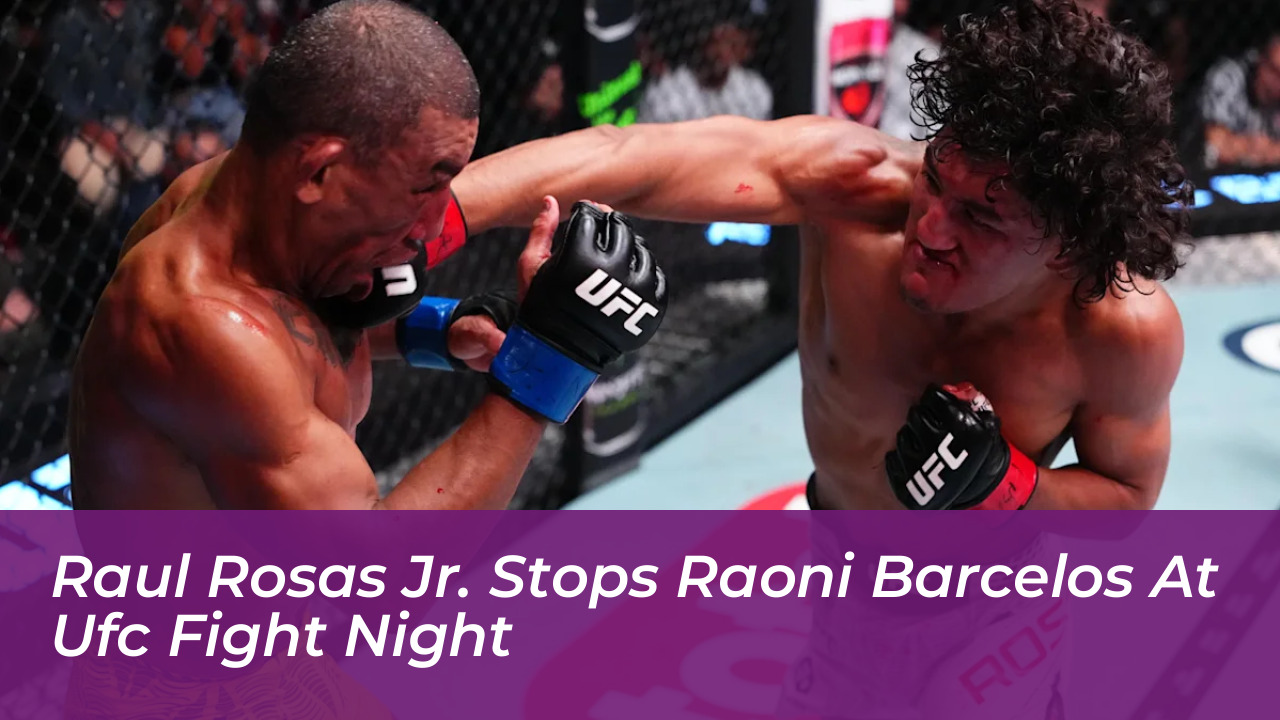
The bantamweight clash between Raul Rosas Jr. and Raoni Barcelos at the Meta Apex facility on September 26, 2026, delivered non-stop action and an unforgettable conclusion. Both athletes entered the Octagon with distinct tactical agendas, blending high-level striking with aggressive grappling exchanges. The main event showcased the contrast between youth and veteran savvy inside the Ultimate Fighting Championship.
- Fight Mechanics: How Rosas Jr. Turned the Tide in Round 5
- Early Striking Dominance and Eye Trauma (Rounds 1-2)
- Barcelos Grappling Control and Fourth-Round Dominance (Rounds 3-4)
- The Unusual Fifth-Round Finish Sequence
- Official Judges’ Scorecards Before the Stoppage
- Statistical Comparison and Key Performance Metrics
- Medical Emergency and Octagon Safety Protocols
- Rosas Jr. Post-Fight Reaction and Career Trajectory
- Frequently Asked Questions
- Who won the bantamweight fight at UFC Fight Night?
- What caused the sudden stoppage in the fifth round?
- What was Raul Rosas Jr.’s record after this victory?
A dramatic fifth-round finish shifted the trajectory of the fight and improved Rosas Jr.’s professional record to 13-1, cementing his status as a serious contender in the 135-pound division. Despite trailing on the judges’ scorecards entering the final frame, the young prospect capitalized on a chaotic sequence to secure the victory. The event highlighted both the unpredictable nature of mixed martial arts and the resilient spirit required to compete at the highest level.

Fight Mechanics: How Rosas Jr. Turned the Tide in Round 5
An examination of the tactical shifts that occurred throughout the 21 minutes of combat reveals how early momentum led to a sudden and unexpected conclusion. Rosas Jr. relied on his speed and volume early in the contest, while Barcelos absorbed the initial pressure to orchestrate a methodical grappling clinic in the middle rounds. The strategic adjustments made by both corners dictated the flow of battle from round to round.
As fatigue set in during the championship rounds, the margin for error shrank significantly. Barcelos utilized his veteran experience to control the center of the cage and dictate grappling exchanges. However, the explosive nature of the bantamweight division ensures that fights can change instantly with a single strike or transition.
Coaches analyze opponent tendencies constantly during live competition to find subtle openings in defense. Athletes must adapt their game plans rapidly when physical exhaustion begins to hinder their primary offensive weapons.
Early Striking Dominance and Eye Trauma (Rounds 1-2)
- Rosas Jr. established high striking volume with calf kicks and southpaw left hands in the opening frame.
- Barcelos managed swelling around his left eye while countering with heavy body shots and double-leg takedowns.
- A competitive second round featured rapid head-level exchanges and tactical adjustments from both corners.
Barcelos Grappling Control and Fourth-Round Dominance (Rounds 3-4)
- Barcelos shifted the tempo in round three through sustained grappling sequences and back control.
- The Brazilian veteran executed a dominant fourth round featuring a 10-8 judge score, heavy ground-and-pound, and multiple rear-naked choke attempts.
- Rosas Jr. displayed defensive resilience to survive severe grappling pressure.
The Unusual Fifth-Round Finish Sequence
- Rosas Jr. initiated aggressive striking and flying knee attempts at the start of the final frame.
- The accidental head collision during a trip takedown against the cage rendered Barcelos instantly unconscious.
- Referee Herb Dean stepped in at 1:38 of round five to officially halt the contest.

Official Judges’ Scorecards Before the Stoppage
Analysis of the official scorecards indicates that Barcelos held a commanding lead entering the final five minutes of the bout. The judges scored the second, third, and fourth rounds clearly for the Brazilian veteran due to his superior control time and damaging ground attacks. Rosas Jr. needed a finish to secure the win.
Scoring criteria prioritize effective striking, grappling, aggression, and cage control across every single round of combat. Judges weigh positional dominance heavily when determining point deductions or round awards during a championship bout.
| Judge | Scorecard Breakdown |
|---|---|
| Derek Cleary | 39-37 for Raoni Barcelos (Rounds 2, 3, 4) |
| Sal D’Amato | 39-37 for Raoni Barcelos (Rounds 2, 3, 4) |
| Chris Lee | 39-36 for Raoni Barcelos (Rounds 2, 3; Round 4 scored 10-8) |
Statistical Comparison and Key Performance Metrics
A comprehensive review of the striking volume, accuracy, and control time registered by both athletes demonstrates the competitive nature of the matchup. Rosas Jr. edged the significant strike count, but Barcelos maximized his efficiency on the canvas.
Advanced analytics track strike distribution across head, body, and leg targets to measure offensive output accurately. Combat sports researchers rely on these detailed metrics to evaluate fighter progression over multiple professional bouts.
- Significant strikes landed: Rosas Jr. landed 84 of 162 attempts (51%), while Barcelos connected on 76 of 138 attempts (55%).
- Target distribution: Rosas Jr. focused heavily on the head with 58 landed strikes, compared to Barcelos who scored heavily to the body with 28 targeted blows.
- Takedowns and control: Barcelos completed 5 of 8 takedown attempts and amassed 7 minutes and 18 seconds of total control time.
Medical Emergency and Octagon Safety Protocols
Details regarding the immediate medical response inside the Meta Apex facility following the knockout underline the inherent risks of combat sports. Barcelos remained motionless on the canvas, prompting immediate intervention from ringside physicians and emergency staff.
Medical personnel stabilized Barcelos’ neck and spine before safely transporting him to a nearby Las Vegas hospital for comprehensive trauma evaluation. The swift and professional response by the athletic commission medical team ensured the athlete received prompt clinical care.
Athletic commissions enforce strict medical suspension guidelines following knockout finishes to protect fighter long-term health. Neurological assessments occur regularly during recovery periods to clear athletes safely for future competition.
Rosas Jr. Post-Fight Reaction and Career Trajectory
Rosas Jr. maintained a respectful demeanor during his in-cage interview, requesting prayers and well wishes for his opponent’s health and recovery rather than celebrating wildly. His maturity resonated with fans and media members alike.
The implications of his fifth consecutive UFC victory elevate his standing within the competitive 135-pound bantamweight division. As Rosas Jr. looks toward future matchups, this hard-fought victory serves as a valuable learning experience in his young career.
Frequently Asked Questions
Who won the bantamweight fight at UFC Fight Night?
Raul Rosas Jr. defeated Raoni Barcelos by knockout in the fifth round of their bantamweight bout.
What caused the sudden stoppage in the fifth round?
An accidental head collision during a takedown attempt rendered Barcelos unconscious, prompting referee Herb Dean to stop the fight at 1:38.
What was Raul Rosas Jr.’s record after this victory?
The win improved Rosas Jr.’s professional mixed martial arts record to 13-1.