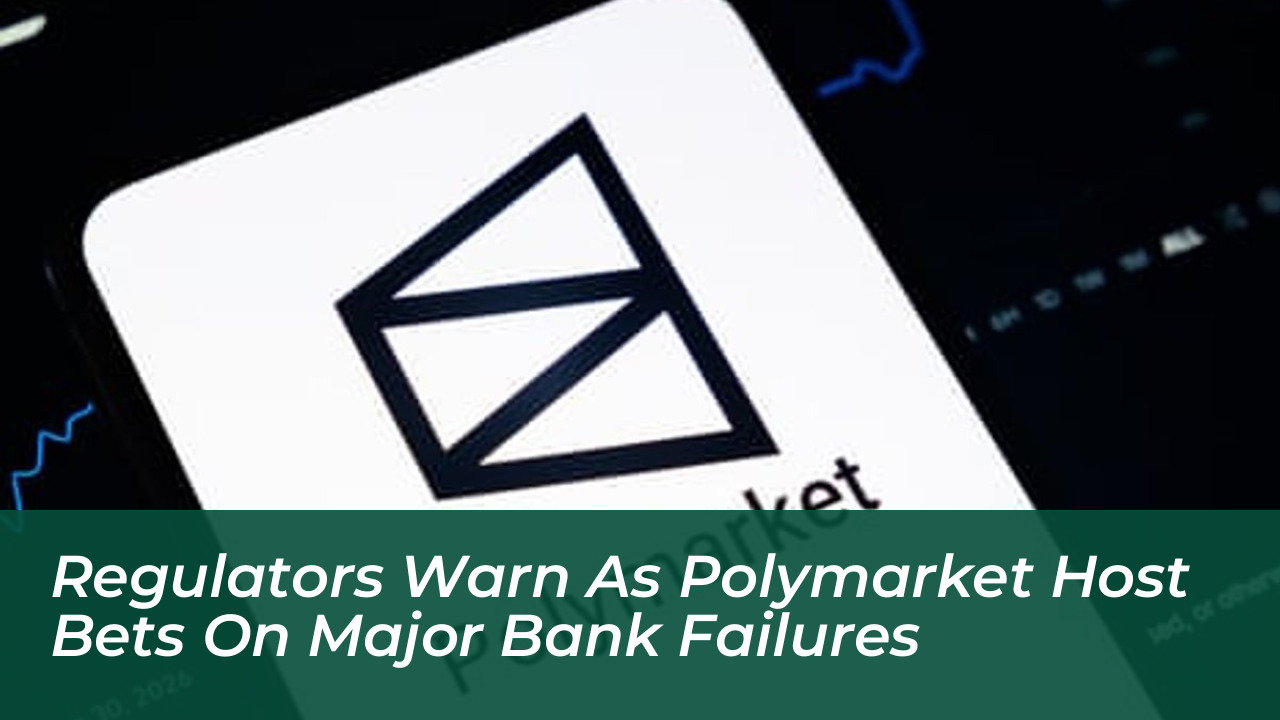
Global financial authorities and lawmakers are raising alarms over prediction market platform Polymarket. Traders have placed $77,507 in bets on whether major global institutions like HSBC, Lloyds, JPMorgan Chase, Wells Fargo, and Bank of America will fail by the end of 2026. Although residents from the UK, US, Canada, and the EU are officially restricted from trading on the offshore platform, users across approximately 150 nations can financially benefit from contract outcomes tied directly to international banking instability.
This development has prompted the UK Financial Conduct Authority (FCA) to consult international regulators regarding prediction markets to protect overall market integrity. These actions come amid mounting fears that speculative bets could fuel artificial bank runs or invite severe market manipulation. Liberal Democrat Member of Parliament and Treasury Committee member Bobby Dean urged official intervention, pointing to systemic vulnerabilities within decentralized prediction mechanisms.
Polymarket has a poor reputation for stopping insider trading or bad actors placing bets on their platform, so it’s easy to see how it could be exploited to try to aggravate real shifts in market sentiment.
Dean cautioned that rapid escalations in trading activity could directly impact public confidence in major commercial lenders. Meanwhile, officials inside the Federal Deposit Insurance Corp. (FDIC) expressed concern during internal meetings when the contracts were highlighted to senior staff. The agency supervises thousands of mostly small banks, insures bank deposits, and acts as a receiver to liquidate assets or orchestrate emergency sales to healthier buyers.
Regulatory Scrutiny and Internal Compliance Concerns
FDIC officials questioned whether there was any legitimate commercial or investment benefit to the bank-failure contracts. They also reviewed whether internal ethics restrictions were strong enough to prohibit agency employees from trading on prediction platforms. Because the FDIC keeps a confidential list of troubled institutions, senior staff evaluated existing rules before concluding that current ethics policies sufficiently prevent staff from participating on Polymarket.
While traditional financial markets allow investors to short stocks or utilize credit default swaps to protect against debt defaults, prediction market contracts offer a direct binary wager on a bank’s total collapse. Customers can take positions without borrowing shares or buying underlying securities. An earlier set of wagers focused on failures by July generated $591,000 in trading volume, while recent trades tied to banks failing by the end of the year attracted an overall volume of $76,000.
Divergent Regulatory Jurisdictions and Industry Defense
The Commodity Futures Trading Commission (CFTC) views prediction markets as derivatives exchanges, maintaining exclusive jurisdiction over US-regulated platforms. Polymarket’s newer US exchange, regulated by the CFTC and accessible to US-based customers, does not offer wagers on bank failures. However, Polymarket’s older international platform operates offshore and remains unregulated by the agency, offering bets on individual bank failures alongside markets tied to the likelihood of major US bank bailouts.
Supporters of the prediction contracts argue that low statistical probabilities across these markets act as a real-time check against false panics and online rumors.
- Information Aggregation: Proponents claim prediction markets aggregate insights typically restricted to sophisticated financial institutions.
- Market Transparency: Advocates state that open access formats allow everyday users to view collective economic sentiment.
- Risk Monitoring: Industry defenders suggest low percentages demonstrate overall stability despite volatile online discourse.
Polymarket Chief Legal Officer Neal Kumar defended the platform in a statement, noting, “Bank bailouts and failures are amongst the most consequential events in America. Our markets aggregate information that is typically only available to the most sophisticated financial institutions, but through our prediction market, are now available in a format everyone can access.”
Industry Opposition and Congressional Pushback
Rival prediction platforms have distanced themselves from the controversy. Kalshi, a CFTC-regulated prediction market, does not offer contracts tied to individual bank failures. Kalshi spokesperson Elisabeth Diana characterized Polymarket’s bank-failure wagers as being “in poor taste.”
Prominent financial figures and lawmakers have strongly condemned the offering. Former FDIC head Sheila Bair warned that failure-focused contracts introduce dangerous incentives into the banking ecosystem. By allowing wagers over a lender’s potential demise, Bair argued, the contracts encourage bad actors to weaponize social media, stoke rumors, and deliberately trigger public panic.
“I don’t see any socially beneficial value with those kinds of contracts to offset the financial stability threats and the risks that they pose,” Bair stated.
That skepticism is shared by key lawmakers on Capitol Hill. Senator Elizabeth Warren, the top Democrat on the Senate Banking Committee, criticized the lack of regulatory oversight, calling the contracts reckless and demanding stricter federal enforcement.