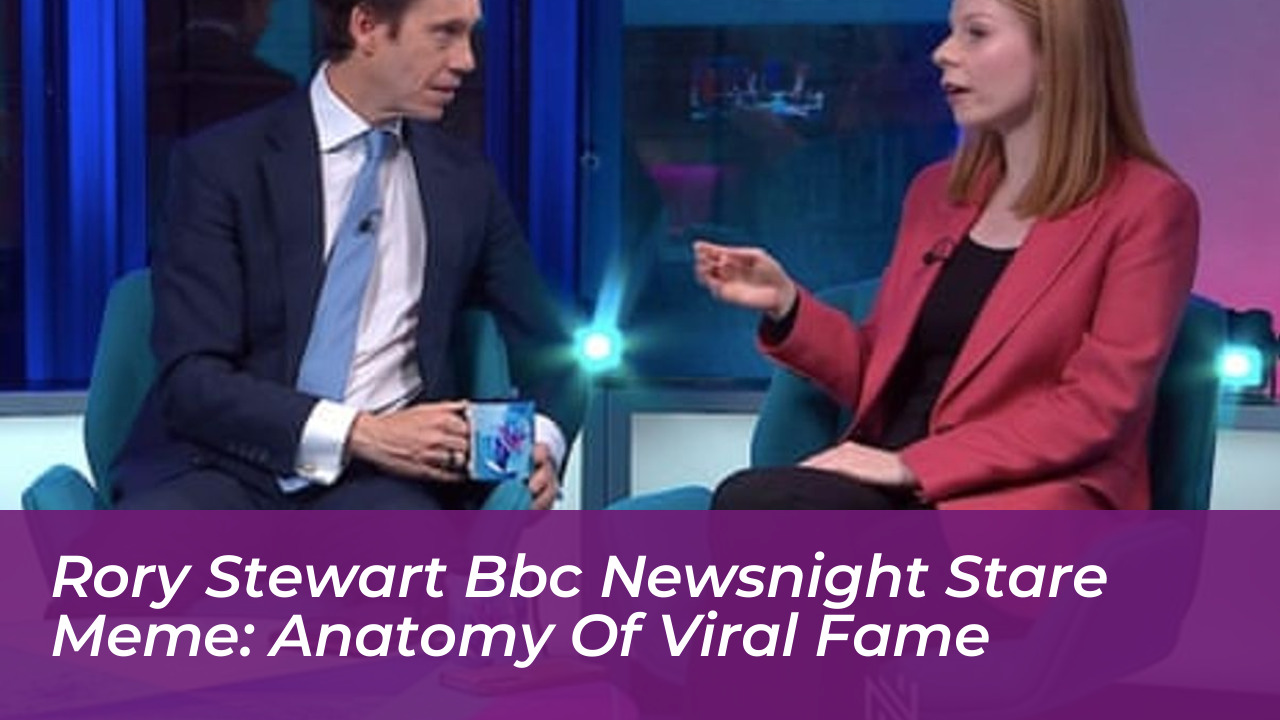

Former cabinet minister and political podcaster Rory Stewart found himself at the center of a massive digital storm after a routine appearance on BBC Newsnight. A mere four-second clip of his rapid chair swivel and unblinking gaze quickly transformed into a viral internet meme across multiple social media platforms. The instant virality of Stewart’s intense focus highlights the intersection of modern broadcasting conventions, active listening, and algorithm driven meme culture.
Introduction to the Rory Stewart Newsnight Stare Phenomenon
The September 18 BBC Newsnight broadcast featured a high-profile panel including Rory Stewart, veteran politician Neil Kinnock, and New Statesman political editor Ailbhe Rea. While the panel gathered to discuss serious international affairs, a fleeting physical reaction captured the public imagination in unexpected ways. A four-second snippet of Stewart pivoting rapidly in his seat and locking eyes onto a co-panellist became the blueprint for countless reaction GIFs and viral jokes.
This digital explosion happened within hours of the broadcast ending. Users on social media stripped the segment entirely of its geopolitical context, turning a serious discussion about artificial intelligence into surrealist comedy. The internet loves moments of authentic human eccentricity, and Stewart provided a masterclass in unintentional physical comedy.
The instant virality of Stewart’s intense focus highlights the intersection of modern broadcasting conventions, active listening, and algorithm-driven meme culture. It demonstrates how television production interacts with fast-moving digital ecosystems where single frames carry more weight than hours of policy debate.
Anatomy of a Viral Moment: Inside the BBC Studio
Setting the Scene on BBC Newsnight
The BBC flagship analysis program recently transitioned to an earlier 7 PM time slot. This scheduling change created a high-energy, fast-paced environment for the production crew and the invited guests. Under bright studio lights, the panel addressed major global headlines, specifically focusing on the intense technological race between the United States and China over artificial intelligence development.
Host Matt Chorley steered the conversation toward domestic Westminster policy regarding technological innovation. He directed a direct question to Ailbhe Rea, expecting a standard political exchange. Instead, the physical reaction of the panellist sitting next to her stole the entire show and shifted the public focus from artificial intelligence to human body language.
The Physics-Defying Chair Swivel
As Chorley addressed Rea, Stewart executed a rapid, physics-defying swivel in his studio chair. He pivoted toward his fellow guest with total bodily commitment, locking his eyes onto her with an unblinking, four-second gaze. The sheer intensity of the fixation contrasted sharply with standard broadcast panel etiquette, where guests usually maintain a relaxed posture or look toward the host.
Inside the physical studio, however, nobody noticed anything unusual. Crew members and fellow guests focused on the flow of conversation under the demanding live broadcast conditions. The telephoto lens and tight camera framing did the heavy lifting, amplifying a natural movement into a theatrical spectacle that looked entirely different through a glass camera lens.
Behind the Broadcast: Matt Chorley and Ailbhe Rea Respond
Matt Chorley Explains the Studio Reality
Matt Chorley addressed the viral phenomenon in interviews following the broadcast, admitting that the interaction felt completely normal inside the studio. He noted that public figures must constantly remember they remain visible on screen even when they are not actively speaking. The tight framing of modern television captures micro-expressions that might go entirely unnoticed in a normal room.
Chorley defended his fellow pundit by suggesting that Stewart simply engaged in active listening with characteristic academic intensity. Before the cameras rolled, Chorley even joked with his panellists about doing something wild to drive audience engagement. Ironically, Stewart achieved that exact goal without intending to do so.
Ailbhe Rea Embraces the Digital Attention
Ailbhe Rea welcomed the digital attention with good humor on social media. She shared the clip alongside a tongue-in-cheek request for similar levels of undivided professional focus during her daily interviews. Her lighthearted approach prevented the moment from turning awkward and helped fuel the humorous wave sweeping across digital platforms.
Public figures often struggle when viral moments distort their public image. Rea and Stewart both navigated the sudden spike in online traffic by leaning into the absurdity of the internet’s reaction, proving that self-awareness remains the best defense against viral mockery.
The Rise of a Digital Meme on Social Media
X, Reaction GIFs, and Surrealist Comedy
Users on X stripped the clip of its geopolitical context within hours of airing. The four-second segment quickly became a universal reaction GIF for awkward social scenarios, corporate human resources seminars, and childhood memories involving parental authority figures. The internet found endless ways to repurpose the wide-eyed concentration.
Notable reactions included a post from the official Larry the Cat account joking about active listening standards in the workplace. Chief executive of Total Politics Group Mark Wallace compared the visual energy to surrealist comedian Kevin Eldon, labeling the moment magnificently strange. The surreal nature of the stare resonated with audiences looking for comic relief.
Rory Stewart and a History of Accidental Internet Virality
This incident is not the first time Rory Stewart has inadvertently captured the internet’s imagination through unconventional public behavior. During his 2019 Conservative leadership campaign, Stewart pioneered a grassroots digital strategy featuring walking tour selfie videos hashtagged with the popular campaign tag #RoryWalks. While intended to project authenticity, those raw broadcasts frequently baffled observers.
Another notable prior digital moment involved Stewart filming a promotional clip in Kew Gardens while pretending to hold a personal smartphone. Critics quickly noticed the physical impossibility of the angle, and Stewart later admitted to faking the setup. This history of eccentric public moments positioned him uniquely for meme culture, ensuring that any unusual studio behavior would instantly trigger widespread digital engagement.
Beyond the Joke: The Psychology of Hyper-Focus in Modern Punditry
Breaking Broadcasting Conventions
Traditional media training teaches politicians and commentators to maintain steady eye contact with hosts or direct camera lenses. Stewart made an unorthodox choice to lock his eyes directly onto a co-panellist instead. This created an immediate visual disjuncture that breaks standard television rules.
Human psychology naturally flags intense, unblinking visual fixations as anomalous. When viewers see someone staring with absolute physical dedication in a casual setting, the brain registers it as unusual. This psychological trigger explains why the clip stopped scrollers in their tracks and forced them to rewatch the segment multiple times.
The Algorithmic Reward for Micro-Expressions
Short-form video algorithms on platforms like TikTok and Instagram Reels heavily favor rapid visual changes within the opening seconds of a video. The sudden chair swivel acted as a powerful visual hook that bypassed traditional political apathy. Algorithms amplify content where unexpected human behavior occurs, proving that silent visual anomalies outperform standard political rhetoric in audience retention metrics.
As modern media consumers shift toward bite-sized video formats, physical eccentricity wins over policy depth in the attention economy. A four-second physical adjustment generates millions of impressions, while a well-reasoned argument on artificial intelligence policy struggles to cross standard view thresholds.
Strategic Takeaways for Modern Media Engagement
The Rory Stewart Newsnight incident offers a clear lesson in how digital audiences consume political discourse through hyper-concentrated visual fragments. Public figures no longer control their narrative once a single camera frame is extracted from live television and fed into algorithmic recommendation engines.
| Traditional Media | Modern Digital Media |
|---|---|
| Long-form policy analysis | Bite-sized visual clips |
| Controlled studio environment | Extracted reaction GIFs |
| Focus on spoken rhetoric | Amplification of micro-expressions |
The boundaries between serious global affairs analysis and internet entertainment continue to blur in multi-platform streaming environments. While Rory Stewart remains a respected intellectual voice on international politics, his digital legacy is now permanently intertwined with a rapid chair swivel and the boundless creativity of internet culture.