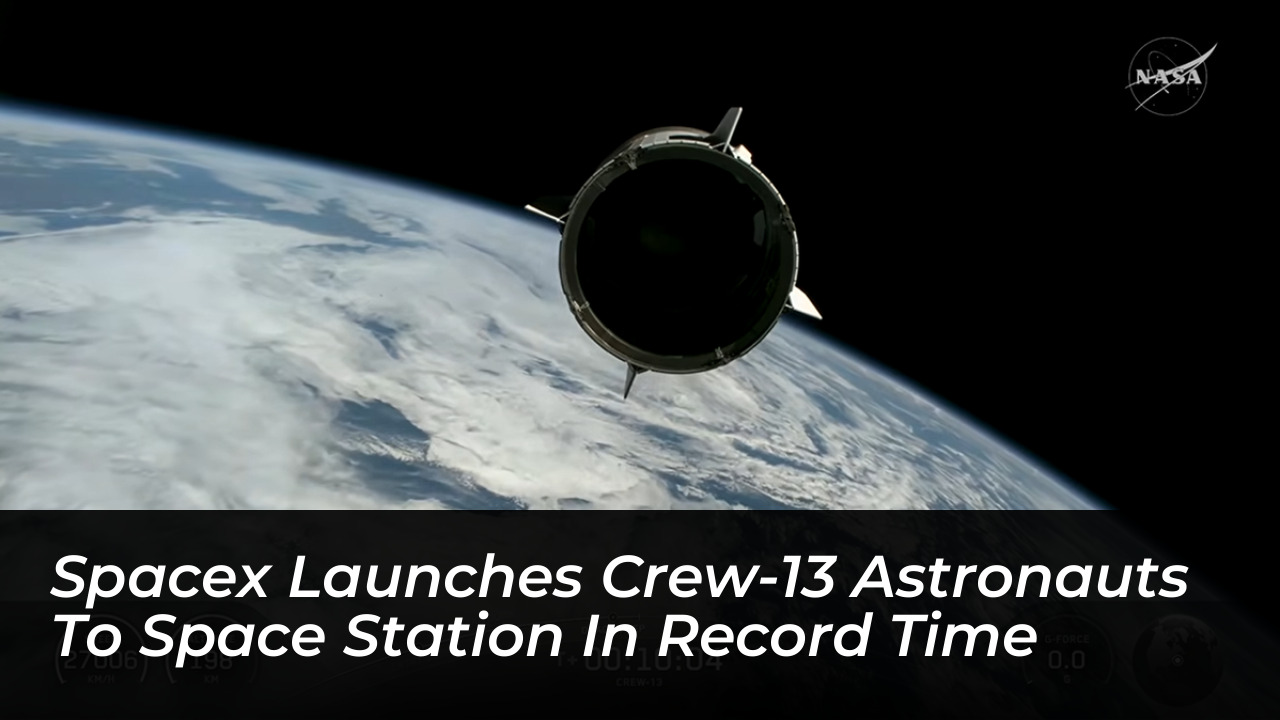
SpaceX successfully launched NASA’s Crew-13 mission aboard a Falcon 9 rocket at 11:10 a.m. EDT on Thursday, Oct. 1, 2026. The flight sent four astronauts toward the International Space Station (ISS) on the fastest American trip to orbit in history. Liftoff occurred at Launch Complex-40 from Cape Canaveral Space Force Station in Florida. The launch followed a brief prelaunch delay from August due to an oxidizer leak in the spacecraft propulsion system.
Fastest Journey to the International Space Station
The Crew Dragon spacecraft, named “Grace,” is scheduled to autonomously dock at the forward port of the station’s Harmony module at approximately 7:00 p.m. EDT. The entire transit will take just seven hours and 50 minutes. This sets a new speed record for a U.S. spacecraft reaching the orbiting laboratory. Typically, Crew Dragon missions require between 15 and 24 hours to catch up to the space station.
During a prelaunch briefing, SpaceX executives explained that favorable orbital mechanics and a recent orbit adjustment maneuver performed by the space station created an ideal alignment. Julianna Scheiman, director of NASA science and dragon programs at SpaceX, noted that the positioning allowed for the shortest launch-to-docking profile achieved to date.
International Crew Members and Mission Objectives
The Crew-13 mission carries a diverse, four-person international crew for a planned six-month science expedition:
- Jessica Watkins (NASA): Mission commander, making history as the first NASA astronaut to launch aboard a Crew Dragon spacecraft for a second time.
- Luke Delaney (NASA): Mission pilot on his first spaceflight.
- Joshua Kutryk (Canadian Space Agency): Mission specialist bringing a 100-year-old family pocket watch as a historical heirloom.
- Sergey Teteryatnikov (Roscosmos): Mission specialist representing the Russian space agency.
Following orbital insertion and separation of the second stage, booster B1101 executed a successful boostback burn and touched down at the landing zone adjacent to Launch Complex-40. Ground teams then welcomed the astronauts to space, with Commander Watkins radioing back to Mission Control, “Thanks for an amazing ride.”
Scientific Research and Expedition Schedule
Once safely aboard the orbiting laboratory, the Crew-13 members will integrate with the Expedition 75 crew. After a brief handover period, the outgoing Crew-12 team will depart the station and return to Earth. The outgoing team consists of NASA astronauts Jessica Meir and Jack Hathaway, ESA astronaut Sophie Adenot, and Roscosmos cosmonaut Andrey Fedyaev.
During their six-month stay, the Crew-13 astronauts will oversee vital microgravity investigations and station maintenance. Primary research objectives include:
- Producing human stem cell-derived tissues in microgravity to advance personalized medicine and pharmaceutical testing for conditions like heart disease and Parkinson’s disease.
- Testing a new, mostly autonomous plant growth system to improve crop production for long-duration deep space exploration.
- Examining factors linked to blood-flow abnormalities in microgravity.
- Testing new inflight diagnostic medical devices to monitor astronaut health.
The mission highlights ongoing commercial partnerships under NASA’s Low Earth Orbit Program. This ensures continuous human presence and research capabilities as the space station approaches its 26th year of continuous operations.