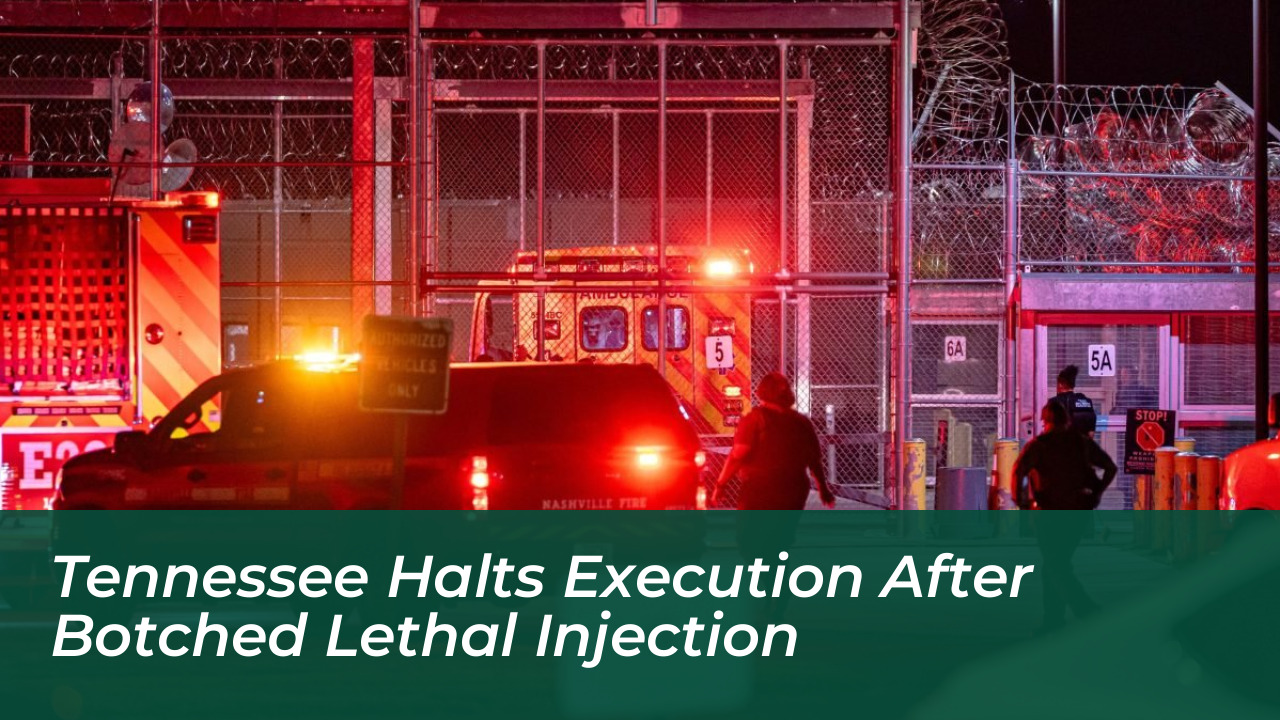
Tennessee prison officials failed to execute death row inmate Christa Pike on Wednesday night at the Riverbend Maximum Security Institution following two unsuccessful lethal injection attempts for the 1995 murder of Colleen Slemmer. Following the failed execution attempt, Governor Bill Lee announced a temporary hold on the state’s remaining 2026 execution schedule, postponing the execution of Gary Wayne Sutton scheduled for Dec. 3, and ordering a comprehensive third-party review of the procedure.
- An Unprecedented Execution Failure
- Governor Lee Orders Third-Party Review
- Background of the 1995 Case
- Frequently Asked Questions About Christa Pike’s Case
- Why was Christa Pike sentenced to death?
- What went wrong during the execution attempt?
- What action did Tennessee Governor Bill Lee take following the incident?
- What is Tennessee’s current lethal injection protocol?
- Who were the co-defendants in the 1995 murder case?
Defense attorneys confirmed that Pike survived despite receiving two full 50-milliliter doses of pentobarbital, prompting emergency legal filings with federal and state courts to secure immediate life-saving care for the inmate. She was subsequently transported by ambulance from the prison to an off-site medical facility.
An Unprecedented Execution Failure
Pike, 50, had been scheduled for execution at 10 a.m. Wednesday for the killing she committed at age 18. Her case had drawn intense legal scrutiny because she would have been the first woman executed in Tennessee in more than 200 years. An appeals court stopped the lethal injection just an hour before it was slated to start, but hours later, the U.S. Supreme Court overturned that stay in a 6-3 decision, clearing the path for the procedure to proceed.
Media witnesses observing from a separate room noted that officials raised the curtains to the execution chamber at 7:27 p.m., revealing Pike strapped to a gurney. In her final statements, Pike told witnesses she was going to leave the world in love and described herself as at peace. However, she also raised her head at one point and asked prison officials if her arm was supposed to feel a certain way, noting that one spot was throbbing.
By 8:26 p.m., witnesses reported that the second dose of pentobarbital had been administered. Pike continued to be heard audibly snoring behind the closed curtain until the microphone was cut off at 8:53 p.m., at which point media witnesses were escorted out of the area as emergency vehicles arrived.
Robin M. Maher, executive director of the Death Penalty Information Center, characterized the incident as singular and unparalleled. While other inmates have survived execution attempts due to medical teams failing to access veins, experts noted no one had previously stayed alive after receiving multiple full doses of the execution drugs.
Governor Lee Orders Third-Party Review
In response to the botched execution, Governor Bill Lee issued a statement announcing an immediate suspension of the state’s remaining execution calendar for the year.
Carrying out a lawfully imposed sentence is among the State’s most serious responsibilities, and the people of Tennessee expect it to be done in a manner that is not only legal and constitutional, but is effective.
The Tennessee Department of Correction maintained that staff followed every step of the state’s lawful, established execution protocol approved by the Attorney General’s Office. The protocol dictates that a secondary set of drug syringes be administered if the inmate is not deceased after the first set, though it does not outline procedures for instances where the inmate remains alive following the secondary dose.
This incident marks the second time in 2026 that Tennessee has been unable to carry out a scheduled lethal injection. In May, state officials abandoned the execution of Tony Carruthers after executioners tried and failed for over an hour to establish IV access.
Background of the 1995 Case
Pike was convicted of the 1995 torture, beating, and fatal stabbing of 19-year-old Colleen Slemmer, a fellow classmate at a Job Corps training facility in Knoxville. Prosecutors stated that Pike lured Slemmer to a wooded area out of jealousy, fearing the victim was trying to steal her boyfriend. During the attack, Pike and co-defendant Tadaryl Shipp used a box cutter and a large chunk of asphalt to kill Slemmer, while Shipp carved a pentagram into the victim’s body. Shipp, who was 17 at the time of the crime, received a life sentence with the possibility of parole, while Pike received the death penalty.
As legal teams and medical experts assess Pike’s current condition following the administration of the lethal doses, the broader debate surrounding the constitutionality of the state’s execution protocols and capital punishment for young offenders has intensified across the legal landscape.
Frequently Asked Questions About Christa Pike’s Case
Why was Christa Pike sentenced to death?
Christa Pike was sentenced to death in 1996 for the premeditated kidnapping, torture, and murder of 19-year-old Colleen Slemmer in January 1995 in Knoxville, Tennessee.
What went wrong during the execution attempt?
Pike was administered two full doses of the lethal drug pentobarbital but failed to die. Witnesses and legal counsel reported that she remained conscious, responsive, and audibly snoring after both injections before being transported to an off-site hospital.
What action did Tennessee Governor Bill Lee take following the incident?
Governor Bill Lee ordered a comprehensive, third-party review of the execution procedure and halted the remaining scheduled executions in the state for the remainder of 2026.
What is Tennessee’s current lethal injection protocol?
Tennessee utilizes a single-drug protocol consisting of pentobarbital. The established protocol mandates a secondary set of drug syringes if the inmate is not deceased after the initial set.
Who were the co-defendants in the 1995 murder case?
Tadaryl Shipp, who was 17 at the time, was sentenced to life in prison with parole eligibility, and Shadolla Peterson received probation for serving as an accessory after the fact.