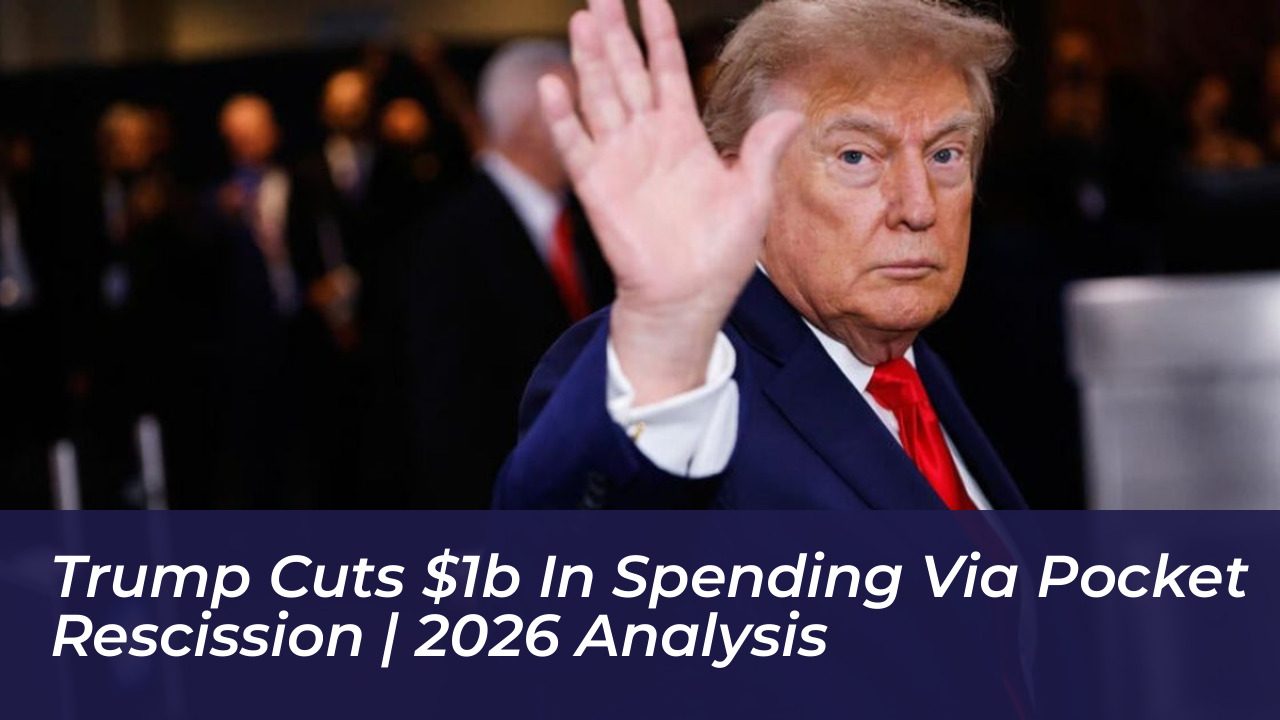
President Donald Trump moved to cancel nearly 1 billion dollars in congressionally approved spending on Friday, September 25, 2026. The administration deployed a rare budget mechanism known as a pocket rescission just five days before the federal fiscal year concluded. This maneuver eliminates unspent funds across multiple federal departments, igniting a constitutional battle over executive power. Understanding this executive action requires examining the specific agency breakdowns, the statutory mechanics of pocket rescissions, legislative pushback, and the hidden operational impacts on sub-grantees.
- Overview of the Budget Rescissions and Impacted Agencies
- Department of Health and Human Services Cuts
- Housing, Education, and International Grants
- Summary Table of Rescinded Federal Funds
- The Mechanics of the Pocket Rescission
- Bypassing the Congressional Review Period
- Historical Precedent and Legal Standing
- Constitutional Confrontation and Legislative Backlash
- Reactions from Senate Appropriations Leaders
- Hidden Operational Impacts on Sub-Grant Recipients
- Macroeconomic Consequences on Municipal and International Finance
- Implications for Future Federal Budgets
- Frequently Asked Questions
- What is a pocket rescission?
- How much money was cut by the administration?
- Which federal agency faced the largest funding reduction?
- Is the pocket rescission legal under current federal law?
Overview of the Budget Rescissions and Impacted Agencies
The White House Office of Management and Budget described the cuts as an effort to eliminate harmful and wasteful government spending. The strategic goals cited by the administration focus entirely on waste reduction and policy alignment with executive priorities. The rescissions target eleven pools of unspent money across seven federal departments and agencies, totaling approximately $810 million to $1 billion depending on the accounting metrics used by federal auditors.
These cuts represent a concentrated effort to claw back funds that federal agencies failed to obligate before the fiscal year deadline. By targeting unspent balances, the executive branch aims to redirect federal priorities without waiting for new legislative packages to pass through Congress. Critics argue this approach undermines the foundational principle that Congress alone dictates federal spending priorities.
Department of Health and Human Services Cuts
The largest single reduction hits the Department of Health and Human Services directly. The administration pulled $567 million originally appropriated for refugee and migrant social services. Officials justified this action by pointing to a sharp decline in illegal border crossings over the preceding year, which reduced the immediate demand for localized social support infrastructure.
Additional cuts within the department include $28 million pulled from ideological and duplicative grants, alongside $5 million diverted from the Office of Minority Health. These specific programs faced intense scrutiny from conservative policy analysts who argued that the funded initiatives overlapped with state-level responsibilities or promoted contentious social agendas.
Housing, Education, and International Grants
Housing and Urban Development programs lost $56 million earmarked for outside housing counseling organizations. The administration argued these funds promoted diversity, equity, and inclusion agendas aligned with political advocacy groups rather than practical housing construction. This rationale reflects a broader push to defund programs perceived as ideological.
Meanwhile, international education grants face a $70 million reduction, and the Department of Education migrant student initiative lost $25 million. The Department of Justice and the Department of Homeland Security experienced a combined $30 million cut to community relations and immigrant legal services programs, signaling a wide-ranging pullback across multiple domestic policy arenas.
Summary Table of Rescinded Federal Funds
To understand the full financial scope of the executive action, a detailed breakdown of targeted agencies, exact amounts rescinded, and specific program categories is necessary. The following data visualization table summarizes the primary funding reductions across federal departments.
| Federal Department / Agency | Amount Rescinded | Targeted Program Category |
|---|---|---|
| Department of Health and Human Services | $567 Million | Refugee and migrant social services |
| International Assistance Programs | $70 Million | Foreign academic fellowships and grants |
| Housing and Urban Development | $56 Million | Housing counseling and outside grants |
| Department of Health and Human Services | $28 Million | Ideological and exploratory research grants |
| Department of Education | $25 Million | Migrant student support initiatives |
| Department of Justice / DHS | $30 Million | Community relations and immigrant legal services |
The Mechanics of the Pocket Rescission
Under the Congressional Budget and Impoundment Control Act of 1974, a president may request the cancellation of previously appropriated funds. The statutory framework normally grants Congress 45 legislative days to review the proposed changes before funds are permanently withheld. This framework was designed to maintain a balance of power between the legislative and executive branches during budget execution.
However, the timing of the recent executive action short-circuits this traditional review window. By announcing the cuts with only five days remaining in the fiscal year, the executive branch effectively nullifies the required congressional debate. Unspent funds expire automatically when the fiscal year ends on September 30, neutralizing legislative pushback by eliminating the voting window entirely.
Bypassing the Congressional Review Period
The strategic deployment of the pocket rescission relies heavily on the calendar. Standard rescission requests require extensive debate, committee hearings, and floor votes. These administrative steps make it impossible for Congress to act within a five-day window.
By letting the clock run out on the fiscal year, the administration ensures that the unspent funds evaporate into the Treasury general fund automatically. This maneuver bypasses the standard legislative oversight mechanisms embedded in the 1974 budget act, setting a contentious precedent for future executive budgets.
Historical Precedent and Legal Standing
Pocket rescissions remain extremely rare in modern American political history. Prior to last year, when Trump blocked $4.9 billion in foreign aid, a pocket rescission had not occurred in nearly 50 years. The Government Accountability Office maintains that the practice is illegal under the Impoundment Control Act.
Despite warnings from congressional watchdogs, the executive branch relies on historical actions from the Ford and Carter administrations to defend the legality of the maneuver. Legal scholars remain divided on whether these historical precedents hold weight against the explicit text of the 1974 budget reform legislation.
Constitutional Confrontation and Legislative Backlash
The sudden clawback triggered immediate bipartisan condemnation from key congressional leaders. Lawmakers view the maneuver as a direct usurpation of legislative authority and an assault on the power of the purse. This confrontation deepens existing divisions between Capitol Hill and the executive branch.
Both Republican and Democratic leaders expressed alarm over the bypass of established statutory procedures. The dispute centers on whether the executive branch can unilaterally override congressional appropriations by exploiting expiration dates at the end of the fiscal year.
Reactions from Senate Appropriations Leaders
Senator Susan Collins, a Republican and chair of the Senate Appropriations Committee, called the action unlawful and stated it occurred without warning or consultation. Collins emphasized that the Office of Management and Budget lacks the unilateral authority to determine which federal programs deserve funding once appropriations bills become law.
Senator Patty Murray, the lead Democrat on the committee, described the move as theft from taxpayers and a direct violation of bipartisan agreements. Murray highlighted the disruption these sudden cancellations cause for federal agencies trying to execute long-term policy goals established by Congress.
Hidden Operational Impacts on Sub-Grant Recipients
While mainstream media reports focus strictly on the political fallout between Capitol Hill and the White House, secondary non-profits face severe operational bottlenecks. Organizations that completed grant milestones months ago now face retroactive clawbacks on disbursed funds. This administrative chaos disrupts cash flow for localized community centers that relied on federal backing to maintain payrolls through the transition.
The bureaucratic uncertainty forces local directors to halt community outreach programs abruptly. Secondary contractors often lack the legal reserves to fight federal clawbacks, leaving them vulnerable to sudden insolvency when funds promised by Congress vanish overnight.
Macroeconomic Consequences on Municipal and International Finance
The cancellation of Treasury programs like the Tropical Forest and Coral Reef Conservation Act alters bilateral debt-for-nature swaps. Emerging market sovereign debt structures depend on these exact funding allocations to secure lower borrowing costs. Cutting these minor pools creates ripple effects across international development finance that standard domestic political coverage completely ignores.
Municipal bond markets also feel the pressure as local governments scramble to replace lost federal matching funds. When federal grants disappear mid-cycle, local municipalities must either raise local taxes or abandon critical infrastructure projects, impacting regional economic stability.
Implications for Future Federal Budgets
This confrontation complicates ongoing negotiations regarding government funding and future appropriations bills. Lawmakers attempting to audit unspent agency funds now face an assertive executive branch willing to utilize obscure statutory loopholes. Trust between the branches has eroded significantly.
Anticipated court challenges from advocacy groups and congressional caucuses will likely define the strict boundaries of presidential impoundment power in the coming months. The judicial system will ultimately decide whether the pocket rescission remains a viable tool for future administrations.
Frequently Asked Questions
What is a pocket rescission?
A pocket rescission is an executive maneuver where a president withholds spending late in the fiscal year to let funds expire naturally.
How much money was cut by the administration?
The Trump administration canceled approximately $810 million to $1 billion in unspent federal funds.
Which federal agency faced the largest funding reduction?
The Department of Health and Human Services absorbed the largest cut, losing $567 million for refugee and migrant services.
Is the pocket rescission legal under current federal law?
Government watchdogs argue it violates the 1974 Congressional Budget and Impoundment Control Act, leading to ongoing legal debates.