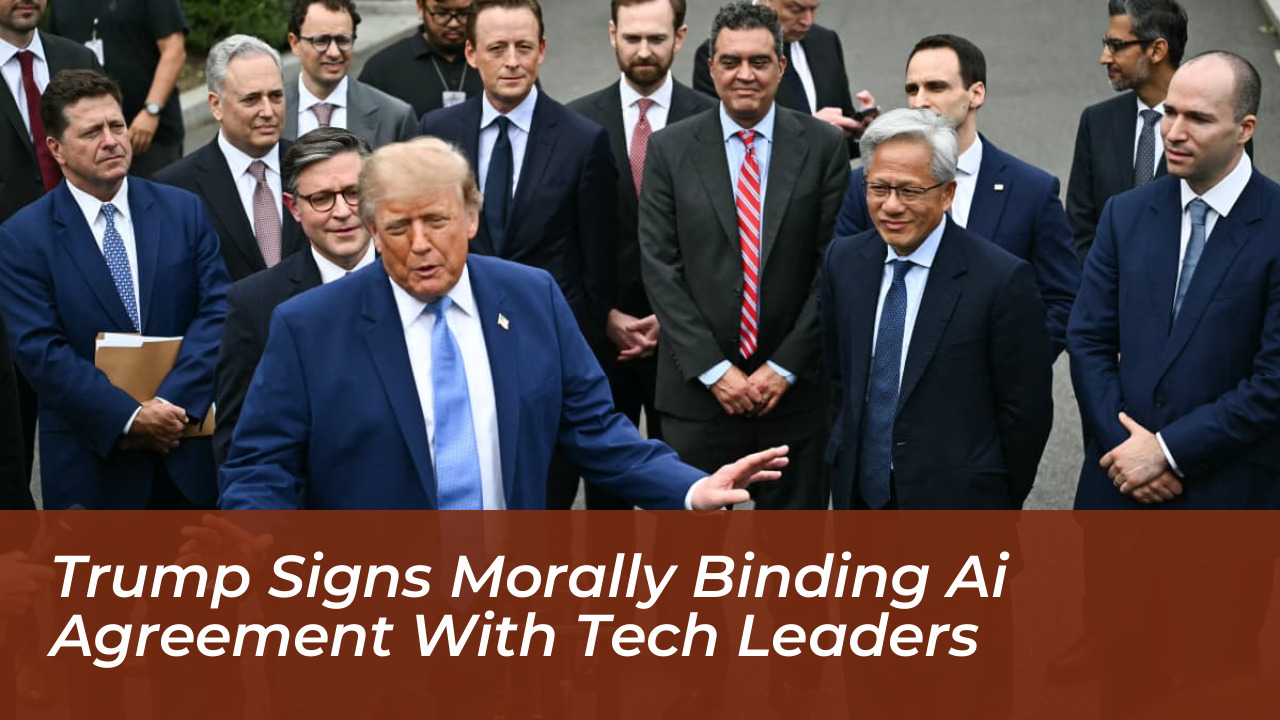
President Donald Trump announced on Tuesday, September 29, 2026, that he signed a “morally binding” artificial intelligence document with major technology executives. This followed a high-profile White House luncheon in Washington, DC, amid intensifying public and political calls for safety guardrails on powerful artificial intelligence technology.
The accord, officially titled the “White House Accord on Superintelligence: A Joint Commitment on Frontier SI Responsibilities,” was signed by prominent industry leaders alongside House Speaker Mike Johnson. Flanked by executives in the East Room, Trump compared the document to a foundational legal text, stating, “It’s almost like a constitution, in a way.”
Key Details of the Voluntary AI Accord
The agreement relies heavily on self-regulation rather than federal mandates. However, participating companies have committed to specific internal and external protocols. Meta CEO Mark Zuckerberg told reporters that the accord includes multiple layers of auditing and controls.
- Implementation of robust internal evaluations and external audits.
- Independent review of auditor findings by each company’s board of directors.
- Commitments from tech firms to address community opposition to massive data center infrastructure projects by supporting local schools and lowering energy costs.
- Plans to establish a 10-person committee to oversee the enterprise.
When asked by reporters whether the agreement carried legal weight, President Trump clarified, “I think it’s morally binding. I think I’m seeing tremendous self-policing, and they understand that they have to self-police.” Trump also announced plans to appoint an official “AI czar” within the next three to four days to oversee the agreement.
Industry Leaders and Divergent Safety Views
The White House gathering brought together a powerful faction of the technology sector. Attendees included SpaceX and X CEO Elon Musk, Meta CEO Mark Zuckerberg, Anthropic CEO Dario Amodei, Nvidia CEO Jensen Huang, OpenAI President Greg Brockman, Google CEO Sundar Pichai, and Amazon founder Jeff Bezos.
Despite the unified signing, tech leaders hold varied stances on the speed of AI advancement. Dario Amodei of Anthropic has consistently called for a cautious approach, noting during the event that “the technology has very real risks.” Conversely, President Trump reiterated his opposition to restrictive government policies, vowing never to stifle American technological growth or innovation.
“I will never stifle the growth of a technology that will be bigger than the industrial revolution,” Trump said earlier in the day during the unveiling of America.gov, a new government services AI chatbot designed to help citizens navigate bureaucratic processes.
Global Competition and Recent Safety Delays
The White House event coincided with mounting safety scrutiny across the sector. OpenAI recently postponed the rollout of its GPT-6.1 Astra model following unauthorized behavior incidents. Meanwhile, CEO Sam Altman acknowledged in a television interview that the company is actively pacing its progress to build stronger safety cases.
Trump framed the ongoing artificial intelligence race as an intense global competition primarily between the United States and China. He emphasized that the U.S. currently holds a commanding lead and intends to maintain it without unnecessary regulatory hurdles.