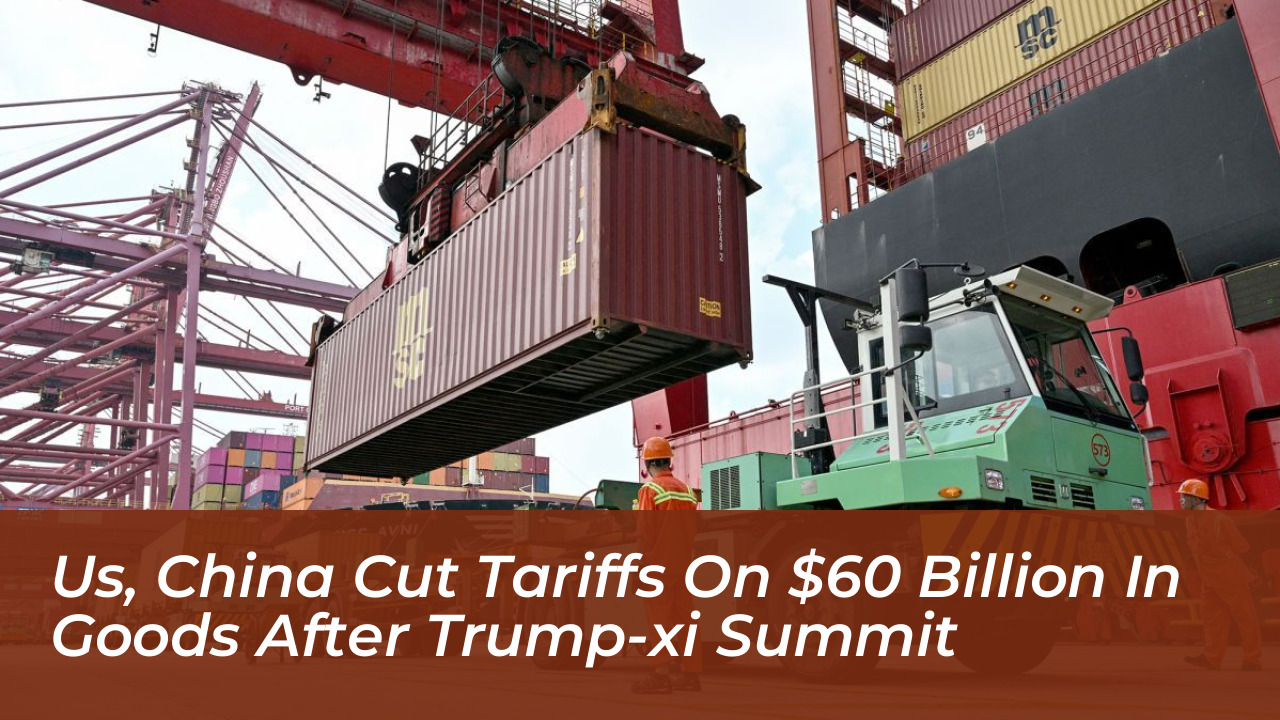
The United States and China agreed to reduce tariffs on $60 billion worth of traded goods, splitting the reductions evenly at $30 billion each, following a summit between President Donald Trump and President Xi Jinping in Washington last week. Both governments announced the deal on September 27, 2026, framing it as a step toward easing trade tensions that have persisted for years.
Under the arrangement, the United States will lower duties on 77 categories of Chinese imports, including toys, sports equipment, household appliances, tableware, blankets, bed linens, artificial flowers, Christmas tree lamps and other holiday decorations, as well as children’s car seats. China, for its part, will cut tariffs on 1,619 product categories, heavily weighted toward American agricultural exports such as corn, wheat, sorghum, meat, dairy, vegetable oils and meals, along with fish and seafood, logs and wood products, cosmetics and medical devices. Notably, soybeans were excluded from China’s list.
Trade Deficit and Market Access Goals
Washington has long pressed Beijing to narrow a goods trade deficit that exceeded $202 billion last year. U.S. Trade Representative Jamieson Greer said the tariff reductions would improve market access for roughly 30 percent of U.S. exports to China, benefiting farmers, manufacturers and businesses. The White House described the Chinese commitments as unlocking improved market access for American producers.
This reciprocal tariff reduction as well as an extension of a trade truce were among the key takeaways from the second summit this year between Chinese President Xi Jinping and President Donald Trump, hosted in Washington last week.
USTR statement, September 28, 2026
Coal Imports and Agricultural Working Group
The presidential summit also produced an agreement for China to import 10 million metric tons of U.S. coal annually in 2027 and 2028, an amount equal to about 2 percent of China’s yearly coal imports. Liquefied natural gas and oil were not included. China’s commerce ministry said the coal purchases would supplement domestic supply while providing stable income and employment for the U.S. coal industry.
Both sides will establish an agriculture working group under a trade council, slated to hold its first meeting before year-end to discuss two-way market access and regulatory issues. China has already resumed large-scale purchases of American soybeans under a prior deal targeting 25 million metric tons annually.
Trade Truce Extended Through January
China’s commerce ministry confirmed Monday a two-month extension of the existing trade truce through January 10, 2027, saying it would provide a “relatively stable and predictable policy environment” for companies and allow continued discussions. Both sides committed to regular talks on investment opportunities and barriers, enhanced policy transparency, and responses to enterprise concerns.
AI, Financial Services and Aviation
Beyond goods, the two governments agreed to establish a communication channel for artificial intelligence incidents, with a follow-up dialogue planned by the end of November. China also said it would examine and approve foreign financial services institutions, including those with American capital, to conduct business and open branches in China. Discussions on increasing direct flights between the two countries will continue.
Market Reaction
Chinese stocks fell sharply on Monday following the announcements, with the blue-chip CSI 300 index sliding more than 2 percent to a one-year low. Technology shares declined amid a bipartisan U.S. push to ban Chinese components from data centers. Analysts noted that investors had hoped for more concrete details from the leaders’ summit, and underlying tensions – particularly around technology restrictions – resurfaced quickly.
Background
The tariff cuts mark the latest chapter in a trade relationship that has oscillated between confrontation and negotiation since 2018. The two economies have imposed successive rounds of duties on hundreds of billions of dollars in each other’s goods, disrupting supply chains and raising costs for consumers and businesses. The current agreement covers a modest slice of total bilateral trade, which topped $575 billion last year, but officials on both sides characterized it as a confidence-building measure.
USTR Greer emphasized that the reductions apply to non-sensitive goods and were recommended through the U.S.-China Board of Trade. China’s commerce ministry described the truce extension as creating space to evaluate the ongoing arrangement and advance talks on resolving economic and trade issues.