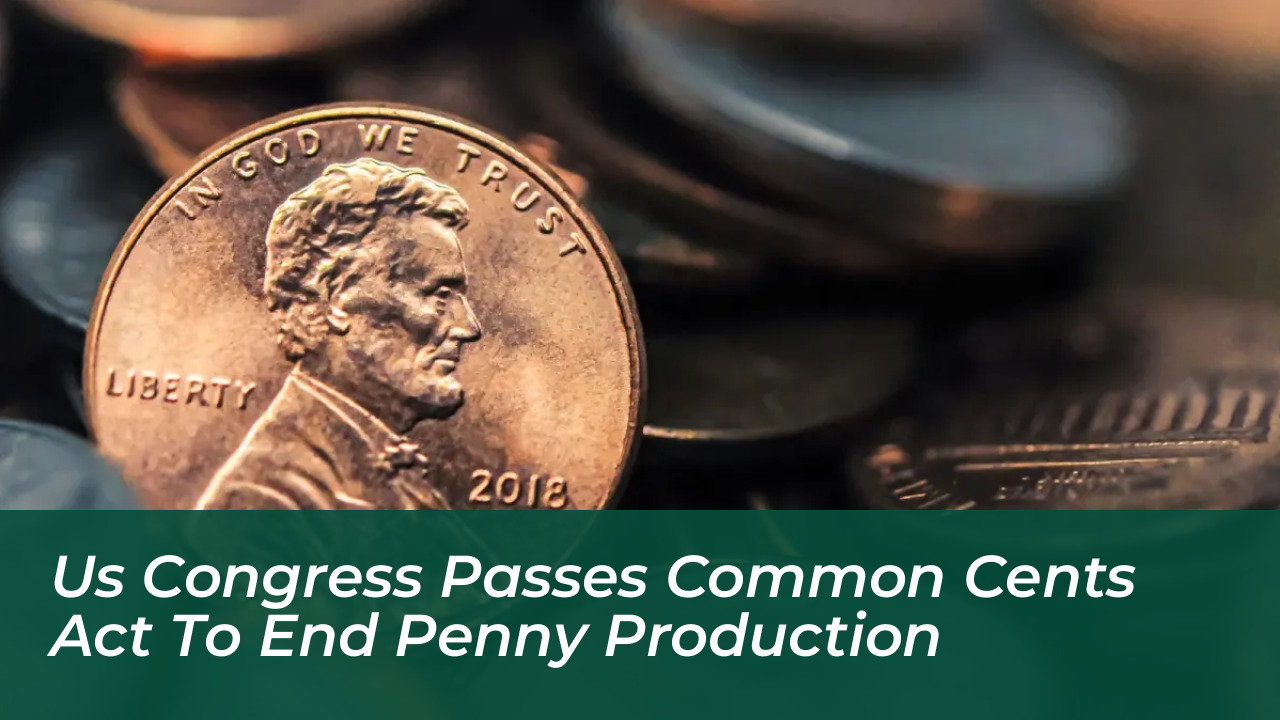
The U.S. Senate passed the bipartisan Common Cents Act on Monday, September 28, 2026, sending the legislation to President Donald Trump. The measure officially ends the production of the 1-cent coin after 234 years and provides retailers with a nationwide framework for rounding cash transactions to the nearest nickel.
- Why Congress Ended Penny Production
- How Cash Rounding Will Work for Retailers
- Industry Response and Additional Provisions
- Frequently Asked Questions About the Common Cents Act
- What is the Common Cents Act?
- Are my existing pennies still worth anything?
- Does cash rounding apply to credit card and online purchases?
- Why was penny production stopped?
- Will nickels also be changed or eliminated?
Sponsored by Reps. Lisa McClain, R-Mich., and Robert Garcia, D-Calif., alongside Sens. Cynthia M. Lummis, R-Wyo., and Kirsten Gillibrand, D-N.Y., the bill aligns federal law with executive action. President Trump previously ordered the Treasury Department to cease minting pennies, leading to the final batch of standard pennies being struck in November 2025. President Trump is expected to sign the bill into law in the coming weeks.
Why Congress Ended Penny Production
For decades, the cost of manufacturing a penny far outpaced its face value. By 2023, producing a single penny cost the U.S. Mint nearly four cents, resulting in a total annual loss of $179 million. Data from 2024 showed taxpayers spent $85.3 million to mint nearly 3.2 billion pennies, with each coin costing about 3.69 cents to produce-marking the 19th consecutive year that production costs exceeded face value.
Supporters of the Common Cents Act emphasize that cutting out penny production reduces federal waste, lowers environmental costs, and speeds up retail transactions.
“If the federal government is spending nearly four cents to make a penny worth one cent, something is broken. Republicans are proving that common sense still has a place in government by cutting waste and protecting taxpayer dollars,” said Congresswoman Lisa McClain.
Congressman Robert Garcia added that the legislation addresses everyday financial burdens. “American families are struggling with inflation and high costs of living across the country, and we need to be investing taxpayer dollars in programs that meet Americans where they are,” Garcia stated.
How Cash Rounding Will Work for Retailers
With the 1-cent coin phased out, the Common Cents Act establishes clear guidelines for businesses processing physical cash payments when exact change is unavailable. The rounding rules apply exclusively to cash transactions:
- Amounts ending in 1, 2, 6, or 7 cents: Rounded down to the nearest nickel.
- Amounts ending in 3, 4, 8, or 9 cents: Rounded up to the nearest nickel.
- Transactions totaling 1 or 2 cents: Rounded up to 5 cents.
Electronic transactions-such as credit cards, debit cards, checks, electronic transfers, gift cards, and money orders-are completely unaffected by the rounding rules, as they can process exact digital amounts down to the exact penny.
Businesses are not legally mandated to round transactions and may choose to absorb costs or round in the customer’s favor. Existing pennies currently in circulation will not disappear or lose value; they will remain legal tender indefinitely for debts, taxes, and private transactions, while the U.S. Mint may continue producing limited runs of pennies for coin collectors.
Industry Response and Additional Provisions
Major retail and hospitality trade groups, including the National Restaurant Association and the National Association of Convenience Stores, praised the passage of the bill. Retail operators emphasized that clear federal guidelines are critical to managing the transition smoothly as circulating pennies gradually disappear from daily commerce.
Beyond ending the penny, the Common Cents Act addresses other long-standing monetary challenges at the U.S. Mint:
- Lower-Cost Nickels: Because nickels currently cost roughly 13 cents to produce, the legislation authorizes the Treasury Secretary to test alternative, lower-cost metal compositions-such as an inner layer of zinc and an outer layer of nickel-provided they work in existing coin-operated machines.
- Advance Notice Requirement: The revised bill includes language requiring the Treasury Department to give Congress 60 days of advance notice before discontinuing any other circulating coin.
- Impact Studies: Federal officials are directed to study how penny shortages and cash-rounding practices affect low-income communities, older Americans, and unbanked or underbanked populations. Over 300 billion pennies are estimated to remain out in the American economy.
With final congressional clearance achieved, the formal end of the American penny moves to President Trump’s desk for his signature, marking a historic shift in U.S. currency history dating back to the Coinage Act of 1792.
Frequently Asked Questions About the Common Cents Act
What is the Common Cents Act?
The Common Cents Act is a bipartisan piece of federal legislation that officially ends the production of the U.S. 1-cent coin (penny) and establishes a nationwide framework for rounding cash transactions to the nearest nickel.
Are my existing pennies still worth anything?
Yes. All existing pennies will remain legal tender indefinitely for cash debts, taxes, and retail purchases. They do not lose their value, and the U.S. Mint may continue to produce limited quantities for numismatic collectors.
Does cash rounding apply to credit card and online purchases?
No. Cash rounding rules apply strictly to physical cash payments. Credit cards, debit cards, checks, gift cards, and electronic transfers will continue to process exact amounts down to the exact cent.
Why was penny production stopped?
Producing a single penny cost the U.S. government nearly four cents-significantly more than its one-cent face value-costing taxpayers tens of millions of dollars annually for nearly two decades.
Will nickels also be changed or eliminated?
Nickels are not being eliminated, but the Common Cents Act authorizes the Treasury Secretary to test cheaper metal compositions to reduce the high cost of minting nickels.