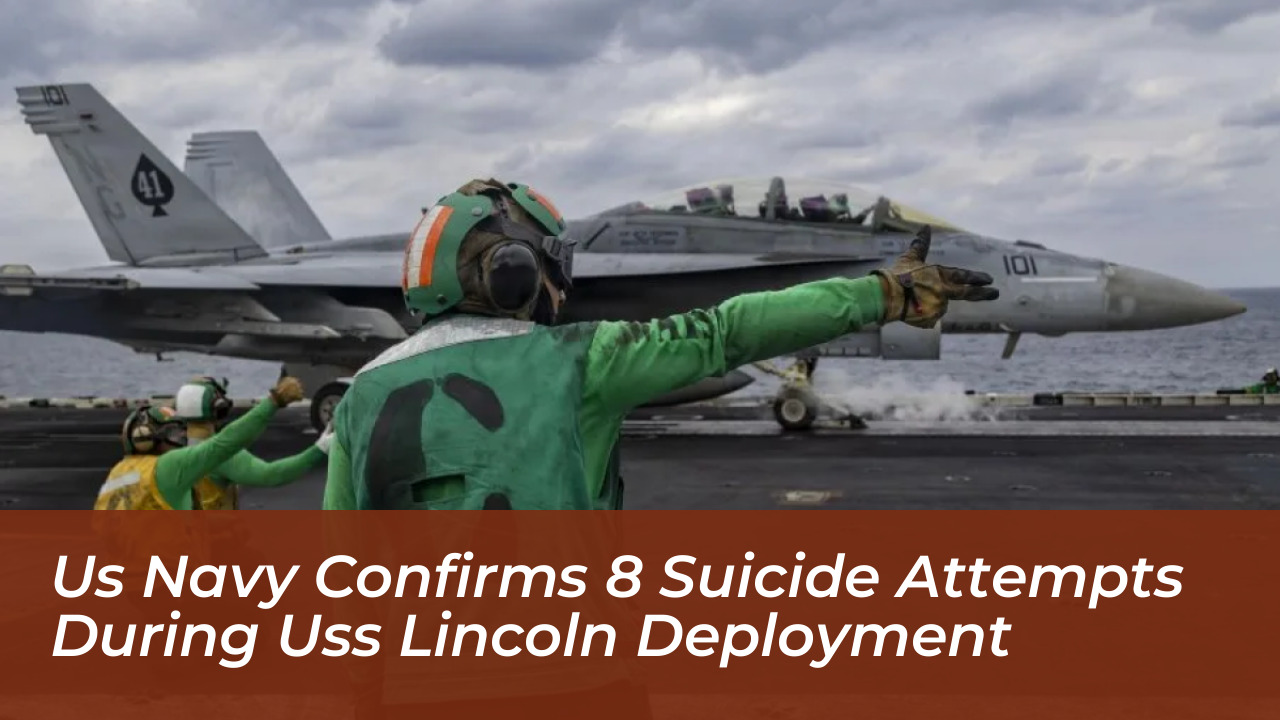
The United States Navy confirmed that eight service members assigned to the USS Abraham Lincoln Carrier Strike Group attempted suicide during a record-shattering deployment in the Middle East. Acting Navy Secretary Hung Cao disclosed these figures in an official four-page letter to Senator Kirsten Gillibrand, bringing acute attention to crew welfare, supply chain bottlenecks, and operational stress during ongoing conflicts in the region. While the disclosure highlights severe mental health pressures among military personnel, the official documentation confirms that zero fatalities occurred by suicide across the entire strike group. The deployment lasted over 250 days at sea, placing immense strain on the roughly 6,000 to 7,000 sailors, aviators, and destroyer crews operating within the United States Central Command area of responsibility.
- Inside the Congressional Disclosure: Timeline and Key Incidents
- Operational Pressures of the USS Abraham Lincoln Deployment
- Resource Constraints, Supply Shortages, and Quality of Life Concerns
- Expanding Fleet Mental Health Support Initiatives
- Political Fallout and Reactions from Washington
- Long-Term Implications for Navy Personnel Policies
- Comparative Overview of Carrier Deployment Metrics
- Frequently Asked Questions
- Did any service members die by suicide during the USS Abraham Lincoln deployment?
- How many suicide attempts were recorded during the deployment?
- What mental health resources were available on the ship?
- Why was the deployment prolonged?
- Where can military members seek confidential crisis support?
Inside the Congressional Disclosure: Timeline and Key Incidents
Acting Navy Secretary Hung Cao provided the casualty and mental health statistics in response to direct congressional inquiries from the Senate Armed Services Committee. The correspondence outlines multiple critical interventions required to save sailors from self-harm while operating near combat zones. These disclosures underscore the heavy psychological toll exacted by prolonged high-tempo naval operations in hostile waters.
During the deployment, an early August helicopter rescue saved a naval aviator assigned to the carrier air wing who went overboard from the nuclear-powered vessel. A rapid-response helicopter crew retrieved the sailor, who received immediate medical attention before transfer off the ship for specialized care. Earlier in the mission, a March shipmate intervention stopped another crew member from jumping overboard. That individual received immediate behavioral health stabilization and returned safely to homeport.
The count of eight attempts covers personnel stationed on the USS Abraham Lincoln, its carrier air wing, destroyer squadron staff, escorting guided-missile destroyers, and all embarked aviation units. Naval officials noted that the total count of eight suicide attempts is broadly proportional to historical baselines across the active-duty fleet. By comparison, the Pentagon documented 356 suicide attempts across an estimated active-duty Navy population of 337,000 service members during the most recent comprehensive reporting year.
Operational Pressures of the USS Abraham Lincoln Deployment
The USS Abraham Lincoln departed San Diego in November 2025, initially slated for standard operations in the South China Sea. Escalating geopolitical tensions and the outbreak of hostilities involving Iran in late February forced a strategic rerouting to the Arabian Sea and the broader Middle East theater. This unexpected pivot thrust the crew into a prolonged combat environment.
The strike group spent 208 consecutive days at sea, including 200 days operating directly inside an active combat zone in support of Operation Epic Fury. By the time the vessel reached a temporary reprieve in Pattaya, Thailand, on September 1, the crew had logged 286 days away from home ports. Subsequent transit days pushed the duration past 302 days by mid-September, ranking it among the longest aircraft carrier deployments in United States naval history since 1964.
Extended operational tempos significantly degrade heavy machinery and test human endurance. Strategic analysts point out that nuclear-powered aircraft carriers require complex depot-level maintenance that cannot be performed underway. The lack of standard port visits deprived sailors of critical shore leave, compounding psychological fatigue and driving up stress levels across all departments.
Resource Constraints, Supply Shortages, and Quality of Life Concerns
Heavy combat operations and targeted regional threats disrupted standard logistical supply chains. Damage to critical naval shore infrastructure in Bahrain forced the Navy to rely on remote logistics hubs like Diego Garcia, located thousands of kilometers away from the strike group operating box. This logistical strain directly impacted daily life aboard the carrier.
The ship temporarily reduced regular meal options from two main entrées to one to conserve provisions and maintain continuous station presence. Cao emphasized that four nutritionally balanced meals remained available daily, ensuring adequate caloric intake. However, crew families and anonymous reports cited issues with plumbing, sporadic hot water access, and mold in shower facilities during peak summer operations. Engineering teams completed repairs on potable water systems, which underwent daily safety testing.
To combat these pressures, the Lincoln deployed with dedicated clinical personnel, including five chaplains, one embedded integrated prevention counselor, one psychologist, one clinical social worker, three behavioral health technicians, and an expeditionary facility dog. Each escort vessel also carried an embedded chaplain to provide direct pastoral care.
Expanding Fleet Mental Health Support Initiatives
Naval leadership recognizes the urgent need to expand behavioral health access across all deployed strike groups. Recent policy updates mandate comprehensive psychological screenings before and after extended missions. These protocols help identify at-risk sailors early.
Commanding officers now receive advanced training on recognizing behavioral changes and severe stress symptoms among junior personnel. This proactive stance aims to reduce stigma and encourage early reporting of mental health challenges.
Political Fallout and Reactions from Washington
The public release of the suicide attempt figures intensified an ongoing political debate regarding military readiness, executive accountability, and transparency. Senator Gillibrand condemned the initial dismissal of crew welfare reports by administration officials, highlighting a perceived disconnect between military spending priorities and the basic needs of enlisted personnel.
Defense Secretary Pete Hegseth and military leadership previously defended the deployment, asserting that media reports regarding morale had been exaggerated. United States Central Command Commander Admiral Brad Cooper visited the Lincoln in August, praising the Chief Petty Officers Mess and crew leadership for prioritizing mental health resilience under extreme operational stress. The USS George Washington ultimately relieved the Lincoln in late August, allowing the veteran crew to begin its long-awaited voyage back to the West Coast.
Long-Term Implications for Navy Personnel Policies
The unprecedented length of this deployment forces military planners to reevaluate scheduling models and rotation lengths. Leaders are examining ways to prevent extreme delays in homeport returns.
Future naval deployments will likely incorporate mandatory mid-mission personnel swaps to alleviate chronic fatigue. Such measures are vital for sustaining long-term force readiness and protecting the well-being of sailors.
Comparative Overview of Carrier Deployment Metrics
| Metric Category | Recorded Data |
|---|---|
| Total Duration at Sea | Over 286 days to Thailand; 302+ days total transit |
| Combat Zone Operating Days | 200 days |
| Confirmed Suicide Attempts | 8 across the strike group |
| Suicide Fatalities | 0 |
| Personnel Affected | Carrier crew, air wing, and escort destroyers (approx. 6,000 total) |
| Relief Vessel | USS George Washington |
Frequently Asked Questions
Did any service members die by suicide during the USS Abraham Lincoln deployment?
No. Acting Navy Secretary Hung Cao confirmed in official congressional documentation that zero fatalities occurred by suicide across the USS Abraham Lincoln carrier strike group during its extended mission.
How many suicide attempts were recorded during the deployment?
Official records confirm eight suicide attempts. This figure encompasses personnel stationed on the aircraft carrier, its air wing, destroyer squadron staff, and escorting warships operating in the Middle East.
What mental health resources were available on the ship?
The USS Lincoln deployed with five chaplains, an integrated prevention counselor, a psychologist, a clinical social worker, three behavioral health technicians, and an expeditionary facility dog, alongside chaplains stationed on each escort vessel.
Why was the deployment prolonged?
Escalating geopolitical tensions and active combat operations involving Iran forced a strategic rerouting from the South China Sea to the Arabian Sea in support of Operation Epic Fury.
Where can military members seek confidential crisis support?
Service members in crisis can contact the Military Crisis Line by dialing 988 and pressing 1, texting 838255, or visiting MilitaryCrisisLine.net for 24/7 confidential support.