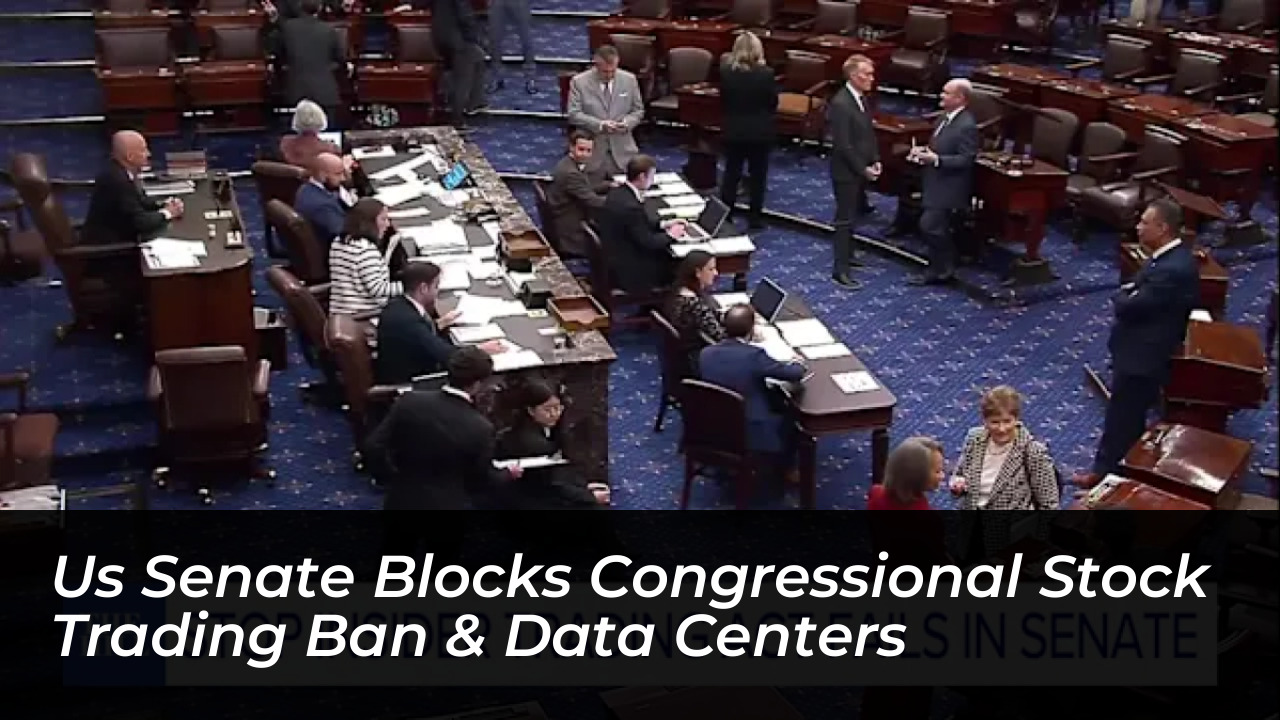
Senate Democrats blocked two Republican-led bills on Wednesday, September 30. The procedural votes halted legislative measures intended to restrict stock trading by members of Congress and limit data center energy costs before the chamber recessed for the 2026 midterm elections.
The procedural drive on the Stop Insider Trading Act fell short on a 53-47 vote. It failed to secure the required 60 votes to overcome the Senate filibuster. A separate measure targeting utility costs, known as the Ratepayer Protection Act, was defeated in a 57-43 vote.
Details of the Blocked Legislative Measures
Republicans strategically merged the congressional stock trading ban with nationwide government-issued photo identification voter requirements. According to a 2023 University of Maryland poll, 86% of Americans support banning lawmaker stock trades. Additionally, a 2025 Pew Research Center survey showed 83% favor voter ID requirements.
The Ratepayer Protection Act previously passed the House on a 417-3 vote earlier in September. It aimed to establish a regulatory framework for states to consider. This framework would require large artificial intelligence data centers to cover their own energy costs rather than passing those expenses down to everyday consumers.
However, Senate Democrats criticized the package. Senate Minority Leader Chuck Schumer, D-N.Y., called the data center proposal a “toothless messaging bill” and labeled the attached voter ID provision a “poison pill” during a speech on the Senate floor. Sen. Elizabeth Warren, D-Mass., similarly dismissed the data center measure as a “silly piece of nonsense.” She advocated instead for a national moratorium until developers guarantee coverage of construction and operation costs.
Political Fallout Heading Into Midterm Elections
The congressional stock trading bill passed the House in July on a 232-198 vote. It aimed to prohibit sitting members of Congress from purchasing individual stocks. Critics, however, pointed out that the text would not force lawmakers to divest their existing portfolios, leaving room for debate over its stringency.
Republicans quickly condemned the Democratic opposition as the Senate prepared to recess for lawmakers to return to their home states for campaigning. House Majority Leader Steve Scalise, R-La., voiced his frustration immediately following the vote on social media platform X. He stated that every Senate Democrat joined the vast majority of House Democrats in blocking accountability demanded by the American public.
Conversely, Democrats maintained that the proposed bills were inadequate and designed purely for political optics. With narrow majorities at stake in both chambers and ongoing public scrutiny over inflation and energy pricing, both parties are expected to leverage the failed votes heavily on the campaign trail throughout the fall.