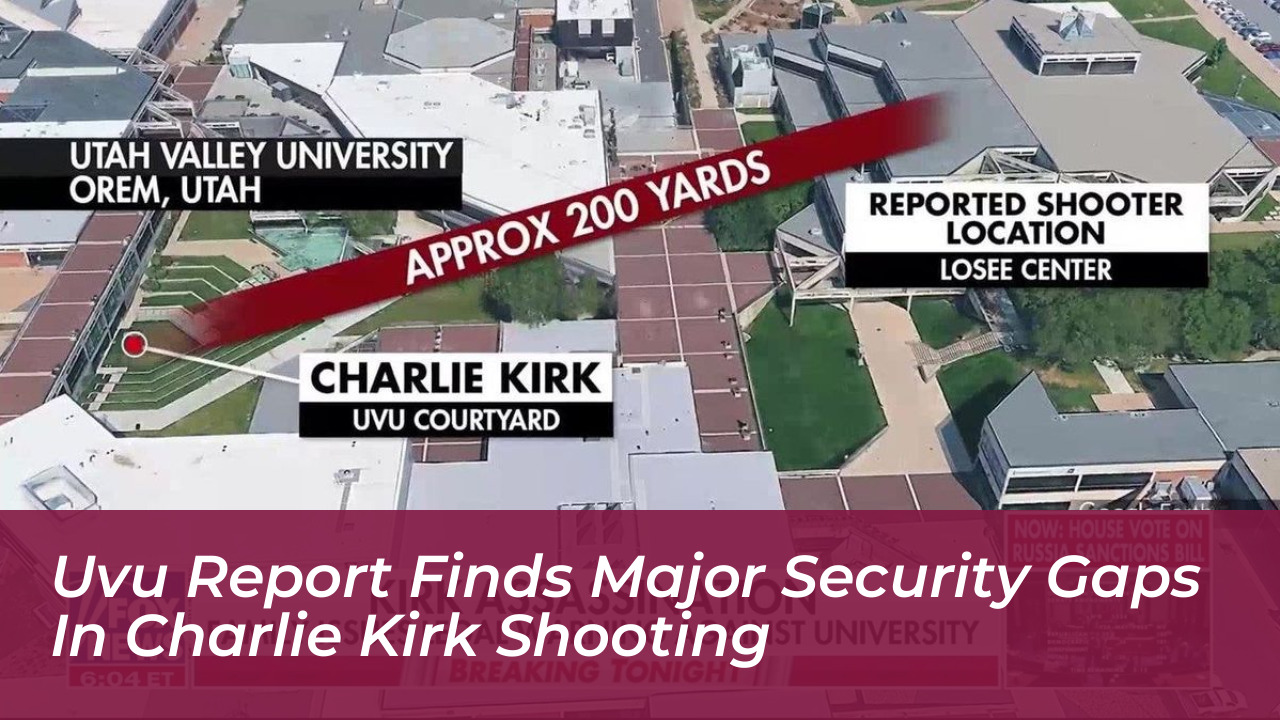
The release of a comprehensive 158-page independent report regarding the September 10, 2025 shooting of conservative activist Charlie Kirk has brought intense scrutiny to Utah Valley University. The security audit, conducted by the Lake Forest Group, exposes severe administrative, structural, and tactical oversights that left the Orem campus vulnerable to a tragic long-range attack. Kirk, aged 31, was fatally wounded by a sniper positioned on a campus rooftop during an outdoor gathering hosted by Turning Point USA. As thousands of students and visitors filled the central courtyard, institutional planning failures compromised the entire event environment. This independent investigation examines the systemic breakdowns in venue selection, risk assessment, and inter-agency communication that continue to reshape public higher education safety policies across the state.
- Scope and Mandate of the Lake Forest Group Review
- Core Systemic Failures and Security Gaps Identified
- Transfer of Authority and Venue Selection Disputes
- Omission of Formal Risk Assessment and Action Plans
- Vulnerabilities of the Outdoor Courtyard and Rooftop Access
- Breakdown in Pre-Event Inter-Agency Communication
- Post-Incident Emergency Alert Delays and Inconsistencies
- Legal Fallout and the Kirk Family Notice of Claim
- Specific Negligence Allegations Against UVU Leadership
- The Unhandled Rooftop Risk Tip
- Criminal Prosecution of Tyler Robinson
- Institutional Reform and Policy Overhauls Across Utah
- Mandatory Reforms Implemented by UVU Leadership
- Statewide Higher Education Policy Shift
- Comparative Summary of Security Deficiencies and Corrective Actions
- Conclusion
Scope and Mandate of the Lake Forest Group Review
The Utah Valley University administration commissioned the Lake Forest Group to perform an unvarnished evaluation of safety protocols following the tragedy. Investigators audited administrative records, campus police logs, inter-agency communications, and physical security layouts. The review examined the sequence of events leading up to the outdoor presentation, the immediate tactical response, and post-incident emergency notifications. The primary mandate centered on identifying systemic vulnerabilities to prevent future security failures across public higher education facilities.
Despite uncovering widespread operational shortcomings, the report contained an explicit legal finding regarding university personnel. The Lake Forest Group concluded that no UVU employee or administrative agent acted in bad faith or exhibited willful and wanton disregard for human life. While procedures failed across multiple departments, the investigation found no evidence of intentional negligence or malicious intent by university staff members during or after the attack.
Core Systemic Failures and Security Gaps Identified
Transfer of Authority and Venue Selection Disputes
A primary vulnerability stemmed from the university surrendering critical event management decisions to an outside entity. Event sponsor Turning Point USA projected a modest turnout of approximately 600 attendees and officially reported no preliminary security threats. TPUSA representatives insisted on hosting the event in an open-air central courtyard rather than an enclosed indoor auditorium. UVU officials initially voiced reservations regarding the open venue but ultimately yielded to the sponsor demands.
Yielding to these external demands effectively transferred control over event parameters from trained campus safety personnel to political organizers. Without institutional authority firmly established at the outset, safety protocols were compromised to accommodate logistical preferences rather than threat mitigation standards.
Omission of Formal Risk Assessment and Action Plans
The Lake Forest Group discovered that UVU failed to conduct a formal, written risk assessment prior to hosting the high-profile speaker. , campus safety directors never compiled a written Event Action Plan. Standard law enforcement protocols require written action plans for public events to establish emergency procedures, line-of-command structures, and perimeter boundaries.
Without an explicit tactical blueprint, responding officers operated without unified directives or clear operational parameters. This absence of planning hindered rapid communication and left personnel scrambling to establish order once the active shooter scenario began.
Vulnerabilities of the Outdoor Courtyard and Rooftop Access
The physical layout of the selected courtyard presented complex security challenges that university staff failed to mitigate. The venue featured multiple open access points, heavy pedestrian traffic routes, and direct line-of-sight exposures from surrounding structures. Most notably, elevated vantage points on nearby academic buildings directly overlooked the temporary stage.
Unsecured roof access points on the Losee Center lacked continuous physical guarding or electronic monitoring. Organizers placed the speaker stage in direct view of multiple unsecured high-rise windows and rooftops. Security teams failed to establish outer screening zones, allowing unchecked access to adjacent elevated walkways.

Breakdown in Pre-Event Inter-Agency Communication
Coordination between UVU Campus Police, local municipal officers, and private security details broke down days before the presentation. Kirk personal security team raised specific concerns regarding an elevated public walkway adjacent to the stage, which led staff to rope off the immediate area. However, a crucial briefing meeting between UVU police command and external security teams never occurred.
This missed meeting prevented law enforcement agencies from assigning explicit responsibilities for rooftop monitoring and perimeter control. When coordination fails prior to a major public gathering, critical security zones inevitably remain unmonitored during the live event.
Post-Incident Emergency Alert Delays and Inconsistencies
Administrative failures extended into the immediate aftermath of the shooting. UVU lacked a synchronized protocol for releasing immediate campus-wide threat notifications. Initial emergency broadcasts suffered significant delays, leaving surrounding campus areas unaware of an active shooter scenario.
When administrators finally issued alerts, the messages contained contradictory instructions, creating confusion among students and faculty seeking shelter. Clear, rapid communication remains a fundamental pillar of emergency management that was noticeably absent during the crisis.
Legal Fallout and the Kirk Family Notice of Claim
Specific Negligence Allegations Against UVU Leadership
The release of the Lake Forest Group report reinforced legal action initiated by the estate of Charlie Kirk. On September 9, 2026, attorney Brett Parkinson filed a formal Notice of Claim on behalf of Kirk widow, Erika Kirk. The legal filing names Utah Valley University, its former president, the UVU Police Department, Police Chief Jeffrey Long, and the State of Utah as prospective defendants.
The notice outlines six distinct counts of institutional negligence, claiming university officials assumed legal responsibility for public safety when they authorized the event. The litigation highlights administrative accountability and challenges the adequacy of pre-event safety measures.
The Unhandled Rooftop Risk Tip
A central pillar of the Kirk family claim involves an unheeded security warning provided to campus authorities before the event. The Notice of Claim asserts that Utah state officials and campus police received a specific, actionable tip highlighting security risks associated with unmonitored roof access at the Losee Center.
The filing alleges that Police Chief Jeffrey Long ignored the tip and failed to assign personnel to secure the building roof, directly enabling the sniper to access the firing position. This unaddressed warning forms a cornerstone of the civil allegations brought against university leadership.
Criminal Prosecution of Tyler Robinson
While civil litigation targets administrative oversights, criminal prosecution against the alleged gunman continues in state court. Authorities arrested 23-year-old Tyler Robinson on September 11, 2025, one day after the shooting. State prosecutors charged Robinson with aggravated murder, indicating they will pursue the death penalty upon conviction.
Court records detail physical and digital evidence linking Robinson to the crime, including text messages sent to his romantic partner stating he could no longer tolerate Kirk public statements. Forensic teams recovered a spent cartridge and firearm near the scene, cementing the physical evidence trail. A state judge ruled in September 2026 that sufficient evidence exists to advance the case to a full criminal trial.
Institutional Reform and Policy Overhauls Across Utah
Mandatory Reforms Implemented by UVU Leadership
In response to the independent findings, newly appointed UVU President Dr. Jon Anderson established a permanent Major Events Assessment Committee to review gatherings through a standardized threat matrix. This committee ensures that all future campus events undergo rigorous safety evaluations before approval.
Additionally, the university implemented mandatory safety and emergency response training for all faculty and staff members alongside joint-response command protocols. These measures aim to bridge the communication gaps identified during the 2025 incident.
Statewide Higher Education Policy Shift
Directives from state legislative leaders, including Senate President J. Stuart Adams and House Speaker Mike Schultz, require comprehensive security audits across all public universities in Utah. These mandates ensure public colleges maintain full authority over venue selection, perimeter security, and threat intelligence evaluation.
State leaders emphasize that institutional safety must never take a backseat to external event sponsor demands. Higher education institutions across the region are now bound by stricter oversight frameworks to protect students, faculty, and visiting speakers.
Comparative Summary of Security Deficiencies and Corrective Actions
| Identified Security Failure | Operational Impact on Sept 10, 2025 | Corrective Policy Enacted |
|---|---|---|
| Venue Selection Surrender | Event placed in vulnerable outdoor courtyard based on external sponsor demands. | Mandatory institutional authority over venue safety and risk assessment. |
| Missing Event Action Plan | Officers operated without unified tactical directives or clear perimeter boundaries. | Required written EAPs and standardized threat matrices for all gatherings. |
| Unmonitored Rooftop Access | Losee Center roof remained unsecured, allowing the shooter direct line-of-sight. | Permanent Major Events Assessment Committee overseeing elevated vantage points. |
| Inter-Agency Miscommunication | Failure to conduct pre-event briefings left rooftop monitoring responsibilities unassigned. | Formalized joint-response command protocols with state and local police. |
| Emergency Alert Delays | Delayed and contradictory broadcasts caused widespread confusion among students. | Synchronized emergency notification protocols and standardized messaging. |
Conclusion
The Lake Forest Group report serves as a watershed moment for public campus safety and administrative accountability across higher education. By dissecting the systemic failures that preceded the shooting of Charlie Kirk, the investigation provides a clear roadmap for correcting past vulnerabilities. Institutional transparency, rigorous pre-event planning, and uncompromised authority over venue security form the absolute foundation for preventing future tragedies in academic environments.
As Utah Valley University and other public institutions implement these necessary policy overhauls, the focus remains firmly on safeguarding public gatherings. Prioritizing strict tactical coordination ensures that campus safety protocols meet the rigorous standards required to protect every member of the academic community.