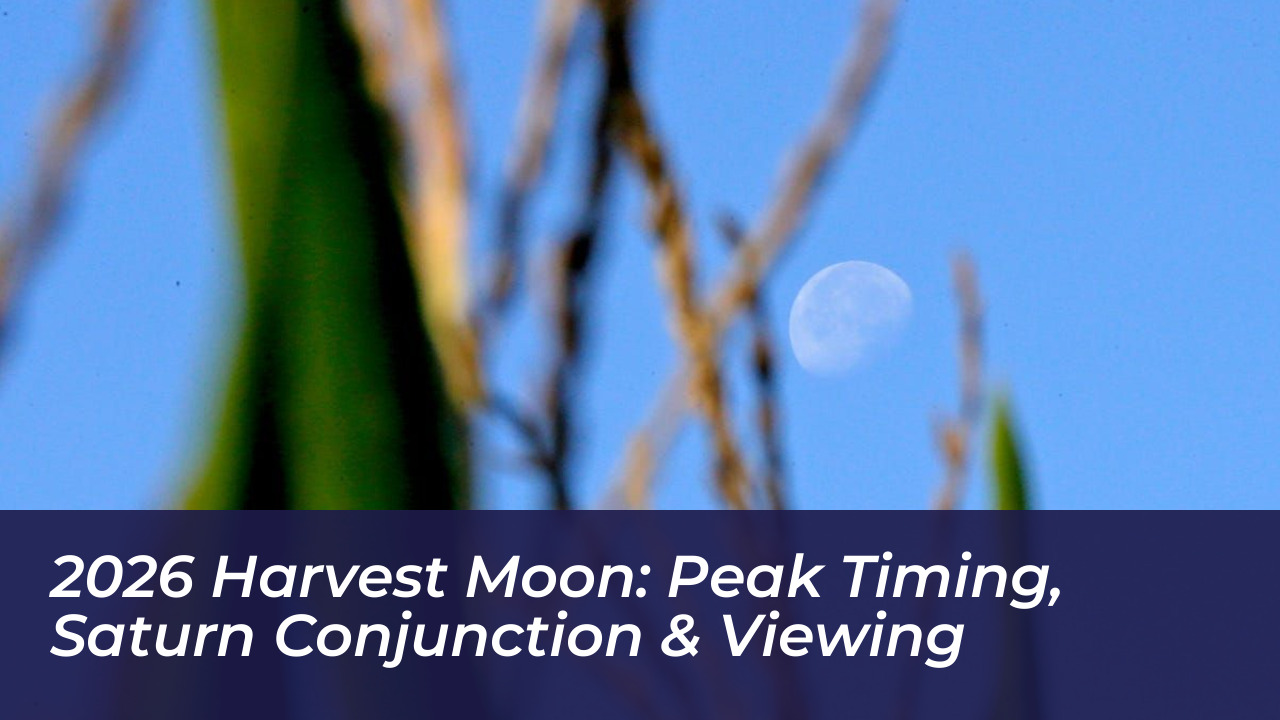
The annual Harvest Moon lights up the Northern Hemisphere sky following the autumnal equinox, offering a stunning celestial display for stargazers. Reaching peak illumination on Saturday, September 26, 2026, at 12:49 p.m. ET, this special full moon brings consecutive evenings of bright lunar light. Even though the precise moment of fullness occurs during daylight hours across North America, observers can enjoy spectacular evening viewing on September 25, 26, and 27. The unique geometry of this September full moon creates an extended window of early moonrises near sunset, making it a favorite event for photographers and astronomy enthusiasts alike.
- Introduction to the 2026 Harvest Moon
- Orbital Mechanics: Why the Harvest Moon Rises So Early
- The Sidereal Orbit and Daily Shift
- The Ecliptic and Horizon Angle
- Celestial Companion: The Harvest Moon and Saturn Conjunction
- Optimal Viewing Strategy and Horizon Conditions
- Atmospheric Scattering and the Moon Illusion
- Step-by-Step Observation Guide
- Global Rise Timings Across Major Northern Latitudes
- Historical Context and Cultural Observances
- Agricultural Roots in North America and Europe
- Global Harvest Festivals
- Cultural Versus Scientific Perspectives on Celestial Alignments
- Frequently Asked Questions About the 2026 Harvest Moon
- Does the Harvest Moon actually appear physically larger than other full moons?
- Is the Harvest Moon always in September?
- Can Southern Hemisphere observers see the Harvest Moon in September?
Introduction to the 2026 Harvest Moon
The arrival of the September full moon follows closely on the heels of the autumnal equinox, which took place on September 22, 2026. This timing marks the official transition from summer to the cooler months of autumn in the Northern Hemisphere. Because the exact peak occurs during the afternoon in North America, evening spectators still witness a full, robust disk. The moon appears completely round and luminous as it clears the eastern horizon during twilight.
Stargazers benefit from multiple nights of optimal viewing conditions. On September 25, 26, and 27, the moon rises shortly after sunset each evening. This steady sequence of bright moonlit nights sets the Harvest Moon apart from every other full moon of the year. The timing provides a rare opportunity to study lunar features without staying up late into the early morning hours.
Orbital Mechanics: Why the Harvest Moon Rises So Early
The Sidereal Orbit and Daily Shift
Understanding the science behind this lunar phase requires looking at celestial mechanics. The moon travels 13.2 degrees daily along its 27.3-day sidereal orbit around Earth. Typically, this continuous orbital movement causes moonrises to shift later by roughly 50 minutes each night. However, the autumn season alters this standard delay significantly for mid-northern latitudes.
The changing tilt of the Earth creates a different perspective for observers on the ground. As the Earth rotates, the angle of the horizon shifts relative to the moon’s orbital path. This geometric alignment compresses the time between successive moonrises, breaking the standard 50-minute rule.
The Ecliptic and Horizon Angle
During late September, the ecliptic meets the eastern evening horizon at a very shallow angle. This low trajectory forces much of the moon nightly movement to travel sideways along the horizon rather than steeply upward into the night sky. Observers require far less planetary rotation before the celestial body reappears in the evening.
At mid-northern latitudes, the time gap between consecutive moonrises shrinks dramatically to just 25 to 30 minutes. This compressed schedule provides a reliable source of bright moonlight over consecutive evenings. Agricultural workers historically depended on this extended evening light to gather crops before the arrival of autumn frosts.
Celestial Companion: The Harvest Moon and Saturn Conjunction
Observers tracking the Harvest Moon across the weekend of September 26 to 27 will spot a bright celestial companion situated very close to the lunar disk. The planet Saturn shines near the moon as the gas giant approaches opposition. Opposition represents Saturn’s closest and brightest appearance relative to Earth for the entire year, creating a brilliant planetary showcase.
While both the moon and Saturn remain easily visible to the unaided eye, optical instruments enhance the experience. Binoculars or a small telescope reveal Saturn and its famous ring system with remarkable clarity. Fainter outer planets like Neptune also occupy the same regional sector of the night sky, though spotting Neptune requires optical assistance due to its low apparent magnitude.
Optimal Viewing Strategy and Horizon Conditions
Atmospheric Scattering and the Moon Illusion
Securing an unobstructed view of the eastern horizon remains the primary requirement for observing the Harvest Moon. Because the moon breaches the horizon near sunset, local atmospheric layers scatter shorter blue wavelengths of light. This physical process allows longer red, orange, and yellow wavelengths to pass through unhindered.
This atmospheric scattering causes the moon to appear significantly larger, more vibrant, and deeply colored shortly after moonrise. Observers must also account for the psychological moon illusion. This perceptual quirk makes any low-hanging moon appear massive when viewed near terrestrial objects like trees or buildings, even though its physical angular diameter remains unchanged.
Step-by-Step Observation Guide
- Locate an open viewing area with an unobstructed view of the eastern horizon, free of tall skyscrapers or dense tree lines.
- Step outside roughly 15 minutes before local sunset on September 25, 26, or 27.
- Allow your eyes 20 minutes to adjust to the gathering darkness to capture faint horizon details.
- Scan the immediate vicinity of the glowing lunar disk to spot the golden hue of planet Saturn.
Global Rise Timings Across Major Northern Latitudes
Peak moonrise windows and visual separation distances from Saturn vary depending on geographic location. The table below outlines specific timings for major cities across the Northern Hemisphere during the weekend of peak illumination.
| City / Region | Latitude | Peak Moonrise Window (Sept 26) | Visual Separation from Saturn |
|---|---|---|---|
| New York, USA | 40.7° N | 7:04 p.m. ET | ~4 degrees East |
| London, UK | 51.5° N | 7:18 p.m. BST | ~5 degrees East |
| Vancouver, Canada | 49.2° N | 7:32 p.m. PT | ~3.5 degrees East |
| Tokyo, Japan | 35.6° N | 5:58 p.m. JST | ~6 degrees East |
Historical Context and Cultural Observances
Agricultural Roots in North America and Europe
The term Harvest Moon originates from traditional farming practices in North America and Europe. Before the invention of artificial illumination, rural communities depended entirely on natural light to complete late-season crop collection. The extended evening moonlight allowed laborers to work long past sunset.
This extra illumination proved essential for gathering staple crops such as corn, pumpkins, squash, and grains before freezing autumn temperatures arrived. The reliability of these early moonrises provided a crucial economic advantage for agrarian societies preparing for the long winter months ahead.
Global Harvest Festivals
This lunar phase aligns with several major international festivals and cultural celebrations observed around the world:
- China: The Mid-Autumn Festival, featuring family gatherings, lantern displays, and traditional mooncake sharing.
- Korea: Chuseok, a major three-day harvest holiday dedicated to giving thanks to ancestors and enjoying seasonal foods.
- Jewish Tradition: The festival of Sukkot, commemorating the historical harvest sheltering period in the wilderness.
- Modern Paganism: Mabon, celebrating the Autumnal Equinox and the exact midpoint of the harvest season.
Cultural Versus Scientific Perspectives on Celestial Alignments
While astronomers calculate orbital nodes, sidereal tracks, and planetary oppositions using strict mechanical physics, cultural traditions assign symbolic narratives to these cycles. Astrological frameworks often interpret the September full moon through zodiacal placements. These systems frequently link the lunar phase in Aries against a Libra sun to themes of personal independence versus relational compromise.
Astronomers emphasize that these interpretive frameworks remain entirely separate from physical observation. The measurable data regarding lunar distance, orbital angles, and photon reflection rates provide concrete parameters for scientific inquiry. Understanding both the scientific mechanics and cultural heritage enriches the overall experience of watching this annual autumn spectacle.
Frequently Asked Questions About the 2026 Harvest Moon
Does the Harvest Moon actually appear physically larger than other full moons?
No. The moon maintains a consistent physical diameter throughout its elliptical orbit. The illusion of increased size stems from the moon illusion, a psychological phenomenon caused by viewing the moon close to terrestrial objects on the horizon.
Is the Harvest Moon always in September?
The Harvest Moon is defined as the full moon closest to the autumnal equinox. Because lunar phases operate on a 29.5-day synodic month while the equinox falls on September 22 or 23, the Harvest Moon occasionally occurs in early October.
Can Southern Hemisphere observers see the Harvest Moon in September?
Southern Hemisphere observers experience the exact same full moon, but it represents their vernal equinox rather than the autumnal equinox. For the Southern Hemisphere, the true harvest moon occurs in March.