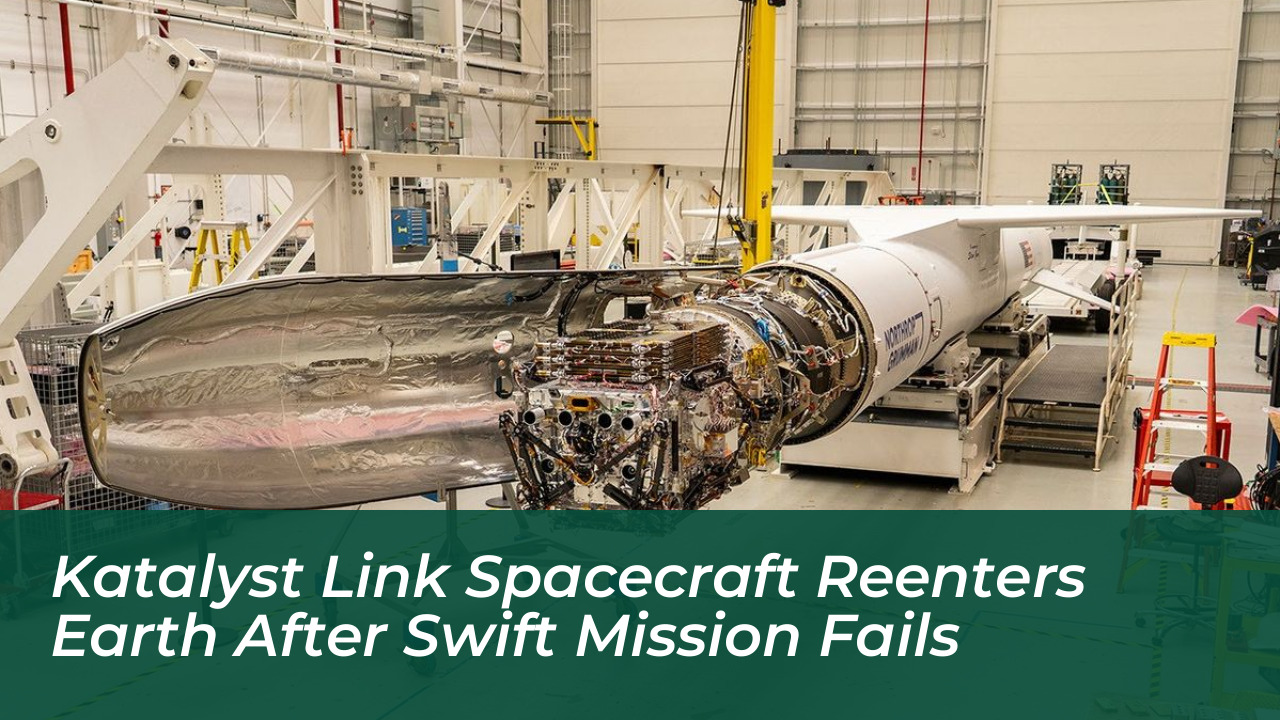
The aerospace industry witnessed a bold attempt at orbital salvage when the Katalyst Link spacecraft successfully reentered Earth’s atmosphere, bringing a high-stakes rescue mission to a close. Built to save the aging Neil Gehrels Swift Observatory, the thirty million dollar venture pushed the boundaries of rapid space engineering. Despite failing to dock with its target, the mission gathered unprecedented flight data that will shape the future of commercial satellite servicing.
- Anatomy of the Katalyst Link Mission
- Engineering Anomalies and On-Orbit Recovery
- Electrical Power System Fault and Multi-Axis Spin
- Emergency Ground Control Protocol
- Execution of Proximity Operations and Data Collection
- High-Resolution Imagery of the Swift Observatory
- Robotic Arm Kinematic Testing
- Implications for the Neil Gehrels Swift Observatory
- Strategic Takeaways for Commercial Space Servicing
- Mission Milestone Timeline
- Frequently Asked Questions
- Why was the Katalyst Link spacecraft launched?
- What caused the failure of the Link mission?
- What happens to the Swift Observatory now?
- What is Katalyst Space Technologies planning next?
Anatomy of the Katalyst Link Mission
Katalyst Space Technologies launched its robotic spacecraft named Link on July 3, 2026, from Kwajalein Atoll using a Northrop Grumman Pegasus XL rocket. The primary objective involved a thirty million dollar NASA-sponsored rescue mission aimed at extending the operational life of the twenty-two-year-old Neil Gehrels Swift Observatory. Swift experienced a rapidly decaying orbit driven by intense solar flare-ups, which created heavy atmospheric drag. The mission timeline moved at an unprecedented pace. Katalyst secured the NASA contract in September 2024 and built, tested, and launched Link inside an accelerated nine-month delivery schedule from contract to flight.
Swift represented an exceptionally difficult target because the scientific satellite was never designed for docking, manipulation, or orbital servicing by an external vehicle. Older spacecraft lack standard grapple fixtures, communication ports, and alignment markers that modern servicing vehicles rely on. Engineers had to design algorithms and robotic tools capable of latching onto a legacy satellite without damaging its sensitive scientific instruments or solar panels. This pioneering effort tested the absolute limits of agile aerospace manufacturing and autonomous guidance systems.
Engineering Anomalies and On-Orbit Recovery
Electrical Power System Fault and Multi-Axis Spin
Shortly after achieving orbit, Link encountered severe technical anomalies that compromised its propulsion and attitude control capabilities. An electrical power system fault disabled two of the three onboard reaction wheels required for stable maneuvering. The resulting imbalance triggered a faulty valve response that sent the spacecraft into a dangerous multi-axis spin, cutting off routine communications with ground control. The immediate crisis threatened to end the mission before proximity operations could even begin.
Reaction wheels act as the primary method for orienting a spacecraft without consuming precious liquid propellant. Losing two units meant the vehicle lacked the fine control needed to point its sensors or prepare for orbital rendezvous. The uncontrolled rotation also threatened solar power generation, as the panels drifted away from direct sunlight. Mission controllers faced a narrow window to regain stability before the onboard batteries depleted entirely.
Emergency Ground Control Protocol
Katalyst engineers engineered an emergency recovery protocol from mission control. Ground operators deployed the Reaction Control System thrusters alongside the single remaining operable reaction wheel. This hybrid control strategy successfully reduced the spacecraft spin rate from nine degrees per second down to 1.47 degrees per second. Operators uploaded brand-new flight software and updated guidance, navigation, and control algorithms to stabilize the vehicle. The team transformed a failing hardware platform into a functional testbed through sheer software ingenuity.
While this recovery preserved the spacecraft, using propellant-heavy thrusters for attitude control rapidly drained the vehicle fuel reserves. Mission managers concluded that Link lacked sufficient fuel to safely execute the final rendezvous, capture, and orbit-raising sequence. Although the primary salvage objective became mathematically impossible, the engineering team quickly pivoted to maximize the remaining utility of the spacecraft.
Execution of Proximity Operations and Data Collection
High-Resolution Imagery of the Swift Observatory
Despite abandoning the capture phase, mission leaders redirected the remaining eighty-five-day orbital lifespan toward rigorous system testing and proximity operations. Link successfully navigated to within seven to nine miles, equivalent to twelve to fifteen kilometers, of the Swift Observatory. From this vantage point, the robotic spacecraft captured detailed high-resolution imagery showcasing the external condition of the decaying telescope. These visual datasets provided engineers with rare insights into how legacy hardware weathers decades of harsh radiation and micrometeoroid impacts in low Earth orbit.
Proximity operations require extreme precision to avoid accidental collisions between non-cooperative satellites. Link demonstrated advanced optical navigation algorithms that tracked the tumbling profile of the Swift Observatory in real-time. This capability proves vital for future debris removal and commercial station-keeping operations, where servicing vehicles must approach untethered or damaged assets safely.
Robotic Arm Kinematic Testing
The engineering team also tested the three robotic arms on board Link. Each arm measured approximately three feet, or one meter, in length and featured a specialized gripping mechanism on the end. Flight controllers completed kinematic control tests, lifetime evaluations, and simulated grapple procedures to validate operational software for future missions. Operating these mechanisms in the vacuum of space confirmed that the multi-jointed arms could withstand thermal extremes and mechanical stress.
Validating these robotic systems on an actual flight mission provides commercial operators with empirical performance metrics. Ground-based simulations can only replicate microgravity up to a point. Testing physical hardware in orbit allows developers to refine joint tolerances, motor feedback loops, and contact dynamics before deploying expensive multi-million dollar servicing architectures.
Implications for the Neil Gehrels Swift Observatory
Launched in November 2004 as a joint collaboration between NASA and Penn State University, the three hundred sixty-four million dollar Swift Observatory specializes in capturing fast-breaking cosmic action, including gamma-ray bursts and exploding stars. Its rapid-pivot design allows it to function as a cosmic lookout, guiding other telescopes toward transient astronomical events. Solar activity accelerated the descent of Swift faster than mission planners anticipated. NASA suspended scientific observations early in the year and repositioned the observatory to minimize atmospheric drag, buying enough time for the Katalyst rescue attempt.
With the failure of the Link mission, Swift faces an unchecked descent and is expected to reenter Earth’s atmosphere in early November 2026. While the loss of the observatory concludes a legendary chapter in high-energy astrophysics, the data collected over its twenty-two-year tenure has revolutionized our understanding of black holes and stellar explosions. Ground controllers will monitor the final orbital decay closely to ensure safe atmospheric burnup.
Strategic Takeaways for Commercial Space Servicing
Leadership from both NASA and Katalyst framed the mission as a calculated high-risk endeavor that yielded vital operational data. NASA Astrophysics Division Director Shawn Domagal-Goldman noted that the initiative successfully tested rapid-timeline satellite servicing concepts in low Earth orbit. Proving that an orbital vehicle can be designed, built, and launched in under a year sets a new precedent for responsiveness in the aerospace sector.
NASA Administrator Jared Isaacman emphasized that space agencies must embrace aggressive innovation timelines to build future servicing capabilities. Traditional space programs often span decades, which slows down technological adoption. Katalyst CEO Ghonhee Lee confirmed that the company will channel all flight data and anomaly correction metrics directly into its next-generation NEXUS spacecraft platform. NEXUS serves as a standardized production vehicle designed for multiple follow-on programs, including a Deorbit-as-a-Service contract for the Defense Innovation Unit and an on-orbit power beaming initiative with the U.S. Naval Research Laboratory.
Mission Milestone Timeline
| Mission Milestone | Date | Operational Status |
|---|---|---|
| Contract Award | September 2024 | Katalyst selected for thirty million dollar NASA salvage agreement |
| Spacecraft Launch | July 3, 2026 | Liftoff aboard Pegasus XL rocket from Kwajalein Atoll |
| Critical Anomaly | July 2026 | Reaction wheel failure triggers multi-axis spin |
| Rescue Abandonment | August 2026 | Fuel depletion forces cancellation of capture phase |
| Proximity Imaging | September 2026 | Link approaches within twelve kilometers of Swift |
| Atmospheric Reentry | September 25, 2026 | Link plunges back into Earth atmosphere after eighty-five days |
Frequently Asked Questions
Why was the Katalyst Link spacecraft launched?
Link launched to rescue and boost the decaying orbit of NASA’s Neil Gehrels Swift Observatory, extending the operational life of the twenty-two-year-old space telescope.
What caused the failure of the Link mission?
An electrical power system fault disabled two reaction wheels, causing a fast spin. Although engineers stabilized the spacecraft, the recovery consumed too much fuel to complete the capture.
What happens to the Swift Observatory now?
Without an altitude boost, the Swift Observatory continues its steady downward spiral and is expected to reenter Earth’s atmosphere in early November 2026.
What is Katalyst Space Technologies planning next?
Katalyst is applying flight data from the Link mission to its standard NEXUS vehicle platform, supporting upcoming defense and commercial servicing contracts.