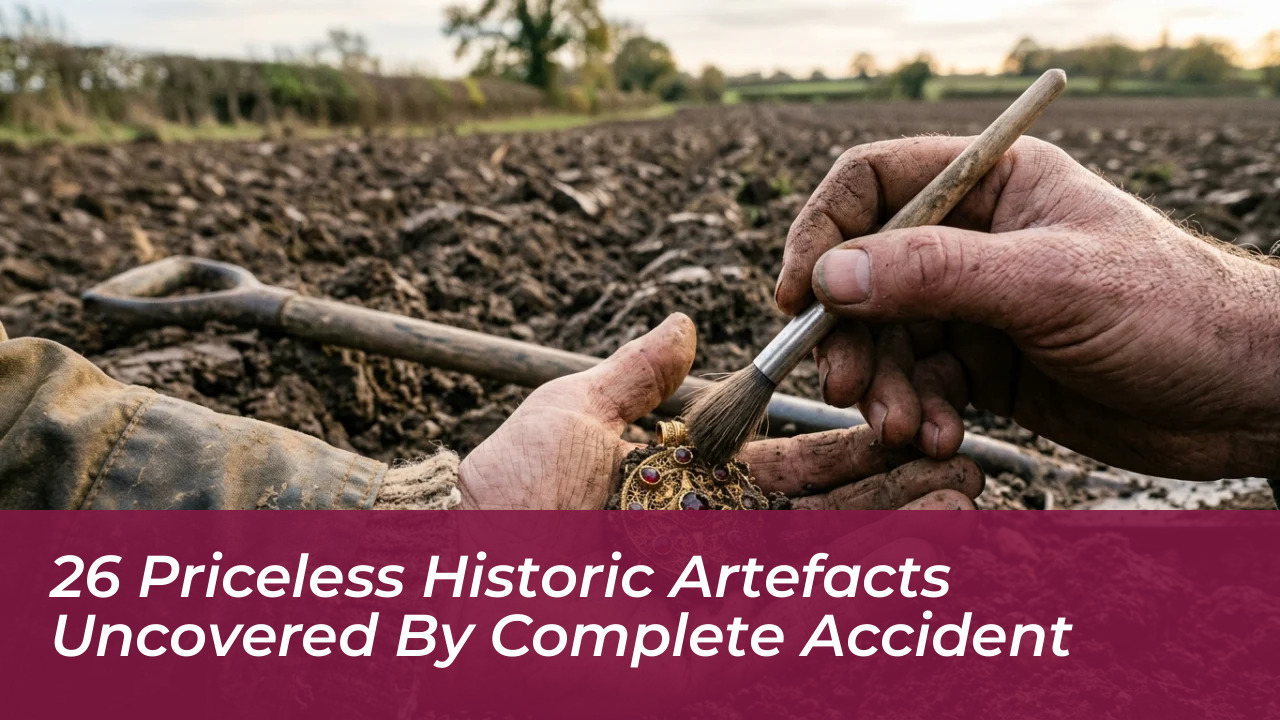

Millions of pounds in buried treasure, foundational religious codices, and lost masterpieces have been uncovered not by targeted academic expeditions, but through sheer chance. Everyday mishaps, such as dropping a farm tool in the mud or clearing out a neglected basement, have routinely delivered some of antiquity’s greatest treasures directly into human hands. While structured archaeological digs account for substantial historical data, an extraordinary share of headline museum displays began with an unsuspecting member of the public stumbling across an odd piece of metal or weathered scrap of parchment. The critical dividing line between a lost relic and a preserved national treasure has always rested entirely on the finder’s next decision.
Buried Fortunes Unearthed in British Fields and Riverbeds
In July 2009, metal detectorist Terry Herbert walked a ploughed field near Hammerwich in Staffordshire and picked up an unrelenting signal. Subsequent formal excavations yielded over 3,500 pieces, representing roughly 5 kilograms of gold and silver fittings stripped from martial gear. Known today as the Staffordshire Hoard, it remains the largest collection of Anglo-Saxon gold ever recovered. It was later acquired jointly by two British museums for £3.3 million, split equally between Herbert and the landowner.
A missing piece of farm equipment led to another monumental find in Suffolk in November 1992. Tenant farmer Peter Whatling lost his hammer in a field near Hoxne and enlisted his friend Eric Lawes, an amateur metal detectorist, to track it down. Instead of just the tool, Lawes struck a buried late Roman chest containing nearly 15,000 coins, gold jewellery, silver spoons, and an empress-shaped pepper pot. Lawes ceased digging immediately to alert authorities, preserving the burial context for the British Museum, where the recovered hammer was later exhibited alongside the multi-million-pound Hoxne Hoard.
Similar serendipity occurred in September 2014 across the Scottish border. Metal detectorist Derek McLennan surveyed land owned by the Church of Scotland in Dumfries and Galloway, recovering a silver arm ring and a Christian cross that marked the gateway to the Galloway Hoard. Over 100 Viking Age relics, packed carefully inside a lidded silver vessel and wrapped in ancient textiles, were secured by National Museums Scotland in 2017 for nearly £2 million following a national fundraising effort.
Chance encounters have just as often rewritten British river and coastal history. In 1857, dredging crews clearing the River Thames near Battersea Bridge hauled up the decorative bronze Battersea Shield, an exquisite Iron Age ceremonial offering dating between 350 and 50 BC. Decades earlier, around 1831, sandbanks near Uig Bay on the Isle of Lewis yielded the famed Lewis Chessmen, carved from walrus ivory and whale teeth in twelfth-century Norway. The enduring value of these scattered figures was underscored in 2019, when an unrecognised warder purchased in Edinburgh for £5 in 1964 fetched £735,000 at a Sotheby’s auction.
Not every discovery remained accessible to the public domain. In May 2010, a detectorist in Cumbria discovered the copper-alloy Crosby Garrett Helmet, an ornate Roman cavalry parade mask. Despite frantic fundraising by Carlisle’s Tullie House Museum, the helmet was sold at Christie’s to an anonymous private collector for £2.3 million, largely removing it from public view.
Ancient Texts and Sacred Codices Preserved in Rubbish and Caves
The preservation of world literature and theological records owes an enormous debt to extreme weather conditions and accidental disturbance. In late 1946 or early 1947, a Bedouin shepherd tracking a stray goat near Qumran tossed a pebble into a desert opening and heard ceramic shatter. That sound led to the recovery of the Dead Sea Scrolls from eleven dry caves, preserving fragments of roughly 900 manuscripts of the Hebrew Bible an entire millennium older than previously known copies.
In December 1945, Upper Egyptian farmers digging for fertiliser near Nag Hammadi struck a sealed earthenware jar. Inside were thirteen leather-bound papyrus codices containing more than fifty early Christian texts, including the Gospel of Thomas. While several sheets were burned as household firewood before their historical weight was recognised, the surviving Nag Hammadi Codices safely reached Cairo’s Coptic Museum, transforming scholarship on early religious movements.
Near Hadrian’s Wall in northern England, routine excavation of waterlogged refuse heaps at Vindolanda fort in 1973 revealed wafer-thin wooden postcards. Preserved by oxygen-depleted soil, the Vindolanda Tablets document domestic life in the Roman garrison, including personal requests for socks and a birthday gathering invitation containing the earliest known Latin handwriting by a woman.
Architectural Demolitions and Accidental Wall Finds
Centuries of building renovations have repeatedly broken through structural barriers to expose hidden assets. French soldiers reconstructing fortifications in the Egyptian town of Rashid in July 1799 extracted a broken slab of granodiorite embedded directly into an old defensive wall. Bearing a 196 BC decree written in hieroglyphs, Demotic, and ancient Greek, the Rosetta Stone provided Jean-François Champollion with the linguistic key to unlock ancient Egyptian script in 1822.
Similarly, London builders demolishing commercial properties on Cheapside in 1912 broke through a cellar floor to expose nearly 500 pieces of Elizabethan and early Jacobean craftsmanship. The Cheapside Hoard, which included an ornate watch housed inside an uncut Colombian emerald, is thought to have been concealed by a jeweller around the outbreak of the English Civil War and never reclaimed.
Prehistoric metalwork emerged in comparable fashion in north Wales in 1833. Quarry workers cutting through a burial mound near Mold uncovered a crushed sheet of pure gold surrounding a skeleton. Hand-beaten from a single ingot between 3,600 and 3,900 years ago, the ceremonial Mold Gold Cape was gradually pieced together after initial fragments were distributed among workers, eventually entering the British Museum’s collection.
Rediscoveries Inside Forgotten Archives and Libraries
Major historical discoveries do not occur solely beneath topsoil. In July 2005, librarian Heather Carbo sorted through a basement storage cabinet at Palmer Theological Seminary near Philadelphia and found an 80-page manuscript: Ludwig van Beethoven’s 1826 working draft of the Grosse Fuge arranged for four hands, missing since 1890. It subsequently fetched approximately £1.1 million at Sotheby’s.
A routine archival search in Kent yielded similar results in 2015. Archivist Mark Bateson, examining material relating to the town of Sandwich, spotted an uncatalogued document in a Victorian scrapbook that was authenticated as a 1300 issue of Magna Carta under King Edward I, valued at up to £10 million. Across the Channel in 2014, librarian Rémy Cordonnier in Saint-Omer, France, re-examined an uncredited English theatrical volume, which American scholar Eric Rasmussen confirmed to be a rare 1623 Shakespeare First Folio.
Medieval recycling habits have also yielded unexpected literary recovery. In 2019, Bristol Central Library staff noticed binding support scraps originating from the 13th-century Estoire de Merlin. Centurial reusing had occurred on an even larger scale with the Archimedes Palimpsest, where a 10th-century Greek manuscript was scraped down in the 1200s to make a religious prayer book. Modern multispectral imaging at the Walters Art Museum eventually recovered the mathematician’s unique treatise, The Method, beneath the medieval script.
Flea Market Finds and Accidental Pocket Change
The casual commerce of second-hand stalls and loose change has quietly produced several multi-million-pound treasures. An American metal trader in the Midwest bought a small decorative golden ornament for approximately $14,000 in the early 2000s, intending to melt it down for scrap bullion. After online searches tied a watch engraving to imperial Russian history, experts at London jewellers Wartski confirmed in 2014 that the item was the lost 1887 Third Imperial Fabergé Egg, later sold privately for millions.
In 1989, a flea-market shopper in Adamstown, Pennsylvania, spent $4 on a battered framed painting simply to salvage the woodwork. Hidden behind the backing paper sat an official July 1776 Dunlap broadside of the Declaration of Independence, which fetched $2.4 million at Sotheby’s in 1991 and over $8 million in 2000. Meanwhile, a 16-year-old student named Don Lutes Jr. received a rare bronze-struck 1943 cent in his school cafeteria change in 1947, minted mistakenly during wartime rationing of copper, which eventually sold at auction in 2019 for $204,000.
Glacial Ice, Bogs, and Submerged Seabeds
Extreme natural terrain has frequently yielded fully preserved artefacts as climate conditions shift. In September 1991, German hikers Erika and Helmut Simon crossed an Alpine glacier in the Ötztal Alps along the Austrian-Italian border and spotted a human corpse emerging from melting ice. The 5,300-year-old mummy, known as Ötzi the Iceman, was discovered with an intact mountain survival kit and a yew-handled axe containing an almost pure copper blade, pushing back known regional metallurgical dates.
Water bodies have served as similarly protective reservoirs. Peat cutters in Himmerland, Denmark, unearthed the disassembled, 9-kilogram silver Gundestrup Cauldron inside a bog in 1891, preserving intricate Iron Age depictions of deities and rituals. Off the coast of Calabria in 1972, holiday diver Stefano Mariottini spotted the arm of a fifth-century BC warrior poking through seabed silt, leading to the recovery of the world-renowned Riace Bronzes.
More recently, environmental fluctuations have produced startling casual recoveries. During an intense drought in the summer of 2018, eight-year-old Saga Vanecek was wading in Sweden’s shallow Lake Vidöstern and pulled an intact 1,500-year-old pre-Viking sword straight out of the waterbed. Subterranean permafrost has proven just as effective at arresting decomposition. In 1978, construction excavators working on a recreation centre in Dawson City, Yukon, struck over 500 reels of early silent cinema used in 1929 as backfill for a derelict swimming pool beneath a local ice rink, preserving irreplaceable nitrate motion pictures.
Not all accidental finds enter public custody smoothly. When looters illegally dug up the 3,600-year-old Nebra Sky Disc in Germany in 1999, the artefact disappeared into the criminal underground until a 2002 police sting operation in Basel recovered the bronze-and-gold astronomical map for the state museum.
Accidental Discoveries
The circumstances that uncovered these international treasures show how frequently historical understanding relies on fortune rather than excavation planning:
- Staffordshire Hoard: Metal detector hobbyist scanning a ploughed farm field in England.
- Hoxne Hoard: Farmer and detectorist searching for a lost work hammer in Suffolk.
- Rosetta Stone: Soldiers demolishing old masonry inside an Egyptian fort wall.
- Dead Sea Scrolls: Bedouin shepherd tossing a stone into an unexplored desert cave.
- Cheapside Hoard: Construction workmen excavating an old London cellar floor.
- Third Imperial Fabergé Egg: Scrap metal buyer browsing an American Midwest flea market.
- Ötzi the Iceman’s Axe: Hikers crossing a melting Alpine glacier border ridge.
- Dawson City Films: Builders digging recreational foundations over an abandoned pool.
Protocol for Stumbling Upon a Historic Find
Popular misconceptions often suggest that finding ancient metalwork permits immediate cleaning and private disposal. In reality, aggressive washing or mechanical digging can destroy vital stratigraphy and permanently devalue the find. For anyone who uncovers a suspected relic, following structured reporting guidelines preserves the object’s legacy:
- Halt extraction immediately: Avoid digging out surrounding soil, as undisturbed contextual layers provide critical dating evidence for archaeologists.
- Record exact location coordinates: Take high-accuracy GPS readings and photographic documentation of the undisturbed surface.
- Notify regional heritage officers: Contact local finds liaison representatives or public antiquities bodies before moving or attempting to restore fragile materials.
Every single one of these priceless historic artefacts was moments away from being destroyed, melted down, or lost to time. Their rescue depended entirely on individuals pausing to look closer at what they had stumbled upon. Have you ever found an unusual or historic object in an unexpected place? Share your experiences and family discoveries in the comments below, and pass this article on to fellow history enthusiasts and detectorists.