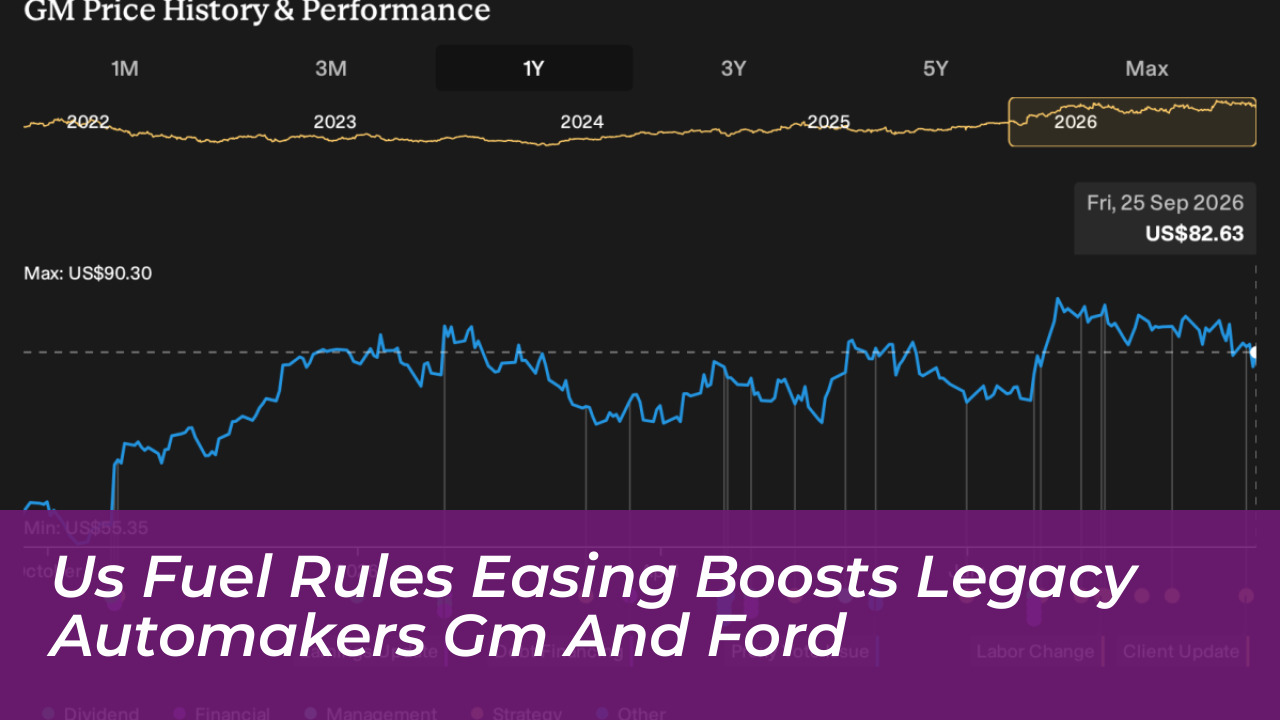
Recent policy adjustments regarding Corporate Average Fuel Economy regulations in the United States signal a massive shift for domestic and international automotive manufacturers. The National Highway Traffic Safety Administration has advanced a reduced fleetwide target of roughly 34.5 to 36.6 miles per gallon by the 2031 model year. This adjustment marks a sharp departure from the previous administration’s aggressive 50.4 miles per gallon benchmark. Federal officials frame this rollback as an essential measure to enhance vehicle affordability and slash manufacturing compliance burdens. Legacy automotive giants, particularly General Motors and the Ford Motor Company, stand to gain immediate operational relief given their deep financial exposure to high-margin internal combustion engine trucks and sport utility vehicles. The regulatory transition effectively neutralizes aggressive mandates that pushed automakers toward rapid electrification, allowing traditional manufacturers to realign production schedules with actual consumer demand.
- Introduction to the US Fuel Economy Policy Shift
- Financial Relief and Balance Sheet Stabilization for GM and Ford
- Easing Compliance Costs for High-Margin Trucks
- Removing the Burden of Regulatory Credit Purchases
- Vehicle Classification Overhauls and Regulatory Realities
- Closing Loopholes in Light-Truck Definitions
- The Reclassification Paradox for Unibody Crossovers
- Navigating the EPA Emissions Factor and Compliance Nuances
- The Dual-Agency Regulatory Environment
- Balancing Efficiency Technology With Profitability
- Strategic Realignment: Slowing Electric Vehicle Expansion
- Recalibrating Capital Expenditure Schedules
- Bridging the Gap With Consumer Demand
- Supply Chain Adjustments and Regional Economic Impacts
- Stabilizing Legacy Manufacturing in the Midwest
- Adjusting Timelines for Battery and Raw Material Suppliers
- Global Competitiveness and Long-Term Market Risks
- International Pressures and Global Standards
- Frequently Asked Questions
- What is the new fuel economy target set by NHTSA?
- How does this policy change affect General Motors and Ford?
- Do EPA emissions rules still apply under the relaxed fuel standards?
- Why are unibody three-row crossovers facing reclassification?
Introduction to the US Fuel Economy Policy Shift
Understanding the U.S. fuel economy policy shift requires examining the historical tension between government environmental targets and automotive manufacturing realities. For years, strict fleetwide averages forced companies to invest heavily in battery technologies while consumer demand for traditional trucks and large utility vehicles remained stubbornly high. The updated framework establishes a more gradual trajectory, easing compliance targets for upcoming model years.
Contrasting the updated framework with the previous 50.4 miles per gallon benchmark highlights the breathing room this policy provides. Under the prior standards, automakers faced immense pressure to transform their entire light-duty fleets within a compressed timeline. The new 34.5 to 36.6 miles per gallon target for 2031 significantly reduces the annual efficiency gains required across assembly lines.
Framing the rollback as an essential measure to enhance vehicle affordability and slash compliance burdens for domestic giants General Motors and Ford addresses long-standing industry complaints. High regulatory costs inevitably translate into higher sticker prices for everyday car buyers. By lowering these hurdles, federal policy helps stabilize retail prices and protects domestic manufacturing sectors from sudden shocks.
Financial Relief and Balance Sheet Stabilization for GM and Ford
For decades, compliance costs tied to strict federal fuel standards consumed billions of dollars in capital. Automakers had to balance low-margin electric vehicle development with the reality of consumer demand, which historically favored larger utility vehicles. The easing of these rules alters profit expectations across the sector. Traditional gas-powered utility lineups face fewer regulatory hurdles, allowing brands to protect profit margins that previously subsidized costly battery-electric vehicle development programs.
Easing Compliance Costs for High-Margin Trucks
Examining how reduced penalties protect profitability across lucrative internal combustion engine utility lineups reveals the core financial driver behind this policy shift. Large trucks and SUVs generate the vast majority of cash flow for traditional domestic manufacturers. Shielding these segments from punitive fines secures the financial foundation required for long-term operational stability.
Analyzing General Motors revenue distribution across North American operations, international markets, and financial services demonstrates the scale of the business. With North American operations generating roughly $153.8 billion, alongside $14.2 billion from international markets and $17.2 billion from GM Financial, the company relies on uninterrupted truck sales to fund its broader corporate enterprise.
Highlighting how capital reallocation stabilizes quarterly earnings without aggressive electrification mandates explains the positive market reception. Executives can now direct cash toward shareholder returns, factory modernization, and pragmatic powertrain engineering instead of pouring funds into slow-moving inventory.
Removing the Burden of Regulatory Credit Purchases
Evaluating the historical financial strain of purchasing regulatory credits or accelerating unprofitable vehicle production uncovers a hidden drain on corporate balance sheets. Manufacturers that struggled to meet aggressive fleet averages routinely paid competitors for surplus credits, transferring millions of dollars away from core research and development.
How flexibility allows legacy brands to align manufacturing schedules with actual consumer purchasing behavior transforms daily operations. Instead of forcing dealerships to stock vehicles that buyers resist, production lines can match the organic rhythm of the retail market. This alignment prevents costly inventory pileups and protects quarterly profit margins.
Vehicle Classification Overhauls and Regulatory Realities
Regulatory easing does not mean a total absence of compliance standards. The National Highway Traffic Safety Administration proposal introduces strict updates to vehicle classification criteria. Historically, many crossover utility vehicles and sport utility vehicles easily secured light-truck status because functional requirements like cargo hauling and towing demand heavier vehicle architectures.
Closing Loopholes in Light-Truck Definitions
Analyzing updates to off-road capability criteria and the removal of the removable-seat pathway sheds light on how federal agencies are tightening definitions. The updated framework removes loopholes that previously classified many minivans and unibody three-row utility vehicles as light trucks. , off-road capability criteria now require vehicles to meet all four legacy specifications rather than just three out of five.
How new Light Duty Work Factor pathways impact payload and towing capacity metrics for large sport utility vehicles ensures that true utility models maintain their status. Body-on-frame behemoths easily clear this numerical threshold, retaining their truck classifications while smaller crossovers face stricter scrutiny.
The Reclassification Paradox for Unibody Crossovers
Examining why unibody three-row crossovers face reclassification as passenger cars exposes an unexpected regulatory hurdle. While overall fuel economy targets are lower, moving popular utility models into the passenger car category makes fleet compliance more challenging within that specific sub-fleet.
The localized compliance challenges product development teams face regarding weight distribution and trim levels require immediate engineering adjustments. Engineers must re-evaluate powertrain efficiencies and material weights to ensure these reclassified models do not drag down passenger car fleet averages.
Navigating the EPA Emissions Factor and Compliance Nuances
A common misconception across early market commentary is that relaxed Corporate Average Fuel Economy rules eliminate all regulatory pressure. In reality, automakers navigate a dual-agency regulatory environment. While the National Highway Traffic Safety Administration governs fuel economy, the Environmental Protection Agency regulates greenhouse gas emissions and Tier 4 particulate matter.
The Dual-Agency Regulatory Environment
Distinguishing between National Highway Traffic Safety Administration fuel economy rules and Environmental Protection Agency regulations clarifies why engineering teams cannot drop all efficiency work. The two agencies operate under separate statutory mandates, meaning relief from one federal body does not automatically grant immunity from the other.
The active enforcement of Tier 4 particulate matter and greenhouse gas emission standards ensures that traditional internal combustion engines must remain remarkably clean. Meeting these strict particulate emission benchmarks requires advanced exhaust filtration systems and continuous catalytic converter optimization.
Balancing Efficiency Technology With Profitability
Why General Motors and Ford must retain advanced exhaust filtration systems and hybrid options comes down to legal survival. Non-compliance with Environmental Protection Agency mandates carries severe penalties, including substantial financial fines, permit revocations, and mandatory corrective action orders.
Avoiding severe financial penalties while maintaining margins requires a delicate engineering dance. Manufacturers utilize mild hybrid systems and advanced turbocharging to satisfy emissions limits while keeping vehicle production costs manageable for the end consumer.
Strategic Realignment: Slowing Electric Vehicle Expansion
The relaxation of federal fuel rules directly impacts corporate capital expenditure schedules. Over the past five years, legacy automakers committed tens of billions of dollars to transition manufacturing facilities toward all-electric vehicle lineups. General Motors invested heavily in its Ultium battery platform, while Ford partitioned its electric vehicle division under the Model e banner.
Recalibrating Capital Expenditure Schedules
Assessing the impact on General Motors Ultium battery platform and Ford Model e divisions reveals a pragmatic scaling back of overly aggressive timelines. With compliance pressures reduced, both companies are executing strategic recalibrations to match current financial realities rather than forced policy milestones.
Pivoting toward a balanced product mix of internal combustion engines and efficient hybrids protects companies from sinking capital into underutilized production lines. This diversification ensures profitability regardless of how fast or slow public charging infrastructure expands.
Bridging the Gap With Consumer Demand
Addressing infrastructure gaps and higher upfront purchase prices in the domestic market explains why consumers hesitated to adopt pure electric models en masse. Range anxiety and a lack of reliable public chargers continue to limit widespread adoption outside of major metropolitan areas.
Aligning federal policy with actual market adoption rates for electrified transport creates a stable environment for long-term business planning. Automakers can build what consumers actually want to buy today while quietly preparing for a more electrified future down the road.
Supply Chain Adjustments and Regional Economic Impacts
Supply chain networks tied to the automotive sector feel immediate ripples from these regulatory shifts. Component suppliers, raw material providers, and assembly plant operators must adapt their delivery schedules to reflect revised vehicle production volumes.
Stabilizing Legacy Manufacturing in the Midwest
Examining employment protection across engine and transmission plants in Michigan, Ohio, Indiana, and Kentucky highlights the human element of policy adjustments. Traditional powertrain manufacturing facilities secure extended operating lifespans as demand for internal combustion engines remains steady.
Operating assembly plants at maximum capacity to boost regional profitability allows legacy brands to reward investors and secure local union jobs. High factory utilization rates lower per-unit production costs across all core vehicle lines.
Adjusting Timelines for Battery and Raw Material Suppliers
How conservative deployment timelines affect dedicated electric vehicle supply chains forces tier-one and tier-two suppliers to pace their investments. Building gigafactories ahead of actual consumer demand created severe financial strain for companies relying on rapid EV scaling.
The strategic advantage of suppliers diversified in both internal combustion and electric architectures becomes immediately apparent. Suppliers that provide components for both traditional engines and hybrid systems weather market fluctuations much better than pure-play electric suppliers.
Global Competitiveness and Long-Term Market Risks
While domestic regulatory easing provides short-term financial relief for American manufacturers, the global stage presents a different set of challenges. Competitors operating in overseas jurisdictions face entirely different policy environments.
International Pressures and Global Standards
Comparing domestic regulatory easing with aggressive electrification trajectories in China and Europe illustrates a growing divergence in global automotive standards. Overseas markets continue to enforce strict zero-emission mandates and heavy penalties for traditional internal combustion engines.
Assessing long-term strategic vulnerabilities for legacy brands in export markets reveals potential risks. If American automakers rely too heavily on relaxed domestic rules, they may lose the technical edge required to compete in rapidly electrifying international arenas. Balancing domestic profitability with global competitiveness remains the ultimate test for General Motors and Ford management teams.
Frequently Asked Questions
What is the new fuel economy target set by NHTSA?
The National Highway Traffic Safety Administration proposed a reduced fleetwide target of roughly 34.5 to 36.6 miles per gallon by the 2031 model year, down from the previous 50.4 miles per gallon benchmark.
How does this policy change affect General Motors and Ford?
The updated framework slashes compliance costs and regulatory penalties, allowing both automakers to protect profit margins on high-margin internal combustion trucks and SUVs while rebalancing their production schedules.
Do EPA emissions rules still apply under the relaxed fuel standards?
Yes. Automakers operate in a dual-agency environment where Environmental Protection Agency greenhouse gas emissions and Tier 4 particulate matter standards remain fully active and legally binding.
Why are unibody three-row crossovers facing reclassification?
NHTSA proposal updates remove certain loopholes, such as the removable-seat pathway, which results in many unibody crossovers being reclassified as passenger cars rather than light trucks.