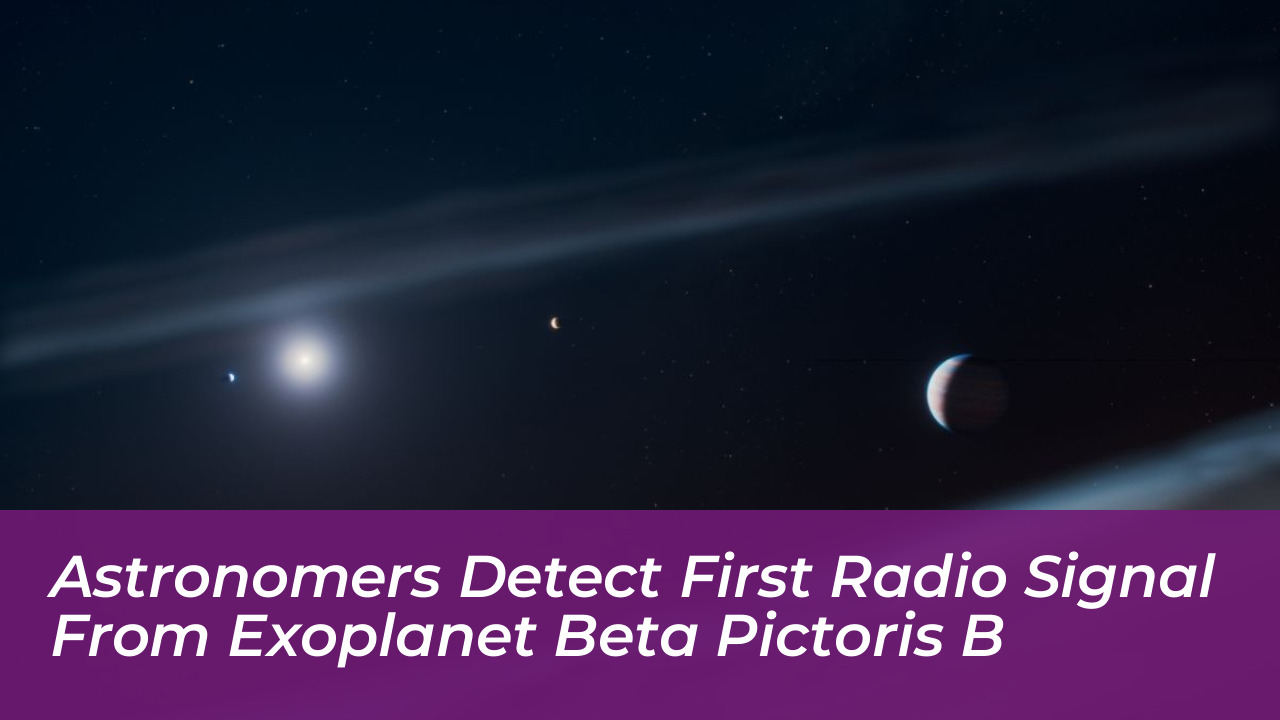
In a milestone achievement for observational astronomy, researchers have directly detected radio emissions from an exoplanet for the first time. The discovery uncovers compelling evidence of an immense magnetic field surrounding Beta Pictoris b, a massive gas giant located approximately 63 light-years from Earth.
The findings, detailed in a research paper posted to the ArXiv preprint server and undergoing peer review, link repeating radio bursts from the distant world to planetary auroras driven by powerful internal magnetic processes. Beta Pictoris b possesses roughly 12 times the mass of Jupiter and orbits a young host star that is 1.75 times as massive as the Sun within a stellar system aged at roughly 23 million years.
Unprecedented Detection Using the MeerKAT Array
To capture these elusive signals, an international team of astronomers observed the Beta Pictoris system on multiple occasions between 2025 and 2026 using the MeerKAT radio telescope array in South Africa. Observations spanned both the L-band (0.856 to 1.712 GHz) and S-band (1.75 to 3.5 GHz). In every epoch, the team detected a persistent radio source matching the precise coordinates of the system.
By tying the radio images to the Gaia celestial reference frame using compact extragalactic radio sources and utilizing advanced astrometric frame-tie corrections, the researchers definitively localized the emissions. The radio source coincides with the known position of Beta Pictoris b and is highly inconsistent with the host star at a 4.4-sigma level of significance, while also ruling out the system’s interior planet c.
Characteristics of the Extrasolar Radio Bursts
The observed emissions are composed of rapid, recurring bursts displaying large circular polarization ranging from 40% to 70%, accompanied by fainter inter-burst continuous emissions. According to the study’s lead researchers, these characteristics point directly to the electron cyclotron maser instability (ECMI) mechanism.
Edo Berger, a professor of astronomy at Harvard University and researcher at the Center for Astrophysics | Harvard & Smithsonian, noted the distinct nature of the discovery. “I know radio signals are associated with searches for extraterrestrial intelligence,” Berger said, “But this is something very different.”
Probing the Magnetic Field of an Exoplanet
The detection of ECMI radiation allows astronomers to directly map emission frequencies to magnetic field strengths at the source site. The S-band campaign captured a high-frequency burst reaching up to 3.5 GHz, establishing a magnetic field of at least 1.25 kilogauss at the planet. This marks the first direct measurement of magnetic field strength for a planet outside our solar system.
The inferred magnetic field aligns closely with dynamo-scaling predictions for young, massive giant planets. The researchers attribute the repeating signals to magnetosphere-ionosphere coupling, driven by the planet’s rapid rotation period of roughly 8 to 9 hours combined with its intense magnetic field.
Alternative Scenarios Ruled Out
The research team rigorously tested and dismissed alternative sources for the radio emissions, including stellar activity and debris disk phenomena. Spectropolarimetric observations previously confirmed that the host star, Beta Pictoris, is magnetically quiet with a large-scale dipole field strength well below the threshold required to produce the observed gigahertz-frequency bursts.
With direct astrometric localization now proven feasible for massive, directly imaged exoplanets, astronomers anticipate that next-generation radio observatories will soon bring additional nearby planetary systems within reach of similar high-precision magnetic field analyses.
Frequently Asked Questions
What is Beta Pictoris b?
Beta Pictoris b is a directly imaged gas giant exoplanet with approximately 12 times the mass of Jupiter, orbiting the young star Beta Pictoris at a distance of about 63 light-years from Earth.
How were the radio signals detected?
Astronomers detected the radio emissions using the MeerKAT radio telescope array across multiple observation epochs in the L-band and S-band frequencies.
Why is this discovery significant?
This represents the first unambiguous detection of radio emissions originating directly from an exoplanet rather than its host star, providing the first direct measurement of an exoplanet’s magnetic field strength.
What emission mechanism causes the radio bursts?
The repeating, highly circularly polarized bursts are generated by the electron cyclotron maser instability, a process similar to how auroras and radio emissions are produced on Jupiter and ultracool dwarfs.
Could the radio signal originate from the host star?
No. Astrometric registration successfully separated the radio source from the host star with high statistical significance (4.4-sigma), and independent measurements confirm the star is magnetically quiet.