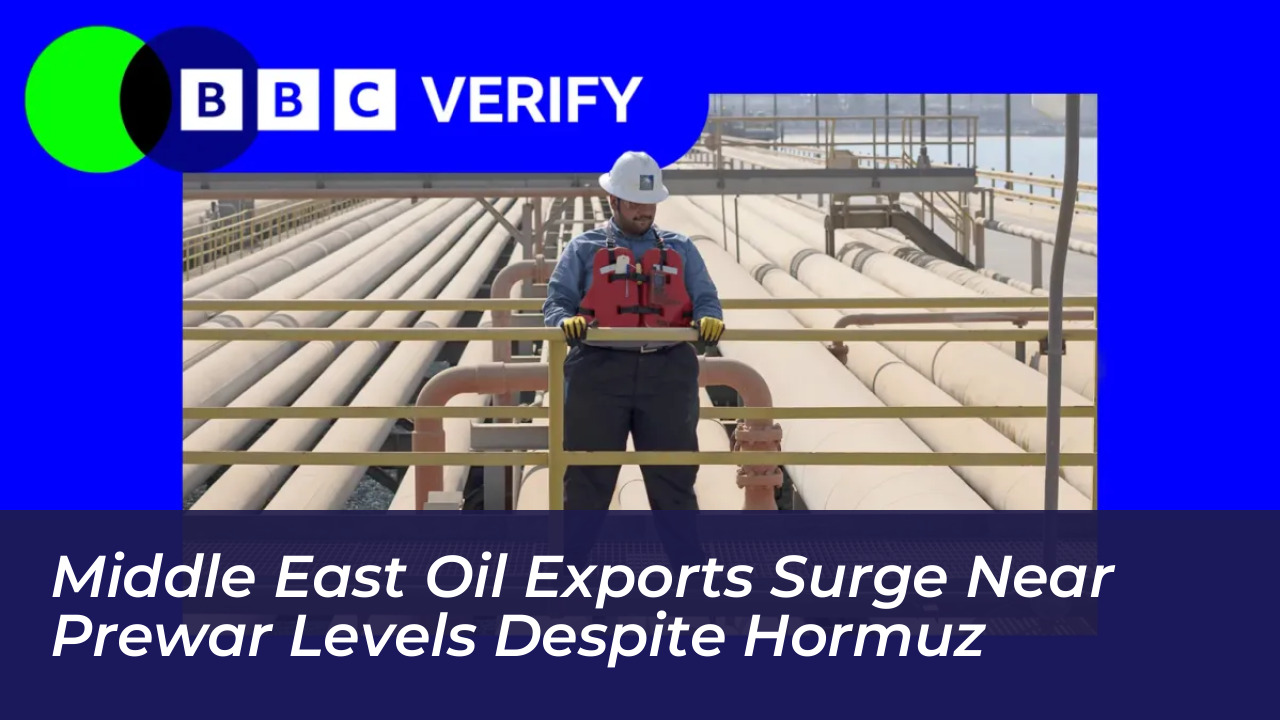
Middle East crude oil shipments bounced back to prewar baseline levels, maritime intelligence firm Kpler reported, as military escorts and pipeline diversions successfully bypassed Iranian maritime restrictions in the Strait of Hormuz. Crude exports transiting the vital waterway reached a seven-day average of 13.5 million barrels per day, matching pre-conflict baselines, while total regional crude exports climbed to 19.5 million barrels daily.
However, refined fuel exports remain severely restricted, threatening a global diesel crisis. Regional security and commodity analysts attribute the sudden recovery in crude flows to strategic transit adaptations, though stability remains precarious under ongoing threats from forces in the region.
JPMorgan and Goldman Sachs Assess the Flow Recovery
Financial institutions have confirmed the substantial rebound in physical energy shipments. According to a September note from JPMorgan Chase & Co. led by Natasha Kaneva, Head of Global Commodities Strategy, crude shipments from the Middle East rebounded to 17.5 million barrels per day, representing approximately 98% of pre-war levels.
Concurrently, Goldman Sachs estimated that Persian Gulf oil exports-inclusive of clandestine operations and dark flows-recovered to 23.3 million barrels per day, aligning closely with their 2025 average. Analysts emphasize that this operational rebound signifies the resilience and adaptability of global shipping rather than an inherently safer geopolitical landscape.
“The Middle East’s oil export arteries are flowing again. Higher crossings should not be mistaken for improved safety – rather, they reflect the industry’s increasing ability to operate under sustained risk.” – JPMorgan Global Commodities Strategy Note
Bypassing the Strait: Alternative Routes and Shuttle Fleets
To mitigate persistent security threats in the Strait of Hormuz, producers and shippers have heavily relied on alternative logistics. Approximately 40% of the region’s crude is now transported without transiting the chokepoint, compared to just 17% prior to the conflict. Pipelines such as Saudi Arabia’s East-West conduit have partially restored flows to the Red Sea port of Yanbu following earlier drone damage.
Within maritime zones, operators utilize shuttle fleets consisting primarily of very large crude carriers with disabled satellite transponders. Cargoes frequently undergo ship-to-ship transfers in open waters near Oman or Fujairah in the United Arab Emirates before continuing to global destinations.
Persistent Crisis in Refined Products and Diesel
Despite the recovery in raw crude, refined petroleum products such as diesel and gasoline lag significantly behind. JPMorgan reported that refined product shipments stand at roughly 3 million barrels per day, equating to 58% of pre-war volumes, while Kpler metrics indicated more severe localized constraints dipping below 20% of historical baselines on certain routes.
This imbalance has kept immense pressure on global markets, driving European and domestic pump prices to record highs and prompting international discussions regarding emergency stockpiles and fuel reserves.
Global Market Impacts and Future Outlook
Even with the restoration of physical crude flows, international benchmarks like Brent crude continue to trade at elevated levels above $100 per barrel. Markets continue pricing in structural volatility, operational insurance costs, and the constant threat of renewed infrastructure disruptions.
As industry participants adapt to elevated operational complexity, energy markets remain highly sensitive to localized military encounters, trade policy adjustments from major importers like China, and the ongoing security posture surrounding critical Middle Eastern transit corridors.