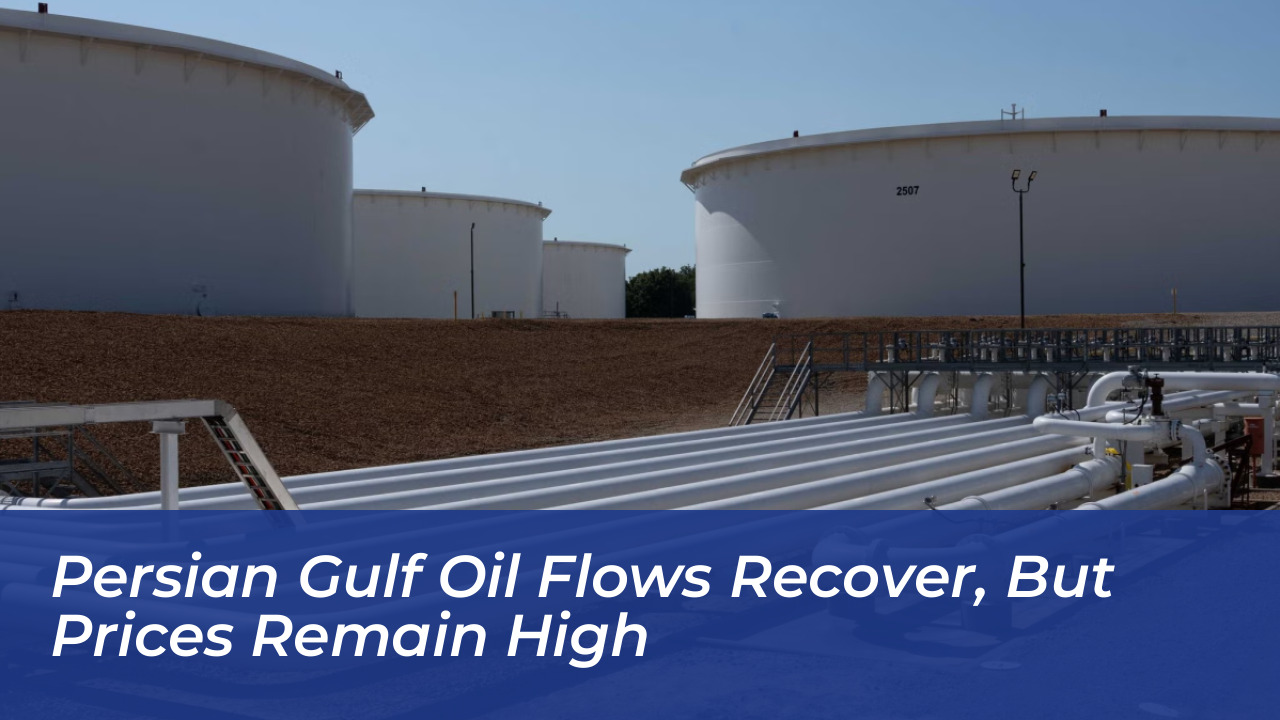
Oil exports from the Persian Gulf have nearly returned to prewar levels, yet crude oil prices remain stubbornly high amid ongoing geopolitical tensions, according to reports from late September 2026. While shipping volumes through vital chokepoints have rebounded significantly, global markets continue to price in severe risks associated with regional instability and shrinking inventories.
- The Divergence Between Crude Rebound and Refined Products
- Market Vulnerability and Depleted Inventories
- Geopolitical Strains and Sanctions Enforcement
- Economic Outlook and Future Price Projections
- Frequently Asked Questions
- Why are oil prices high if Persian Gulf exports recovered?
- What is the current volume of oil moving through the Strait of Hormuz?
- How has the conflict affected Iran’s oil exports?
- What role do global strategic reserves play in current oil markets?
- What are analysts predicting for future oil prices?
Data from energy analytics firm Kpler shows that crude flows through the Strait of Hormuz averaged 13.1 million barrels per day last week. This volume represents approximately 80% of the 17.1 million barrels per day recorded before the conflict began. Meanwhile, JPMorgan reported that total Middle Eastern crude exports-including routes circumventing the strait-have reached 98% of prewar volumes.
David Fyfe, chief economist for Argus Media, explained the underlying price paradox: “Flows seem to have picked up. But it’s because the industry has said, ‘What the hell, let’s go for it,’ while the politicians have failed to reach any sort of an agreement.” Consequently, international benchmark Brent crude recently traded near $98 per barrel, holding at higher levels than during earlier months when physical supplies faced more severe constraints.
The Divergence Between Crude Rebound and Refined Products
The recovery in energy shipments has been highly concentrated in crude oil, while refined petroleum products lag behind. Goldman Sachs analysts noted that Persian Gulf crude exports climbed past prewar averages due to increased shipments through the Strait of Hormuz, ship-to-ship transfers, and the rerouting of Saudi Arabian exports to eastern ports.
However, exports of diesel, gasoline, and jet fuel remain at about half of their normal operational levels. Analysts attribute this gap to persistent regional refinery outages exceeding seasonal norms and the elevated risks of transporting refined fuels, which carry higher flammability risks than crude.
Market Vulnerability and Depleted Inventories
Despite the physical flow recovery, traders continue bracing for prolonged instability. Joe Adamski, managing director at supply chain consultancy ProcureAbility, emphasized the fragility of the current balance.
“The market is still running a deficit, in that strategic stocks are still being drawn down. Most of the world’s spare production capacity sits in the region and is still at risk. There is no room to absorb another shock. Any serious incident in the Gulf and this conversation shifts again,” Adamski stated.
Global oil reserves have continued to shrink under the strain. Notably, the United States Strategic Petroleum Reserve dropped below the 300 million-barrel mark, hitting its lowest level in over four decades. Analysts warn that this reduced inventory cushion leaves consumer nations vulnerable to any sudden disruptions in maritime trade.
Geopolitical Strains and Sanctions Enforcement
While neighboring producers have restored maritime shipments, Iran has faced mounting pressure under a renewed US naval blockade. Kpler data indicates that Iran’s ability to export fresh crude has fallen close to zero. Homayoun Falakshahi, head of crude oil analysis at Kpler, noted the complete reversal from the early stages of the conflict when Iranian exports continued while neighbors struggled.
Washington has simultaneously intensified financial measures under “Operation Economic Outcast,” targeting the foreign banking networks Tehran utilizes to collect trade proceeds. The US Treasury Department recently proposed restricting Banque Misr’s UAE branches from accessing US correspondent banking, alleging they processed billions of dollars linked to Iranian shadow-banking networks.
Economic Outlook and Future Price Projections
Goldman Sachs maintains a forecast for Brent crude to moderate toward $85 a barrel by year-end and $80 in 2027, driven by the broader recovery in Gulf exports and softer Chinese import demand. Nevertheless, analysts warn that renewed escalations targeting energy infrastructure could trigger significant upside spikes in global fuel costs.
Frequently Asked Questions
Why are oil prices high if Persian Gulf exports recovered?
Prices remain elevated because traders are pricing in the risk of future attacks on energy infrastructure, unusually low global inventories, and the absence of a permanent diplomatic agreement between major adversaries.
What is the current volume of oil moving through the Strait of Hormuz?
Crude flows through the Strait of Hormuz have recovered to about 13.1 million barrels per day, which is roughly 80% of prewar volumes, aided by dark crossings and ship-to-ship transfers.
How has the conflict affected Iran’s oil exports?
While neighboring producers recovered up to 98% of total Middle Eastern crude exports, Iran’s ability to export fresh crude has dropped close to zero under tightened maritime blockades and increased US financial sanctions.
What role do global strategic reserves play in current oil markets?
Global strategic reserves, including the US Strategic Petroleum Reserve falling below 300 million barrels, are being drawn down to offset deficits, leaving little cushion against further supply disruptions.
What are analysts predicting for future oil prices?
Major financial institutions like Goldman Sachs forecast Brent crude to moderate toward $85 per barrel by the end of the year and $80 in 2027, provided no major energy infrastructure disruptions occur.